[Navigating Toward the Future with K Shipbuilding]
Lee Hogi, Head of the Eco-friendly Research Center at the Shipbuilding and Ocean Research Institute
"Unified Regulations Needed for Eco-friendly Alternative Fuels"
Samsung Heavy Industries has begun demonstration work this month at its Geoje shipyard on an independent fuel supply system to be applied to ammonia-powered vessels. Ammonia is considered the most promising zero-carbon energy source for reducing greenhouse gas emissions from ships. Its liquefaction temperature is minus 33 degrees Celsius, which is higher than hydrogen's minus 253 degrees Celsius, and it also has a higher storage density, making it suitable for large-scale long-distance transport.
However, due to its toxicity, safe management is crucial. This is why demonstration of the ammonia-powered vessel fuel supply system is necessary. The demonstration facility, to be built on a 1,300㎡ (approximately 380 pyeong) site, will be equipped not only with ammonia fuel supply and reliquefaction systems but also safety facilities such as air pollution prevention and cleaning equipment.
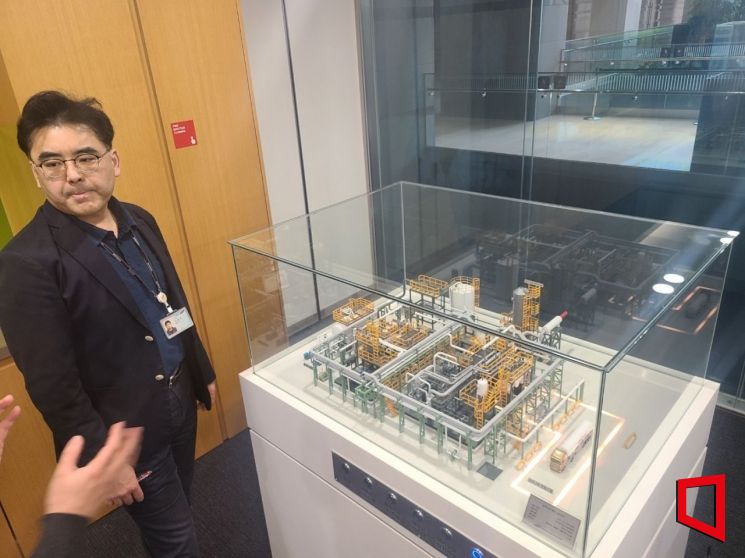 Lee Hogi, Executive Director and Head of the Eco-friendly Research Center at Samsung Heavy Industries' Shipbuilding and Offshore Research Institute, is explaining the Hydrogen Demonstration Center at the Pangyo R&D Center on the 23rd. (Photo by Samsung Heavy Industries)
Lee Ho-gi, Executive Director and Head of the Eco-friendly Research Center at Samsung Heavy Industries' Shipbuilding & Marine Research Institute, said in an interview with Asia Economy on the 23rd of last month at Samsung Heavy Industries' Pangyo R&D Center, "In short, it is the concept of first implementing the equipment applied to ships on land." He added, "Since this equipment has never existed before, we have had to personally verify every construction step, traveling back and forth countless times between Pangyo and the Geoje shipyard."
He continued, "Through demonstration, we can verify the performance and safety of the independently developed core system, which will increase product reliability," adding, "There is also the advantage of being able to proceed with localization of parts together with domestic equipment suppliers in the future."
Lee emphasized that the demonstration of the fuel supply system will play an important role in securing future customers. He explained, "The International Maritime Organization (IMO) is strengthening environmental regulations, and the paradigm is shifting to eco-friendly alternative fuel vessels using ammonia, hydrogen, and nuclear power following LNG and methanol," adding, "Even if the ship price is higher, there is a growing trend of shipowners preferring eco-friendly vessels that meet environmental regulations."
He stated, "The key elements of eco-friendly vessels are emission reduction, energy efficiency, fuel supply (bunkering) infrastructure, and technology maturity," adding, "Some shipowners even place orders to retrofit existing vessels into eco-friendly fuel-powered ships, but besides performance such as emission reduction, they require high reliability and quality standards regarding safety and durability, considering the unique conditions at sea."
Lee pointed out the need to ease overlapping regulations during the demonstration process after technology development.
He said, "Since it is a fuel supply facility, it must comply with maritime regulations from classification societies as well as land-based regulations such as the High-Pressure Gas Safety Control Act and the Chemical Substances Control Act, requiring separate approvals," emphasizing, "Special regulatory approval is necessary, but if the approval process is delayed, new technology development or demonstration may not proceed smoothly, so there is a need to unify regulations related to eco-friendly alternative fuels."
 Lee Hogi, Executive Director and Head of the Eco-friendly Research Center at Samsung Heavy Industries' Shipbuilding and Ocean Research Institute, is being interviewed at the Pangyo R&D Center on the 23rd. (Photo by Samsung Heavy Industries)
Samsung Heavy Industries is conducting next-generation vessel R&D along three main axes. The Ship & Offshore Research Center at the Daejeon Daedeok Research Complex studies vessel performance technologies, while the Busan R&D Center, established last year, focuses on design and engineering functions for the offshore plant business. The Eco-friendly Research Center located at the Pangyo R&D Center headquarters is responsible for research on eco-friendly energy, including ammonia fuel supply systems, liquefied natural gas (LNG) value chains, liquefied hydrogen-powered vessels, and carbon reduction.
Lee introduced, "We are researching various fields from next-generation fuels such as ammonia and hydrogen to carbon capture and utilization (CCU), fuel cells, and nuclear power used in offshore plants," adding, "Safety and environmental fields are also key research areas, covering risks such as fire or explosion from conventional fuels and toxicity risks from ammonia."
Samsung Heavy Industries plans to establish a hydrogen fuel supply demonstration facility after 2025. Additionally, it is conducting joint research on nuclear-powered vessels with the Korea Atomic Energy Research Institute. This involves developing small molten salt reactors and applying them to shipbuilding and offshore products. They are also developing floating nuclear power generation facilities with the Danish company Seaborg.
He predicted that the technology gap with China in eco-friendly fuels will widen further. He said, "There is still a technological gap between China and us in LNG carriers," adding, "China has experienced accidents where LNG carriers stopped during operation, and their ammonia vessels are being built together with European engineering firms, so we believe our technology still holds the advantage."
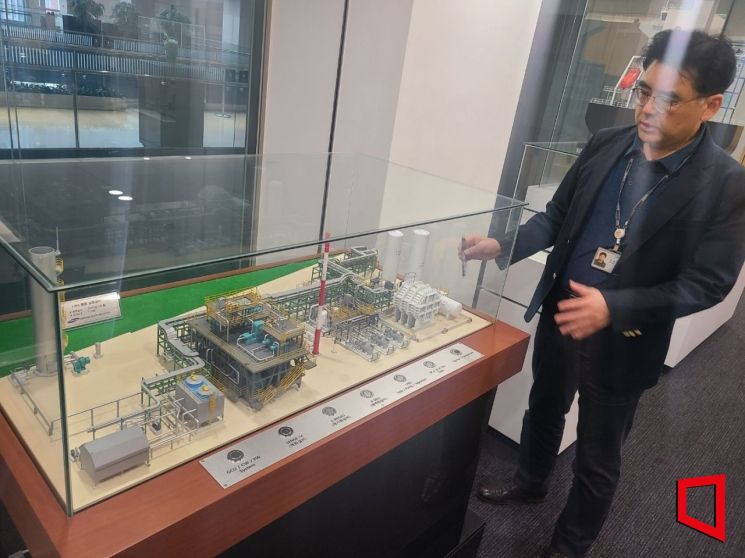 Lee Ho-gi, Executive Director and Head of the Eco-friendly Research Center at Samsung Heavy Industries' Shipbuilding and Offshore Research Institute, is explaining the LNG integrated demonstration facility at the Pangyo R&D Center on the 23rd. (Photo by Samsung Heavy Industries)
© The Asia Business Daily(www.asiae.co.kr). All rights reserved.
![Clutching a Stolen Dior Bag, Saying "I Hate Being Poor but Real"... The Grotesque Con of a "Human Knockoff" [Slate]](https://cwcontent.asiae.co.kr/asiaresize/183/2026021902243444107_1771435474.jpg)


















