After President Yoon Suk-yeol exercised his right to request reconsideration (veto), the amendment to the Grain Management Act newly proposed by the Democratic Party of Korea passed the National Assembly's Agriculture, Forestry, Livestock, Food, and Fisheries Committee plenary session on the 2nd solely by the opposition party. The amendment to the Agricultural Products Price Stabilization Act, which focuses on guaranteeing prices for agricultural products, was also processed together. The Ministry of Agriculture, Food and Rural Affairs expressed concerns, stating that "the financial burden is excessive."
The Ministry of Agriculture, Food and Rural Affairs held a briefing for reporters the day before and stated that the amendments to the Grain Management Act and the Agricultural Products Price Stabilization Act could distort market prices due to oversupply of rice and agricultural products.
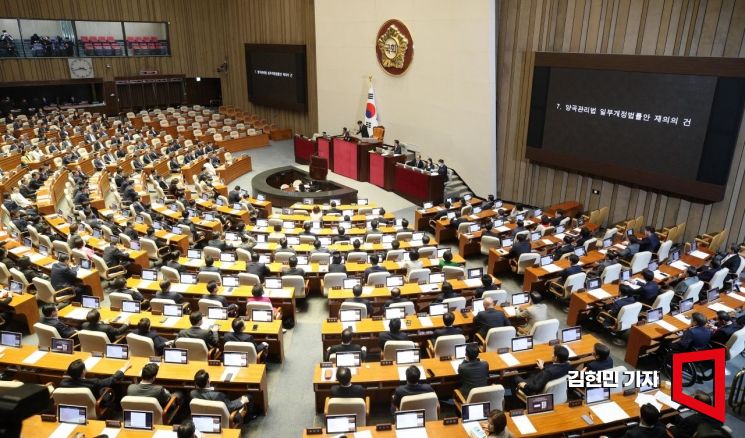 On the 13th, the reconsideration bill of the Grain Management Act was presented at the 4th plenary session of the 405th National Assembly (extraordinary session) held at the National Assembly in Yeouido, Seoul. The amended Grain Management Act, returned to the National Assembly after President Yoon Seok-yeol exercised his veto power, was ultimately rejected with 290 members present, 177 in favor, 112 against, and 1 abstention. Photo by Hyunmin Kim kimhyun81@
The amendment to the Grain Management Act mandates the establishment and implementation of measures to purchase surplus production in the event of a rice price collapse or risk of collapse. The change is that the criteria for collapse and surge will be set by the Grain Supply and Demand Management Committee, which includes stakeholders. Jeon Han-young, Director of Food Policy at the Ministry of Agriculture, Food and Rural Affairs, said, "Previously, the Grain Management Act set the purchase criteria as a 3-5% price drop, but now the committee will decide," adding, "Once the criteria are set, exceeding them will effectively result in mandatory purchases, which could lead to the side effect of overproduction."
Considering the continuous production of rice beyond demand and the decreasing consumption trend, there is also a forecast that rice prices will stagnate within a certain price range. According to the Korea Rural Economic Institute (KREI), if market isolation is mandated, an average of 430,000 tons of rice will be overproduced annually until 2030, and the farm gate price of rice is expected to stagnate at around 170,000 to 180,000 KRW per 80kg sack. The financial burden is also significant. KREI projected that due to the worsening oversupply structure, 1.4 trillion KRW in government funds will be required by 2030.
The Ministry of Agriculture, Food and Rural Affairs also voiced concerns about the amendment to the Agricultural Products Price Stabilization Act, which guarantees minimum prices for vegetables and other agricultural products. Kim Jong-gu, Director of Distribution and Consumer Policy, pointed out, "If prices for certain vegetables and fruits are guaranteed, farmers who do not currently cultivate those crops may try to grow them, causing a concentration in specific crops," adding, "Social conflicts may arise during the process of selecting the crops."
The financial burden is also cited as a problem. According to estimates by the Korean Society of Agricultural Economics in May, if a minimum price guarantee system is implemented for the five major vegetable types based on average prices, production increases ranging from 3.5% to 41.2% will occur depending on the crop and growing season, and prices will fall by 3.1% to 67%. Furthermore, if their prices decline compared to the recent five years (2017?2021), a budget of 1.1906 trillion KRW will be required.
© The Asia Business Daily(www.asiae.co.kr). All rights reserved.
![Clutching a Stolen Dior Bag, Saying "I Hate Being Poor but Real"... The Grotesque Con of a "Human Knockoff" [Slate]](https://cwcontent.asiae.co.kr/asiaresize/183/2026021902243444107_1771435474.jpg)
















