Expansion of Medical School Quotas and Introduction of Regional Essential Doctor System
10 Trillion Won Invested in Essential Medical Care, Promise to Rebuild Regional Healthcare
Yoon: "Retreating from Reform Due to Resistance Is Abandoning the Role of the State"
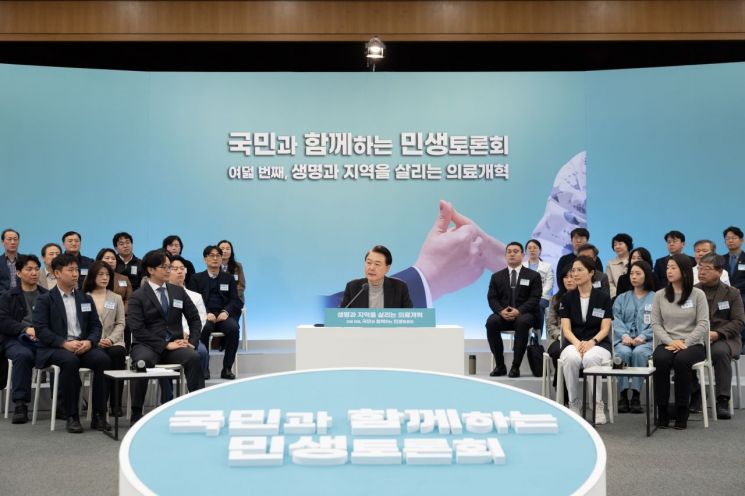 President Yoon Suk-yeol is speaking at the "Eighth Public Discussion on Livelihoods with the People - Medical Reform to Save Lives and Communities" held on the 1st at Bundang Seoul National University Hospital in Seongnam-si, Gyeonggi-do.
 [Image source=Yonhap News]
The government plans to significantly expand medical school enrollment starting next year to prepare for a shortage of approximately 15,000 doctors by 2035. Measures such as 'expanding regional talent admissions for medical schools' and introducing a 'contract-based regional essential doctor system' will strengthen regional healthcare, and essential medical fees will be increased through a financial investment of over 10 trillion won by 2028. Although this is a long-term task, a presidential advisory 'Special Committee on Medical Reform' will be established to swiftly develop a roadmap for reform to gain strong momentum.
President Yoon Suk-yeol stated at the 8th Public Livelihood Forum held on the 1st at Bundang Seoul National University Hospital in Seongnam, Gyeonggi Province, "We will invest more than 10 trillion won in essential medical care using health insurance reserves." The aim is to resolve the chronic shortage of medical personnel and strengthen compensation to prevent the collapse of essential medical fields such as surgery, obstetrics and gynecology, pediatrics, and emergency medicine.
In his opening remarks, President Yoon said, "A country where phrases like 'emergency room round-robin' and 'pediatric open run' are popular cannot be called a good country," adding, "If people living in rural areas cannot receive proper medical services just because of their location, it would be shameful to call ourselves an advanced country."
First, President Yoon emphasized that securing sufficient medical personnel is an urgent task. He said, "With the rapid increase in the elderly population and the growing demand for the health industry, expanding medical personnel is essential to revive regional and essential medical care. No matter how good the infrastructure is, it is useless if there is no one to implement it. We will support the expansion of medical personnel by providing quality medical education and training environments."
A fair compensation system for medical personnel will also be introduced. President Yoon stated, "Medical staff who perform high-risk treatments and essential medical personnel who must be on standby at all times should receive fair compensation commensurate with their efforts," and reiterated, "We will invest more than 10 trillion won in essential medical care using health insurance reserves."
He continued, "The government's four major medical reform policy packages (expansion of medical personnel, strengthening regional healthcare, establishing a safety net for medical accidents, and enhancing fairness in the compensation system) are the best initiatives to revive essential and regional medical care," emphasizing, "Now is the golden time to push forward medical reform."
President Yoon promised strong policy implementation, saying, "If medical reform desired by the majority of the people is rolled back due to opposition or resistance from a few, it would be tantamount to abandoning the fundamental role of the state."
Regarding legal risks for medical personnel, President Yoon said, "There are many complaints and accusations against medical personnel, but cases where doctors are found guilty of intentional or gross negligence are very rare. Doctors suffer from police investigations, while victims often do not receive proper compensation, creating a contradictory situation," adding, "We will completely reform the system so that doctors can practice with confidence and victims receive ample compensation."
To rebuild regional healthcare, he mentioned plans to promote ▲ expansion of regional talent admissions ▲ regional policy fees ▲ establishment of regional networks.
Among the four major policy packages, President Yoon plans to swiftly resolve tasks requiring urgent action and establish a presidential special committee to carefully develop measures for tasks needing deliberation and discussion.
Shortage of 15,000 Doctors by 2035... Expansion of Enrollment Quotas
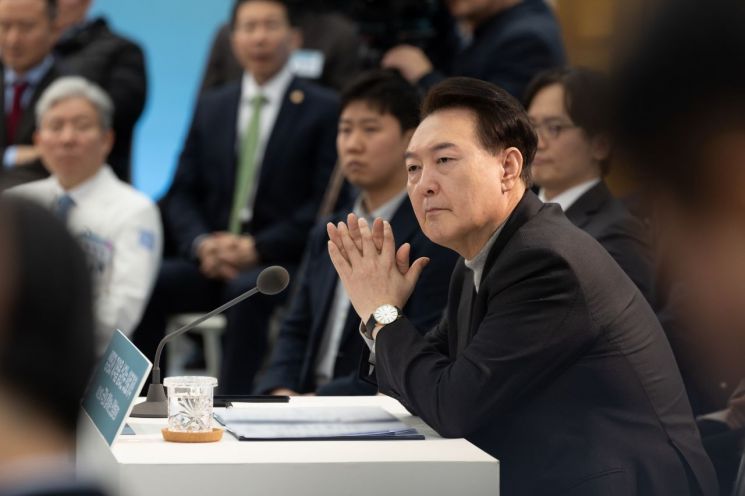 President Yoon Suk-yeol is listening to a participant's remarks at the "Eighth Public Discussion on Livelihoods with the People - Medical Reform to Save Lives and Communities," held on the 1st at Bundang Seoul National University Hospital in Seongnam, Gyeonggi Province.
 [Image source=Yonhap News]
To this end, the Ministry of Health and Welfare will work on 'expanding personnel' to fill medical gaps in regional and essential medical fields. The current medical school enrollment quota is 3,058, which has been maintained for 18 years. At the time of the 2000 separation of prescribing and dispensing of medicines, the medical community requested a 10% reduction (351 students) in medical school enrollment, but recently concerns about doctor shortages have emerged in essential medical fields such as surgery and pediatrics, as well as in rural areas.
The Ministry of Health and Welfare announced plans to expand medical school enrollment starting from the 2025 academic year, considering a shortage of about 15,000 doctors by 2035, ten years from now. According to a nationwide survey of demand for increasing medical school enrollment conducted last November, universities hope to increase enrollment by at least 2,151 and up to 2,847 students in 2025. The total increase in medical school enrollment is estimated to be between 1,000 and 2,000 students.
However, on the 9th of last month, the Korean Association of Medical Colleges and Medical Schools announced that an increase of about 350 students is appropriate, showing that differences in opinion remain unresolved. The government plans to decide the scale of the increase by comprehensively considering the capacity of medical schools, regional medical infrastructure, and personnel redistribution plans, but since discussions with the medical community are ongoing, the scale and timing will be announced separately in the future.
To strengthen essential medical care, it is pointed out that 'adjustment of medical fees' should be carried out alongside the increase in medical school enrollment. Accordingly, the Ministry of Health and Welfare plans to invest more than 10 trillion won by 2028 to raise fees for essential medical services. They plan to selectively and intensively increase the relative value scores of essential medical items that are highly demanding and resource-consuming but undervalued.
For severe emergencies, this includes high-difficulty surgeries such as endoscopic surgery and surgical specialties like burn surgery, pediatric surgery, and transplant surgery, which are often avoided. Essential medical areas where fee-for-service support is difficult will be supported through public policy fees. Factors such as difficulty, risk, urgency, skill level, and time spent outside of treatment (waiting, on-call) will be reflected. To prevent distortion of the medical system by the non-reimbursed market and to resolve compensation imbalances, a new 'ban on mixed treatment' will be promoted. The core is to prohibit the billing of health insurance fees for reimbursed treatments that are accompanied by excessive non-reimbursed treatments such as manual therapy and cataract surgery.
Significant Expansion of Regional Talent Admissions and Introduction of Contract-Based Regional Essential Doctor System
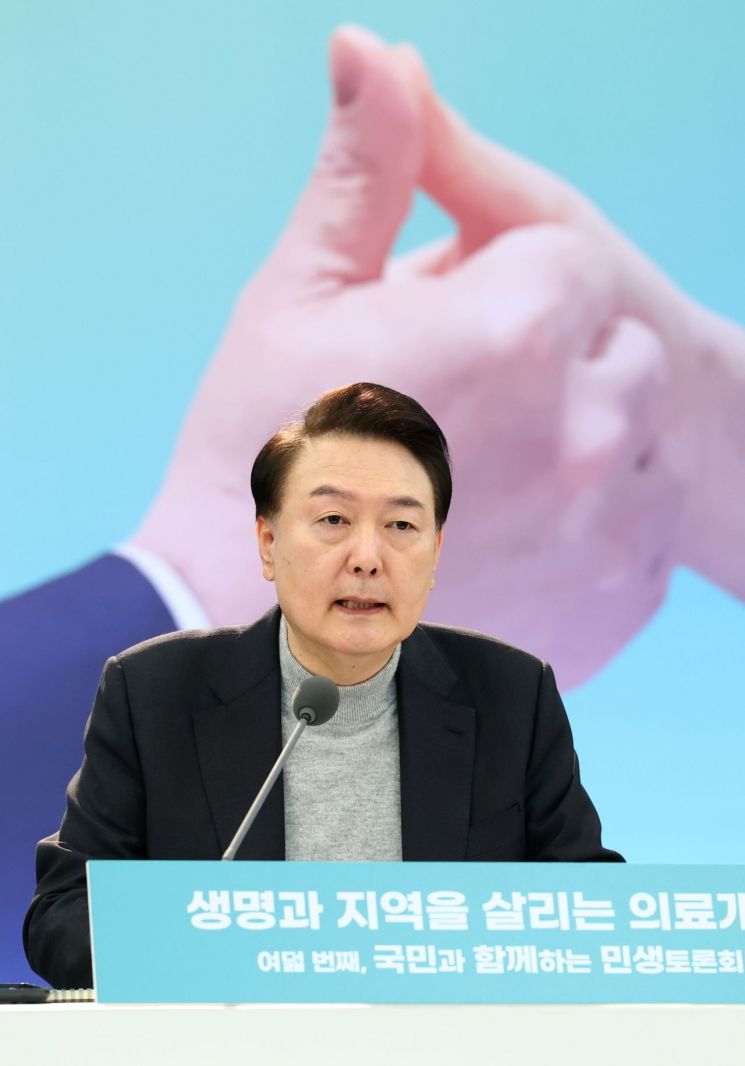 President Yoon Suk-yeol is speaking at the "Eighth Public Discussion on Livelihoods with the People - Medical Reform to Save Lives and Communities" held at Bundang Seoul National University Hospital in Seongnam, Gyeonggi Province on the 1st.
 [Image source=Yonhap News]
Regional healthcare will also be strengthened. The Ministry of Health and Welfare plans to focus on nurturing national university hospitals and regional private and public hospitals to establish regionally complete essential medical care and will promote pilot projects for regional medical innovation. Selected regions will receive up to 50 billion won in support over three years. To secure essential doctors who can work stably in the region, the 'regional talent admissions' for medical schools will be significantly increased, and a 'contract-based regional essential doctor system' will be introduced.
Currently, non-metropolitan medical schools select more than 40% of their students as regional talents, and this ratio will be expanded. Park Min-su, Vice Minister of Health and Welfare, said, "Some schools have a regional talent ratio of up to 80%. It is difficult to uniformly increase the ratio, but the proportion of regional talent selection will be gradually expanded according to each school's circumstances." The 'contract-based regional essential doctor system' is a system to secure regional medical talents through regional medical leader development programs and preferential contracts. A Ministry of Health and Welfare official explained, "It is not a legal obligation, but allows individuals to work on necessary tasks in the region through contracts with the government according to their will." Other policies such as establishing a regional medical development fund and introducing customized regional fees are expected to serve as incentives for regional healthcare.
Additionally, to prevent essential medical personnel from leaving the medical field due to excessive civil and criminal burdens, a safety net for medical accidents will be established. The 'Medical Accident Handling Special Act,' which limits prosecution for medical accidents on the premise that all medical personnel are enrolled in insurance or mutual aid, will be promoted. This will allow medical personnel to focus on treating severe and emergency cases in a stable environment, and patients will receive prompt and sufficient compensation. National compensation for no-fault medical accidents such as childbirth will also be expanded from the current 70% to 100%.
The government plans to promptly advance short-term feasible tasks that require urgent resolution, while fundamental institutional improvements such as issues related to the medical accident special act, improvement of the non-reimbursed system, introduction of the regional essential doctor system, and establishment of regional medical funds will be addressed through the presidential Medical Reform Special Committee, which will prepare an implementation roadmap within the first half of this year. The committee will be expert-centered and operate for one year, focusing on concretizing policies.
In his closing remarks at the Public Livelihood Forum, President Yoon reiterated, "I deeply felt that now is the golden time to hasten medical reform," and promised, "If facilities are established and doctors and nurses are hired in essential medical fields such as obstetrics and gynecology, pediatrics, and surgery so that doctors can perform essential medical care in the region, it will itself create public benefits, and we will expand compensation accordingly."
President Yoon Demonstrates Directly at Smart Simulation Center
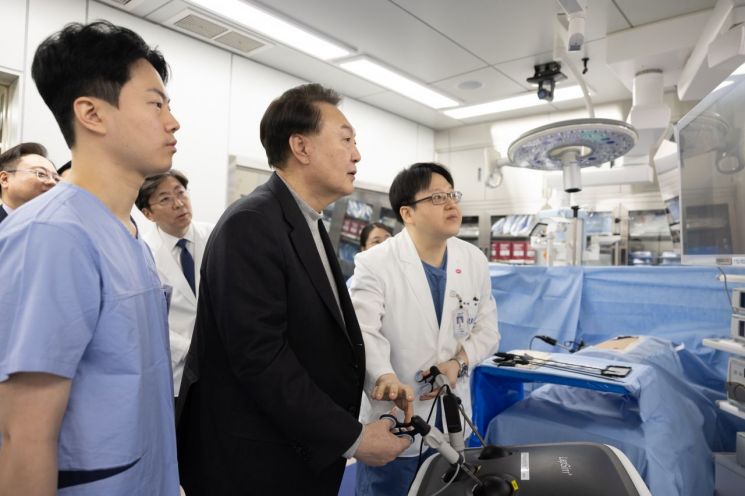 President Yoon Suk-yeol visited the "Smart Simulation Center" ahead of the "Eighth Public Discussion on Livelihood - Medical Reform to Save Lives and Communities" held at Bundang Seoul National University Hospital in Seongnam, Gyeonggi Province on the 1st, where he held a simulation tool and personally experienced laparoscopic surgery. [Image source=Yonhap News]
Before the forum, President Yoon visited the 'Smart Simulation Center' for clinical practice within Bundang Seoul National University Hospital and observed surgical practice by residents, according to spokesperson Kim Soo-kyung. Opened in January last year, this center replicates the hospital's main facilities and equipment in an environment similar to actual conditions to conduct clinical education such as surgery and intensive care management.
President Yoon observed residents practicing laparoscopic appendectomy using simulator equipment. After watching the resection of the inflamed appendix in a software virtual environment, President Yoon took the simulation tool and performed surgery himself upon the suggestion of Choi Jun-young, Director of the Robotic Surgery Center.
Finally, President Yoon watched the process of cancer removal surgery through a 3D stereoscopic simulation screen inside the abdomen. After the observation, President Yoon expressed his gratitude to the medical staff, saying, "I studied a lot."
© The Asia Business Daily(www.asiae.co.kr). All rights reserved.



















