Bank of Korea Report on "Background and Implications of Growth Divergence Between the US and Europe"
"Short-term Factors Will Fade, but Structural Factors Deepen the Gap"
"Supply Chain Restructuring and Active Population Policies Needed"
The growth rate gap between the United States and Europe is attributed to structural factors such as productivity and labor input, according to an analysis. It is pointed out that South Korea will also be unable to avoid stagnation in growth rates in the future without innovation in the industrial sector and solving population issues.
According to the ‘BOK Issue Note: Background and Implications of the Differentiated Growth Trends between the United States and Europe’ published by the Bank of Korea on the 1st, the recent growth rate gap between the U.S. and Europe is interpreted as having widened due to differing fiscal policies, energy price shocks, and sluggish trade. Although these short-term factors are expected to disappear this year, structural factors such as differences in productivity and labor force may widen the growth rate gap in the long term.
The report states that in the case of the U.S., active fiscal policies during the pandemic period increased consumption, resulting in a favorable economic recovery. A significant portion of fiscal support at that time was directly provided to households, contributing to consumption. In contrast, the Euro area’s household fiscal support was about half that of the U.S., reducing consumption capacity.
Additionally, the Euro area is highly dependent on energy imports, and when the Russia-Ukraine war disrupted natural gas supply, energy prices surged, leading to economic contraction.
Moreover, the Euro area, which has a high degree of trade openness, experienced a greater economic slowdown effect compared to the U.S. due to reduced exports caused by recent Chinese economic downturn and decreased trade with Russia.
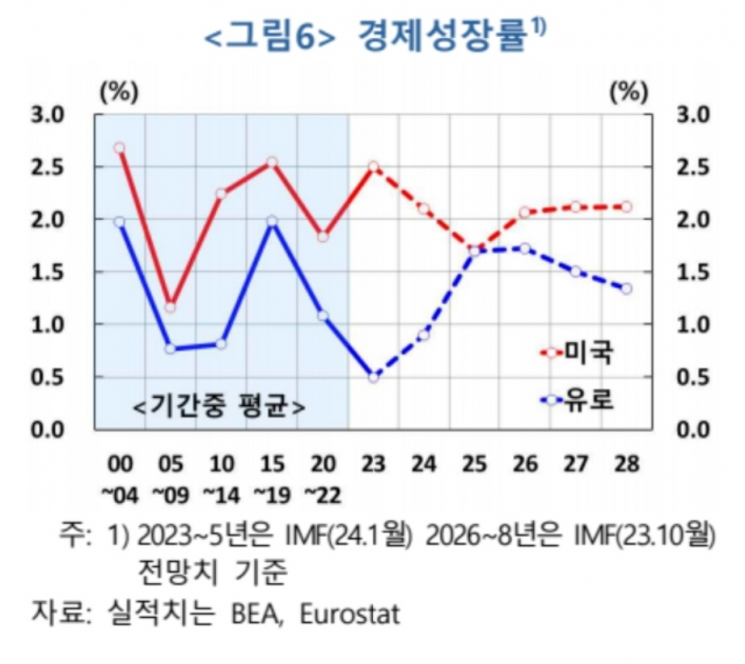 Economic growth rates and forecasts for the United States and the Euro area. Major international organizations such as the International Monetary Fund (IMF) expect that, in the medium to long term, the growth rate of the United States will generally exceed that of the Euro area. / Source: Bank of Korea
In the future, the growth rate gap between the U.S. and Europe is likely to widen further due to differences in structural factors such as productivity and labor force. From 2010 to 2019, the average annual growth rate difference between the U.S. and the Euro area was 0.9 percentage points, which was found to stem from differences in productivity (0.5 percentage points) and labor input (0.4 percentage points).
The U.S. has an environment where innovative unicorn companies such as venture capital (VC)-backed startups can emerge, holding a global advantage in advanced sectors like artificial intelligence (AI) and autonomous driving. In addition, the dissemination of knowledge and increased dynamism from immigrants help maintain high productivity.
In contrast, the Euro area relies heavily on tourism and traditional manufacturing industries, and policy efforts to foster advanced industries are relatively insufficient, with low-skilled workers constituting a significant portion of immigrant inflows.
The decline in the working-age population (ages 15?64) due to aging is also a problem. From 2010 to 2019, the working-age population increased by an average of 0.5% annually in the U.S., whereas it decreased by an average of 0.1% annually in the Euro area. Kim Minsu, head of the U.S.-Europe Economic Team at the Bank of Korea’s Research Department, said, "These demographic factors explain a significant portion (0.3 percentage points) of the growth contribution gap caused by labor input between the two economic zones."
This outlook has significant implications for South Korea as well. Kim said, “South Korea is also at the starting point of rapid aging in terms of labor input, and in terms of productivity, it is commonly experiencing international competition surrounding advanced industries and the resulting supply chain restructuring. Therefore, it is necessary to seek effective countermeasures.” He added, “For example, it is necessary to mitigate the decline in labor force by simultaneously implementing active immigration policies and low birthrate policies, and to create an environment where innovative companies can emerge in new growth industries.”
© The Asia Business Daily(www.asiae.co.kr). All rights reserved.
![User Who Sold Erroneously Deposited Bitcoins to Repay Debt and Fund Entertainment... What Did the Supreme Court Decide in 2021? [Legal Issue Check]](https://cwcontent.asiae.co.kr/asiaresize/183/2026020910431234020_1770601391.png)















