Stakeholder Airlines Called to US Site for Opinions
Antitrust Strengthening Policy... Difficult to Reach Conclusion in Short Term
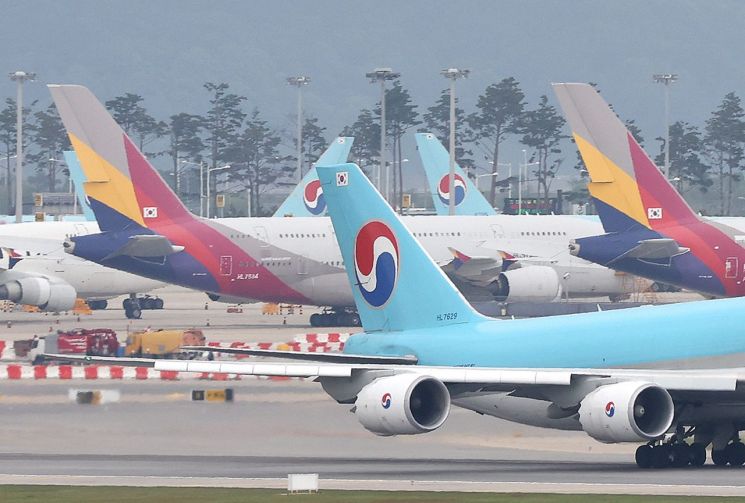
U.S. competition authorities plan to convene South Korean industry stakeholders as early as next month to decide whether to approve the merger between Korean Air and Asiana Airlines. Following Japan's recent approval of the merger, only the decisions from the U.S. and the European Union (EU) remain, signaling that the U.S. is now actively moving forward with its review. Industry insiders expect that, given the U.S.'s tough stance on monopolies, a conclusion is unlikely to be reached soon.
On the 1st, the U.S. Department of Justice announced it will hold stakeholder hearings related to the merger of the two companies and is expected to summon domestic airline representatives starting next month. An aviation industry official said, "We understand that U.S. authorities will soon gather stakeholders to inquire about relevant matters. Until now, they have been observing the EU's decision without much movement, but it seems they are now taking serious action."
The U.S. move is closely watched as it is effectively the final hurdle for the merger. According to major foreign media, the EU is reportedly leaning toward conditionally approving the merger between Korean Air and Asiana Airlines. The day before, Japan's competition authority, the Japan Fair Trade Commission (JFTC), also approved the corporate merger of Korean Air and Asiana Airlines.
However, given the U.S. government's strong response to monopolies, it is expected that reaching a conclusion will not be easy. Although concerns about cargo transport monopolies raised by the EU were resolved through the sale of Asiana Airlines' cargo division, issues regarding passenger route monopolies remain. According to the aviation industry, Korean Air and Asiana Airlines operate 12 and 5 routes to the Americas, respectively. Passenger numbers on Korea-U.S. routes totaled 5,634,402 last year based on Incheon Airport data, with Korean Air, Asiana Airlines, and Korean Air's partner Delta Air Lines accounting for 4,554,543 passengers, representing 80.9% of the total.
The U.S. Department of Justice has consistently responded to passenger route monopolies through litigation. In 2013, when American Airlines, one of the U.S. 'Big 3' carriers, attempted to merge with US Airways, the DOJ filed a lawsuit to block the merger. American Airlines received approval for the merger on the condition that it divested several routes and some ground facilities. In March last year, the DOJ also filed a lawsuit against the merger of the U.S.'s largest low-cost carrier (LCC) JetBlue and Spirit Airlines, which ultimately resulted in a ruling blocking the merger. The reason was that the merger would reduce competition and increase airfares, harming consumers. Korean Air stated, "Mergers between LCCs and mergers between full-service carriers (FSCs) are different issues."
Especially with the U.S. presidential election coming up in November, there may be an emphasis on protecting domestic interests to garner votes. United Airlines, a member of the same Star Alliance as Asiana Airlines, has operated codeshare flights with Asiana. If Asiana is absorbed by Korean Air, United's market share could decrease, leading them to demand concessions. An aviation industry official explained, "Under the pretext of protecting domestic interests, the U.S. might require that flight slots (takeoff and landing frequencies per hour) previously held by Asiana be allocated to U.S.-based carriers," adding, "Given the complex interests involved, a swift resolution is unlikely."
© The Asia Business Daily(www.asiae.co.kr). All rights reserved.
![User Who Sold Erroneously Deposited Bitcoins to Repay Debt and Fund Entertainment... What Did the Supreme Court Decide in 2021? [Legal Issue Check]](https://cwcontent.asiae.co.kr/asiaresize/183/2026020910431234020_1770601391.png)
















