Digital Spectrum Plan Public Discussion Held on 31st
Policy to Enhance Frequency Utilization Efficiency Across All Mobile Communication Bands
SKT 5G Frequency Additional Allocation to be "Announced Separately"
The Ministry of Science and ICT announced that it will consider the broadband expansion of mid-band frequencies used for 3G, LTE, and 5G in line with the deepening digital era and will promote securing 6G frequencies. However, regarding the specific supply details of the frequency band for which SK Telecom requested additional allocation, the ministry refrained from commenting, stating it is "under review."
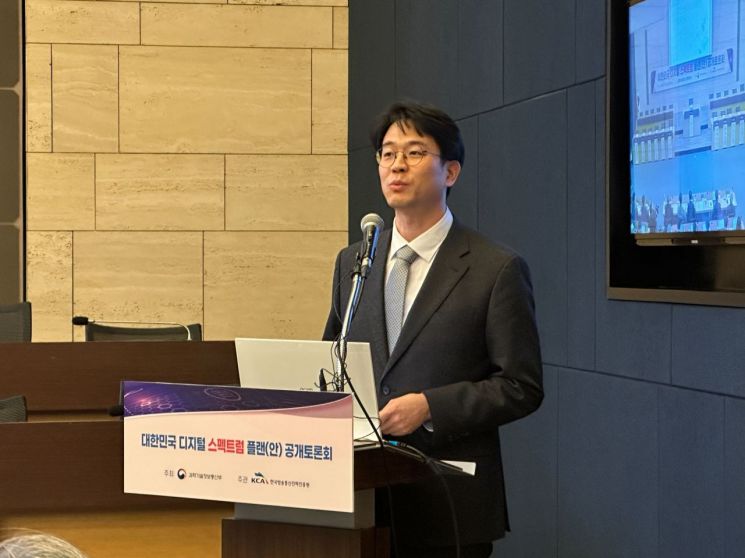 On the 31st, at the Korea Chamber of Commerce and Industry Members' Meeting Room in Jung-gu, Seoul, Ha Junhong, Director of the Frequency Policy Division at the Ministry of Science and ICT, is presenting the plan at the "Korea Digital Spectrum Plan Public Forum." Photo by Lee Seongmin, Junior Reporter minute@
At the "Korea Digital Spectrum Plan Public Forum" held on the 31st at the Korea Chamber of Commerce and Industry conference room in Jung-gu, Seoul, Ha Junhong, Director of the Frequency Policy Division at the Ministry of Science and ICT, stated that they will enhance the utilization efficiency of mobile communication frequencies across low, mid, and high bands. He also mentioned that frequencies will be opened for use not only by mobile carriers but also by various industrial services.
First, to improve the utilization efficiency of mobile communication frequencies across all bands, a mid- to long-term blueprint was announced for each band. Regarding the low band (below 1 GHz), the plan is to provide opportunities to discover new innovative services. For the 700 MHz and 800 MHz bands, supply will be promoted by securing frequencies through band reorganization and utilizing previously secured but unused bands.
In the mid-band (1?6 GHz), the plan is to supply broadband resources timely and in appropriate quantities to achieve high utilization efficiency and to promote investment and competition. The 1.8 GHz and 2.1 GHz bands, currently used for nationwide 3G and 4G services, have allocation periods set until 2026, and a conclusion on the appropriate scope of reallocation will be made.
For the 2.3 GHz, 2.6 GHz, and 3.7 GHz bands, supply will be considered at an appropriate time to ensure high utilization efficiency of broadband resources and to promote investment and competition. For bands above 4.82 GHz, plans to secure the I-eum 5G band will be studied. It was also added that additional conditions on frequency use will be applied in the mid-band frequencies to respond promptly to market demand.
However, specific remarks on the 3.7?3.72 GHz (20 MHz) frequency band, for which SK Telecom requested additional allocation, were avoided. Director Ha said, "It was judged inappropriate to announce allocation details similar to an allocation notice when presenting a five-year mid- to long-term plan," and added, "The supply of the relevant band will be separately notified." He also stated, "Regarding the 3.7 GHz band, whether to supply 20 MHz or up to 300 MHz bandwidth is still under review," and "No clear conclusion has been reached yet, so various scenarios are being considered." Regarding the high band (above 24 GHz), securing opportunities for new entrants and expanding I-eum 5G will be reviewed.
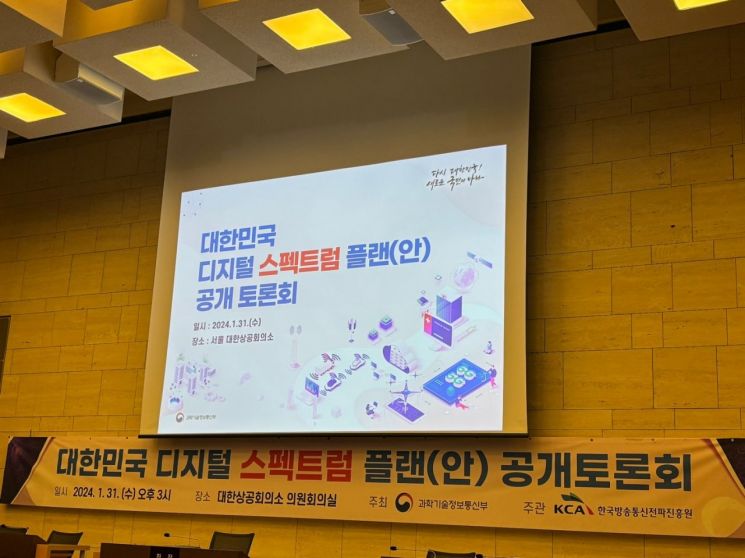 On the 31st, the "Korea Digital Spectrum Plan Public Forum" was held in the Members' Meeting Room of the Korea Chamber of Commerce and Industry in Jung-gu, Seoul. Photo by Hwang Seoyul chestnut@
Efforts to secure 6G frequencies will also be pursued. Director Ha said, "At the World Radiocommunication Conference (WRC), there was a global consensus to conduct research on three out of four frequency bands proposed by the Korean government," and added, "We will pursue balanced frequency discovery and securing from low bands below 1 GHz to terahertz units."
A plan was also announced to supply frequencies at appropriate times to support new industry growth. In particular, for the 30 MHz frequency for 5G used in experiments and demonstrations for Urban Air Mobility (UAM), where Korea is a leader, supply will be expedited. However, since communication technologies and frequencies for UAM networks are not yet concretely defined, additional conditions such as usage scope, usage area, and possible band changes will be attached to prevent premature investment. Additionally, support for frequencies for unmanned/autonomous ships, autonomous vehicles, and satellite communications will be considered.
Furthermore, plans were announced to strengthen social safety nets by securing public frequencies for disaster preparedness in disaster, industrial, and daily life sectors. In particular, to efficiently utilize limited resources, frequency bands for shared use between private and public sectors and among public sectors will be discovered and secured based on data such as usage time, usage scope, and output.
The government plans to finalize the frequency spectrum plan by collecting opinions from experts and stakeholders who participated in the forum.
© The Asia Business Daily(www.asiae.co.kr). All rights reserved.


















