Reform of Large Corporation Participation Restriction System After 11 Years
"An Opportunity to Advance the Public SW Market"
The government will significantly ease restrictions on large companies participating in public software projects. Design and planning projects such as informatization strategic plans will be fully opened to all companies, and large projects worth over 70 billion KRW will allow participation from large companies subject to mutual investment restrictions (Sangchulje).
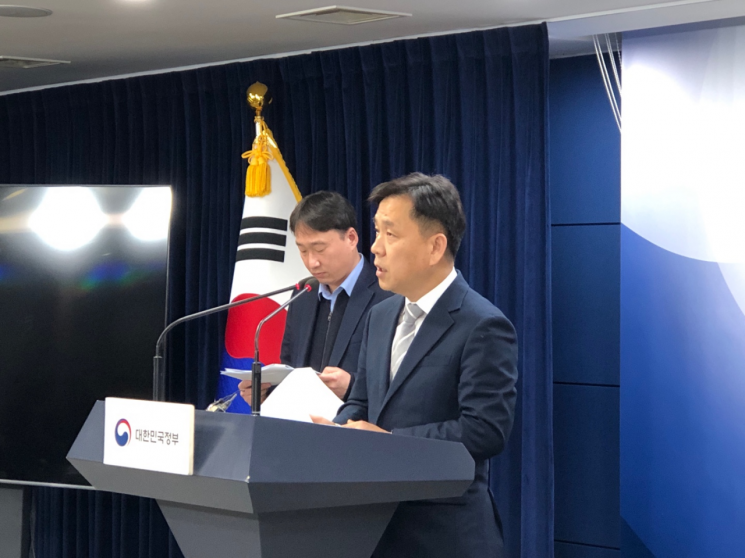
Kang Dohyun, Director of the Information and Communication Policy Office at the Ministry of Science and ICT, held a briefing at the Government Seoul Office on the 31st and announced the "Improvement Plan for Restrictions on Large Company Participation in Public SW Projects" with these details.
Director Kang explained the purpose of this institutional improvement plan, saying, "Due to quality issues arising in many large public SW projects causing inconvenience to the public, there has been strong criticism that quality improvement through competition should be encouraged regardless of company size."
‘Design and Planning Projects’ Fully Opened to All Companies
The government will first fully open design and planning projects through amendments to the Software Promotion Act (SW Promotion Act). The plan is to allow all companies to participate in projects without restrictions regardless of company size.
Until now, public SW projects have followed the design and planning practices centered on service integration (SI) projects. As a result, there have been limitations in the public sector’s leading application of cutting-edge technologies such as cloud and artificial intelligence (AI) and in driving the domestic SW industry.
Although the need for capable companies to participate from the design and planning stages is increasing, the government judges that the current SW Promotion Act restricts participation of companies with expertise not only in SW development and construction but also in design and planning projects such as informatization strategic plans (ISP).
Director Kang expressed expectations, saying, "This can be an opportunity to modernize and improve the public SW market by accelerating the cloud transition of the existing service integration-oriented public SW market, promoting the introduction of accumulated new technologies in the private sector such as verified commercial SW utilization and modular design."
Large Projects Over 70 Billion KRW Also Open to Large Companies
The government also decided to allow participation of Sangchulje large companies in projects worth over 70 billion KRW without exception review. Until now, the SW Promotion Act has fundamentally restricted participation of Sangchulje large companies regardless of project amount. Sangchulje large companies could only participate in projects where exceptions were recognized through review, such as in national security or new technology fields.
Through amendments to the SW Promotion Act, the government plans to select the optimal business operator regardless of company size and encourage quality improvement efforts between large and medium-sized companies.
Director Kang explained, "Since large companies play a leading role, the impact of deregulation on win-win cooperation between companies is not significant," and added, "We judged that securing the effectiveness of deregulation is necessary as major next-generation projects that were concentrated recently are coming to an end."
Regarding setting the threshold at 70 billion KRW, he explained, "The standard amount was finalized by comprehensively considering the impact on the public SW market, industry acceptance, effectiveness of regulatory improvement, and future demand for large projects."
Mid-sized Competitive Project Range Expanded from 2 Billion KRW to 3 Billion KRW
As a countermeasure for small and medium enterprises (SMEs), the government decided to expand the project range exclusively for SMEs. The competitive project range for SMEs will be expanded from the current under 2 billion KRW to under 3 billion KRW, thereby supplementing the participation base of SMEs in the public SW market.
Director Kang said, "This considers the original purpose of restricting large company participation to foster SMEs," and added, "By expanding opportunities for SMEs to participate as main contractors, it will support the accumulation of technology and expertise and contribute to enhancing the role of SMEs in large projects in the mid to long term."
Additionally, the government proposed measures to improve the growth of SW companies and the quality of public SW projects, including ▲ improvement of win-win cooperation evaluation systems ▲ relaxation of consortium composition restrictions ▲ strengthening evaluation of subcontracting plans’ appropriateness in large projects ▲ shortening review periods for exception projects.
Director Kang stated, "The Ministry of Science and ICT will promptly promote this institutional improvement plan through close consultations with related ministries such as the Office for Government Policy Coordination, the National Assembly, and the industry, and will continuously identify and improve unreasonable practices and systems in public SW projects," adding, "Focusing on the first institutional reform in 11 years, we will establish an institutional foundation that allows capable companies to participate and compete without restrictions in large public SW projects that greatly affect citizens’ lives and convenience."
© The Asia Business Daily(www.asiae.co.kr). All rights reserved.
![Clutching a Stolen Dior Bag, Saying "I Hate Being Poor but Real"... The Grotesque Con of a "Human Knockoff" [Slate]](https://cwcontent.asiae.co.kr/asiaresize/183/2026021902243444107_1771435474.jpg)
















