On the 1st, '4 Major Essential Medical Policies' Announced at the Public Livelihood Forum
Medical School Admission Quotas to Expand from 2025 Academic Year
Over 10 Trillion Won Invested to Raise Essential Medical Fees
The government plans to significantly expand the admission quota for medical schools starting next year in preparation for a shortage of approximately 15,000 doctors by 2035. Measures such as 'expanding regional talent selection for medical schools and introducing a contract-based regional essential doctor system' will strengthen regional healthcare, and essential medical fees will be increased through a financial investment of over 10 trillion won by 2028. Although this is a long-term task, to gain strong momentum for implementation, a presidential advisory 'Special Committee on Medical Reform' will be established to promptly prepare a roadmap for reform execution.
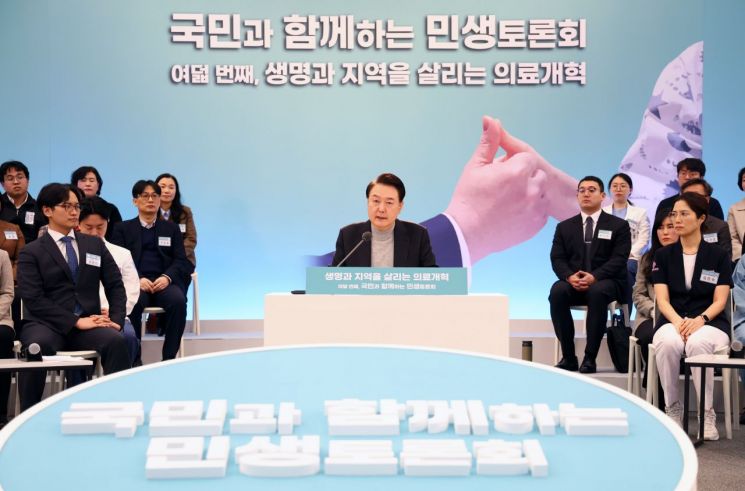
On the morning of the 1st, President Yoon Seok-yeol presided over the eighth 'Public Discussion on Livelihood Issues' at Bundang Seoul National University Hospital in Seongnam, Gyeonggi Province, under the theme of 'Medical Reform to Save Lives and Regions,' stating, "A country where terms like 'emergency room roundabout' and 'pediatric open run' are popular cannot be called a good country," and added, "If people living in rural areas cannot receive proper medical services just because of their location, it would be shameful to call ourselves an advanced country."
This discussion was organized to hear the vivid voices of citizens and medical staff struggling with the collapse of regional and essential medical services and to discuss fundamental solutions.
In his opening remarks, President Yoon said, "The four major policy packages announced today are part of a promise to restore our collapsing medical system and protect the health and lives of our people," and added, "They include plans to develop South Korea's medical industry to the world's highest level."
Following this, Minister of Health and Welfare Cho Kyu-hong detailed the four major policies: expanding medical personnel, strengthening regional healthcare, establishing a safety net for medical accidents, and enhancing fairness in the compensation system.
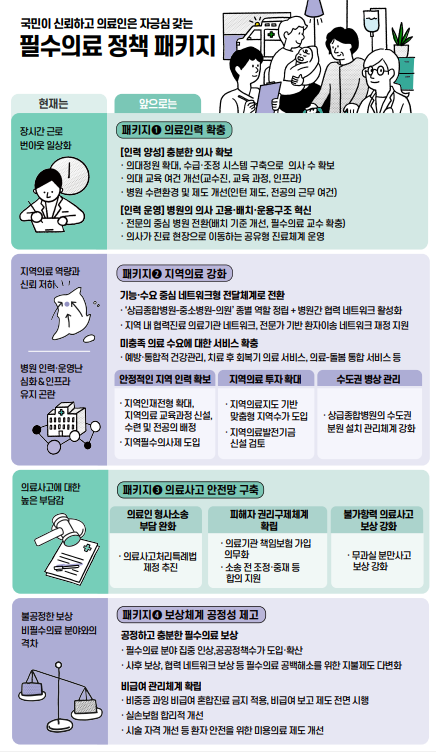
Regarding the expansion of medical personnel, the government anticipates a shortage of 15,000 doctors by 2035 and plans to significantly increase the medical school admission quota, which has been capped at 3,058 students for 18 years, starting from the 2025 academic year. According to a nationwide survey of demand for increasing medical school admissions conducted last November, 40 medical schools nationwide expressed hopes to increase admissions by at least 2,151 and up to 2,847 students in the 2025 academic year. The total increase in medical school admissions is estimated to be between 1,000 and 2,000 students. However, on the 9th, the Korean Association of Medical Colleges and Medical Schools announced that an increase of about 350 students is appropriate, showing that the gap in positions has yet to be narrowed. The government plans to decide the scale of the increase by comprehensively considering the capacity of medical schools, regional medical infrastructure, and workforce redistribution plans, but since discussions with the medical community are ongoing, the scale and timing will be announced separately in the future. To prevent side effects of oversupply of doctors pointed out by the medical community, the admission quota will be periodically adjusted according to doctor supply and demand projections.
To strengthen regional healthcare, a regional medical innovation pilot project will be implemented. Selected regions for the pilot project will receive up to 50 billion won in support over three years. To secure essential doctors who will work stably in the regions, the regional talent selection for medical schools will be significantly expanded. The mandatory regional selection ratio for non-metropolitan medical school quotas, currently at 40% or more, will be increased, and the increased admission quota will be actively utilized for regional talent selection. Additionally, the introduction of a contract-based regional essential doctor system will be pursued. The Ministry of Health and Welfare explained, "The regional essential doctor system will be conducted as a contract based on the doctor's own will, not as an obligation." The government plans to expand customized regional medical fees and consider establishing a regional medical development fund.
To establish a safety net for medical accidents, the burden of criminal punishment on medical personnel will be eased. The 'Special Act on Medical Accident Handling' will be promoted, which limits prosecution for medical accidents on the premise that all doctors or medical institutions have insurance or mutual aid coverage. The national support ratio for compensation for no-fault medical accidents such as childbirth will be expanded from the current 70% to 100%. Expansion of national support for compensation for unavoidable medical accidents occurring in pediatric care and other areas will also be considered. Furthermore, measures to reduce criminal liability for essential medical work-related negligent homicide or injury will be reviewed.
The government plans to enhance fairness in the compensation system to resolve the avoidance of essential medical subjects by doctors. By 2028, more than 10 trillion won will be invested to focus on raising essential medical fees. The funding will mainly come from health insurance finances, with some input from the national treasury and general budget. To prevent distortion of the medical system by the non-reimbursed market and to resolve compensation imbalances, the prohibition of health insurance claims for non-severe excessive non-reimbursed treatments such as manual therapy (mixed treatment ban) will be pursued. Comprehensive institutional improvements, including improving qualifications for procedures in the cosmetic medical field, will also be promoted.
To implement the policies announced on this day, the government plans to establish a presidential advisory 'Special Committee on Medical Reform' and operate it for one year. The committee will first prepare a medical reform implementation roadmap within the first half of the year.
© The Asia Business Daily(www.asiae.co.kr). All rights reserved.


















