"Platform Dominance, a Result Chosen by Consumers"
"Concerns Over Reduced Consumer Welfare Due to Platform Act"
Concerns have emerged that the Platform Competition Promotion Act (Platform Act), promoted by the Fair Trade Commission, will stifle the activities of domestic platform companies and reduce consumer welfare. This is because it could block various membership benefits and discount policies provided by platforms, thereby increasing the burden of food prices.
On the 31st, Kim Hee-gon, a member of the People Power Party, held a "Policy Discussion on the Platform Fair Competition Promotion Act from the Perspective of Consumer Rights" at the National Assembly Members' Office Building in Yeouido, Seoul. The discussion was jointly hosted by the Korean Consumer Law Association and the consumer organization Consumer Watch.
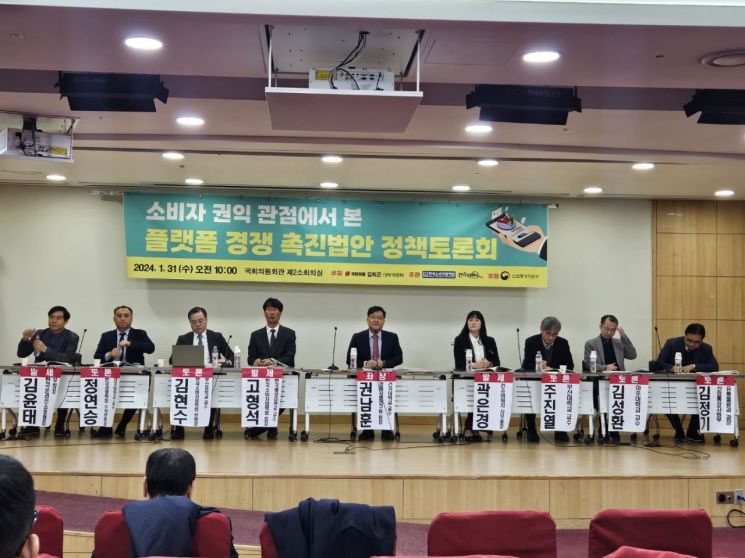 Kim Hee-gon, a member of the People Power Party, held a policy discussion on the "Platform Fair Competition Promotion Act from the Perspective of Consumer Rights" at the National Assembly Members' Office Building in Yeouido, Seoul.
 [Photo by Choi Yuri]
The Platform Act is a regulation that pre-designates platform companies with monopolistic status as "dominant operators" and prohibits four major unfair practices. These include ▲ "self-preference," which exposes their own products or content more favorably than other companies ▲ "most-favored-nation treatment," which requires prices equal to or lower than competitors ▲ "tying," which forces customers to purchase other products along with their own services ▲ and "multi-homing restrictions," which prohibit users of their platform from using other platforms. Although the targets and criteria of the regulation have not been disclosed, major companies such as Naver, Kakao, Google, and Apple are likely included.
There are significant concerns that banning such practices will only increase consumer harm. This is because the cost of preferred products and services may rise or benefits may decrease.
Self-preference for private brand (PB) products is a representative example. If promotion or marketing of PB products is banned as self-preference, it will result in limiting consumer choice. The same applies to tying. Coupang Wow Membership members receive discounts on the online video service (OTT) Coupang Play and the delivery service Coupang Eats, which falls under tying. Consumers would lose access to these benefits. Kwak Eun-kyung, Secretary General of Consumer Watch, pointed out, "The market dominance of platforms is the result of voluntary choice by consumers due to the benefits provided. Regulating this will reduce consumer benefits and only increase the burden of food prices."
On the other hand, experts view the policy effect as unclear. In the online shopping market, Chinese companies such as AliExpress and Temu are rapidly growing beyond the companies targeted by the regulation. Professor Jeong Yeon-seung of Dankook University said, "Self-preference for PB products and tying are marketing strategies used worldwide for differentiation. In an era of unlimited competition without borders, it is questionable whether regulations in a specific country will be effective."
There are also growing voices that the act will block the opportunities for small and medium-sized merchants and startups collaborating with large platforms. Kim Yoon-tae, Vice President of the Korea Online Shopping Association, predicted, "If platforms are constrained, the sellers and manufacturers operating on them will be adversely affected, ultimately hindering employment and economic growth."
Experts unanimously agreed that a system encouraging competition is necessary to protect consumers. They argue that strengthening competition between online platforms and offline retailers, as the government recently allowed dawn delivery by large marts, will increase consumer choice. Secretary General Kwak emphasized, "The government banned Tada and Uber, which only strengthened Kakao Taxi's monopoly. An environment where various platforms can be created must be fostered."
In response, the Fair Trade Commission stated that the concerns are excessive. They said misunderstandings arose because the government proposal has not been disclosed and promised to communicate as soon as possible. Park Seol-min, Director of the Digital Economy Policy Division of the Fair Trade Commission’s Competition Policy Bureau, who attended the discussion, said, "Issues such as delivery benefits, which are not regulated under the current Fair Trade Act, will not be regulated under the Platform Act either. The intention is to regulate platforms that maliciously drive out other actors, not platforms that grow through good services."
© The Asia Business Daily(www.asiae.co.kr). All rights reserved.

















