Last year, a tax revenue shortfall amounting to 56 trillion won occurred. This marks the second consecutive year of tax revenue falling short of the budget, the first time in nine years since consecutive tax revenue shortfalls occurred from 2012 to 2014. The decline is attributed to reduced corporate tax and capital gains tax due to worsening corporate performance and a sluggish real estate market.
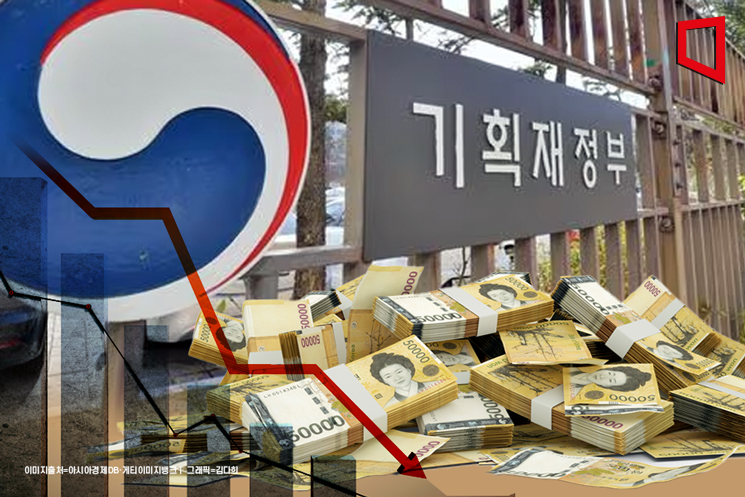
On the 31st, the Ministry of Economy and Finance announced that the provisional annual national tax revenue for last year was 344.1 trillion won, a decrease of 56.4 trillion won (14.1%) compared to the budget (400.5 trillion won). The 14.1% tax revenue error rate is the largest ever on the negative side.
The so-called “tax revenue shortfall,” also known as a “tax revenue punk,” refers to the situation where actual national tax revenue collected is less than the expected national tax revenue estimated when drafting the budget for the previous year. Income tax was collected at 115.8 trillion won, 12.2% less than the budget; corporate tax was 80.4 trillion won, 23.4% less. Inheritance and gift tax was 14.6 trillion won, 14.6% less than budget; comprehensive real estate tax was 4.6 trillion won, 19.5% less; and value-added tax was 73.8 trillion won, 11.3% short.
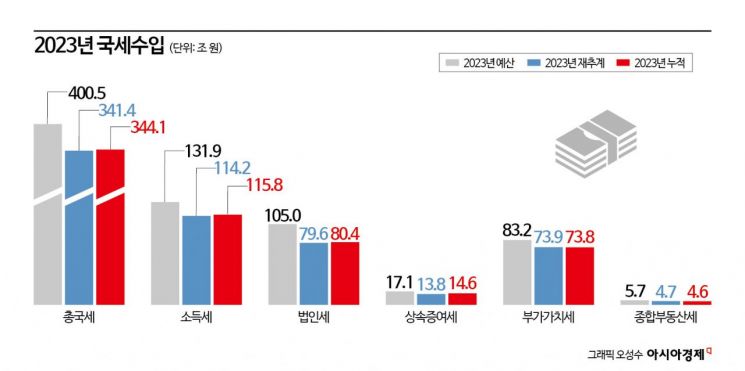
As the tax revenue shortfall became noticeably apparent from the beginning of the year, the Ministry of Economy and Finance unusually announced a revised tax revenue estimate (341.4 trillion won) in September last year. The actual total national tax revenue collected was 2.7 trillion won (0.8%) more than the revised estimate.
This means that the Yoon Seok-yeol administration has experienced tax revenue shortfalls for two consecutive years since its early period. Choi Jin-gyu, head of the Tax Analysis Division at the Ministry of Economy and Finance, explained, “This is the first time since consecutive tax revenue shortfalls occurred from 2012 to 2014,” but added, “In 2022, the final shortfall compared to the budget was only 700 billion won, and the error rate was about 0.2%, so the level of tax revenue shortfall was not significant.”
The tax revenue shortfall is also a result of the government’s inaccurate tax revenue forecasts. The Ministry of Economy and Finance stated that it is discussing improvement measures with international organizations such as the International Monetary Fund (IMF) to address this issue. Choi said, “We have been continuously collaborating with international organizations since the end of last year and are having concrete discussions at the working level,” adding, “This year, we plan to enhance the forecasting model when drafting next year’s budget, and the Tax Revenue Forecasting Committee is also continuously considering increasing the number of private experts.”
Separately from the budget, the tax revenue decreased by 51.9 trillion won compared to the previous year’s tax revenue performance (395.9 trillion won). Corporate tax decreased by 23.2 trillion won and capital gains tax by 14.7 trillion won compared to the previous year; combined, these two items account for 37.9 trillion won. Excluding the base effect of tax support (10.2 trillion won), most of the decrease came from corporate tax and capital gains tax. Additionally, as revenue declined, value-added tax decreased by 7.9 trillion won (9.6%) and customs duties by 3 trillion won (29.4%) compared to the previous year. Due to a drop in publicly announced land prices, comprehensive real estate tax decreased by 2.2 trillion won (32.4%) compared to the previous year, and transportation tax also decreased by 300 billion won due to the temporary reduction of fuel tax.
The Ministry of Economy and Finance expects tax revenue to increase this year compared to last year. The national tax revenue reflected in this year’s budget, confirmed by the National Assembly, is 367.3 trillion won, about 23 trillion won higher than last year’s actual performance. Choi said, “Normally, if the economy grows normally, tax revenue increases compared to the previous year,” adding, “However, the key factor is how corporate tax will perform depending on the real estate market and corporate performance.”
© The Asia Business Daily(www.asiae.co.kr). All rights reserved.
![Clutching a Stolen Dior Bag, Saying "I Hate Being Poor but Real"... The Grotesque Con of a "Human Knockoff" [Slate]](https://cwcontent.asiae.co.kr/asiaresize/183/2026021902243444107_1771435474.jpg)

















