"Monitoring Tariffs, NATO, and Climate Change"
"Unanimous Agreement on Interest Rate Cuts... Wage Data is Important"
Christine Lagarde, President of the European Central Bank (ECB), stated that Europe must prepare for economic threats such as new tariffs imposed by the United States if former President Donald Trump regains power.
According to CNN on the 30th (local time), President Lagarde said, "We must prepare for potential tariffs and unexpected harsh decisions."
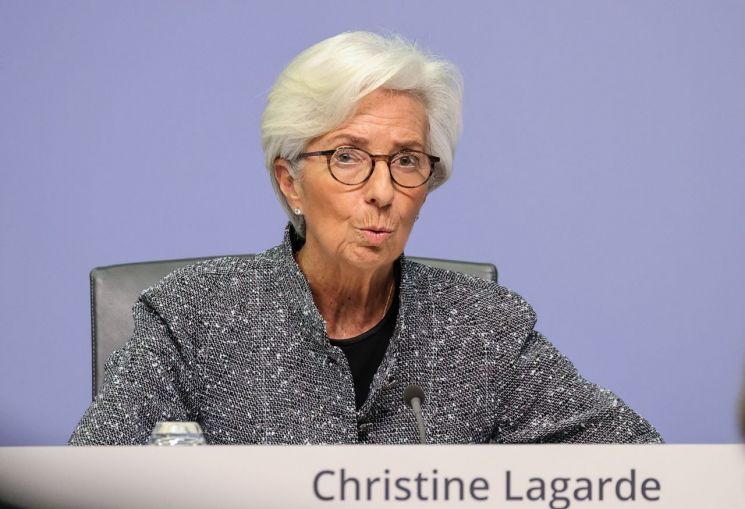
This statement is in line with Lagarde's remarks earlier this month in an interview with French public broadcaster France 2, where she said that if former President Trump succeeds in his re-election, it would pose a clear threat to Europe.
During Trump's first term, relations between the United States and the European Union (EU) were strained due to trade disputes. The U.S. imposed tariffs on EU steel and aluminum, and in response, the EU imposed tariffs on American whiskey, motorcycles, denim, and other products. Following Trump's victories in the Iowa and New Hampshire Republican primaries, concerns about a second Trump term have emerged in Europe. In 2022, the total trade volume of goods and services between the U.S. and the EU was estimated at $1.3 trillion (approximately 1,728 trillion KRW). CNN explained that Trump's return could affect everything from trade policy to support for the Ukraine war.
President Lagarde said the best way for Europe to prepare for a second Trump term is to "strengthen the single market to ensure the free movement of goods, services, people, and capital," adding that this means "integrating financial markets to make financing easier for small and medium-sized enterprises and to encourage innovation."
She also said that if former President Trump is elected, attention must be paid to the U.S. stance on tariffs, the North Atlantic Treaty Organization (NATO), and climate change. Lagarde noted, "In the past, the interests of the U.S. and Europe did not align in these three areas."
Regarding interest rate cuts, she said, "All ECB members agree that the next step is a rate cut," but added that it is still difficult to present a specific schedule.
She stated, "We have not yet reached the stage for a rate cut," and emphasized, "We need all kinds of data, but wage-related data is the most important." Earlier, Philip Lane, the ECB's Chief Economist, also stressed the importance of wage improvements in the Eurozone (20 countries using the euro). European wage statistics are expected to be released around May. Although there is speculation that the ECB might announce a rate cut in April, Bloomberg analyzed that since there is no ECB meeting in May, the first rate cut is likely to begin in June. Fran?ois Villeroy de Galhau, Governor of the Bank of France, recently said about the timing of the rate cut, "Everything will be revealed at the next meeting."
President Lagarde emphasized that a prerequisite for a rate cut is a decline in inflation. Inflation must fall to the ECB's target of 2%. She said, "Europe is on a downward trend in inflation," but added, "Before cutting rates, we need to delve deeper into the process of eliminating inflation."
© The Asia Business Daily(www.asiae.co.kr). All rights reserved.
!["The Woman Who Threw Herself into the Water Clutching a Stolen Dior Bag"...A Grotesque Success Story That Shakes the Korean Psyche [Slate]](https://cwcontent.asiae.co.kr/asiaresize/183/2026021902243444107_1771435474.jpg)
















