Benchmarking Carbon Neutrality Best Practices through Business Trip to Germany and the Netherlands from January 27 to February 4... Agreement Signed on February 1 for Carbon Neutrality Policy Cooperation with Utrecht City, Netherlands
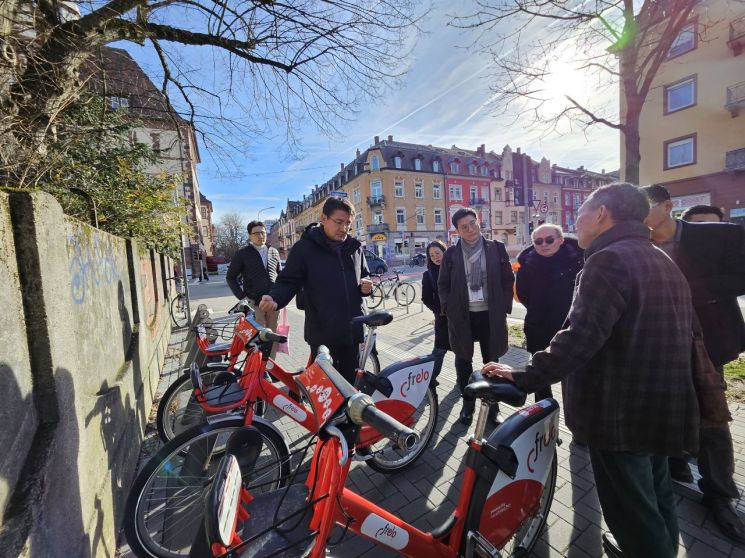
Nowon-gu, Seoul (Mayor Oh Seung-rok) has embarked on learning from Freiburg, Germany, a city that focuses intensively on solar energy among renewable energies.
Freiburg is a city that has adopted the use of renewable energy as a key policy and is known as the "City of the Sun." From January 27 to February 4, a total of 7 nights and 9 days, Mayor Oh Seung-rok and related officials visited the site to directly observe the application of renewable energy policies, which are gaining global importance.
Major sites visited include the "Freiburg Historic District," designated as a pedestrian zone after being heavily damaged during World War II, and "Freiburg Central Station," which serves as a hub for regional transportation with train and public transit transfers and features solar glass windows that generate electricity, establishing a sustainable transportation system.
The most eye-catching place is the Freiburg City Hall building, the world's first to produce surplus energy. Solar panels cover the entire exterior wall of the building, supplying more energy than needed for the city hall, with the excess energy used elsewhere.
Particularly notable is the Heukrim Wind Power Plant in Simonswald, about 20 km from Freiburg, which demonstrates the importance of communication and consensus with citizens in forming various energy activation policies. The large-scale wind turbine power facility is an example of citizen-led renewable energy distribution operated by the community.
In fact, residents of Freiburg are well aware of the environmental significance of the city hall and the city's renewable energy policies. The permitting process for major buildings in Freiburg is also based on eco-friendliness. Building permits require designs that consider solar energy efficiency from the land sale stage.
The Innovation Academy located in Freiburg shows how ongoing renewable energy policies affect citizens' lives. It clearly illustrates the emergence of a citizen-led eco-city, zero carbon dioxide emissions, the spread of new renewable energy centered on solar power, and a public transportation system focused on bicycles and pedestrians.
The delegation also visited model sites of zero-energy housing in Nowon. These include the world's largest passive house complex, the "Heidelberg Bahnstadt Residential Complex," and the eco-friendly apartment "Darmstadt Waldspirale," which combines energy saving and artistic architecture. They plan to explore ways to apply these to the creation of carbon-neutral residential complexes in Nowon.
The delegation will also visit Utrecht City Hall in the Netherlands, recognized as the world's best bicycle city and selected in 2022 by the European Union as one of the top 100 cities implementing carbon neutrality and smart city initiatives. An agreement will be signed with Utrecht City to exchange carbon neutrality cases and promise close cooperation between the two cities.
Currently, Nowon-gu has 55 apartment complexes with over 30 years of age, totaling about 74,000 households, the largest number among Seoul's autonomous districts. Given the high demand for redevelopment and reconstruction, Nowon aims to lead by proposing a carbon-neutral reconstruction promotion model and aims to create carbon-neutral residential complexes through zero-energy building certification design and consulting support.
Energy efficiency improvement projects and the expansion of Nowon-style solar power plants in multi-family housing are also notable, considering that 68% of Nowon's greenhouse gas emissions come from buildings such as residences.
Other local specialized projects include establishing an electric vehicle leading city linked to the living economy, culture, and youth jobs; promoting carbon-neutral modernization of the Nowon Resource Recovery Facility in Seoul; and securing urban forests in living areas to expand carbon sinks.
The district plans to systematically implement 35 policy projects across seven major sectors covering energy transition, green buildings, future transportation, resource circulation, green space conservation, public leadership, and just transition, supported by 11 projects under three foundations: "strengthening resident participation and public-private cooperation," "carbon-neutral organizational and cultural innovation," and "policy project implementation enhancement" to ensure effective policy execution.
Meanwhile, the "Nowon-gu 2050 Carbon Neutral Green Growth Committee," launched on June 8 last year, aims to reduce greenhouse gas emissions by 40% by 2030.
Mayor Oh Seung-rok said, "Through this visit, we will incorporate the excellent renewable energy policy cases of Germany and the Netherlands into our district policies to draw the blueprint for Nowon as a carbon-neutral future city completed with eco-friendly architecture and transportation."
© The Asia Business Daily(www.asiae.co.kr). All rights reserved.
![Clutching a Stolen Dior Bag, Saying "I Hate Being Poor but Real"... The Grotesque Con of a "Human Knockoff" [Slate]](https://cwcontent.asiae.co.kr/asiaresize/183/2026021902243444107_1771435474.jpg)
















