Children as Property? Slow Change in Social Perception
Increase in Parents Committing Extreme Acts After Killing Children
"Legal Reform Can Lead to Change in Awareness"
On the 21st, a couple in Gangneung, Gangwon Province, who attempted an extreme act with their three children, was booked by the police. The couple, who had been expressing economic difficulties, made this attempt while their children were asleep at a camping site, and were transported to the hospital following a report by the campsite owner. The children were not in life-threatening condition but reportedly received medical treatment due to physical and mental distress.
Although the number of parents who kill their children and then attempt extreme acts is increasing every year, social awareness and related legislation regarding these cases remain slow to change. Experts point out that the wrong perception begins with the social convention of viewing children not as independent individuals separate from their parents but as 'property.' They suggest the need for movements to raise social awareness, such as establishing aggravated punishment provisions for filicide.
“Parents Who End Their Lives After Killing Children” Up 180% in 5 Years
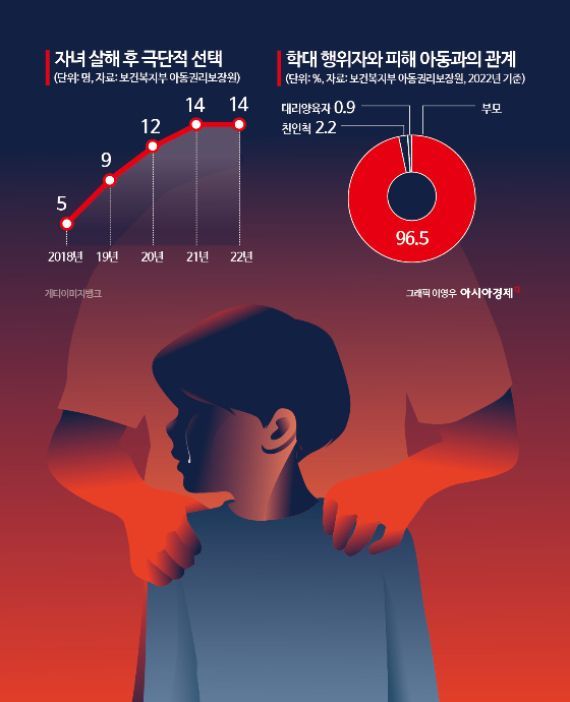
According to the 'Major Statistics on Child Abuse' published on the 31st by the Child Rights Protection Agency under the Ministry of Health and Welfare, the number of children killed by parents who committed suicide in 2022 was 14, a 180% increase compared to five years earlier in 2018 (5 children). Over the five years, the total number of children killed by parents who decided on extreme acts was 54, increasing annually from 5 in 2018, 9 in 2019, 12 in 2020, 14 in 2021, to 14 in 2022. Considering that the government officially began compiling statistics in 2018, officials believe that more children were likely killed by parents before this period.
During the same period, the most common cause of death was 'fatal physical abuse' with 75 cases (49.6%), followed by 'filicide followed by extreme acts' with 54 cases (35.7%). Regarding the relationship between the abuser and the child victim, 'parents' accounted for an overwhelming 96.5%, followed by 'relatives' (2.2%) and 'substitute caregivers' (0.9%).
A Ministry of Health and Welfare official stated, "The influence parents have on young children is absolute, and due to the nature of this relationship, it is difficult for outsiders to detect abuse. Therefore, child abuse inflicted by parents is harder to discover." The official added, "Although reports of suspected abuse have significantly increased recently due to media attention on several child abuse cases, proactive measures such as separating children from parents remain insufficient."
"They must have been desperate"... Awareness Needs to Change
Experts criticize that although killing one's children and then attempting extreme acts clearly constitutes 'child abuse,' society tends to view such cases more leniently. They also point out that unlike 'parricide,' which carries aggravated punishment, there are no separate aggravated punishment provisions for 'filicide,' which slows the change in this misguided perception.
Under current law, a person who kills their own or their spouse’s direct ascendants is subject to 'parricide' charges and can be sentenced to death, life imprisonment, or imprisonment for at least seven years. This is a heavier sentence than murder, which is punishable by death, life imprisonment, or imprisonment for at least five years.
However, there are no separate aggravated punishment provisions for direct descendants. While 'infanticide' charges can be applied, the maximum sentence is 10 years in prison, which is lighter than for parricide. Several amendment bills proposing aggravated punishment for filicide, similar to parricide, have been submitted to the National Assembly, but none have passed the standing committee stage.
Experts say that the current law, which only includes aggravated punishment for parricide, reflects Korea’s unique cultural background, such as Confucianism, and advise that changing this could lead to shifts in social awareness.
Oh Young-geun, a professor at Hanyang University Law School, said, "Currently, aggravated punishment provisions apply to most violent crimes against ascendants, such as injury, assault, abandonment, abuse, detention, confinement, and threats, but this is a unique phenomenon in Korea that is hard to find overseas." He added, "It reflects Korea’s Confucianism, which has long regarded harming parents as 'filial impiety.' This is somewhat inconsistent with the current growing social importance of filicide."
Gong Hye-jung, president of the Korea Child Abuse Prevention Association, said, "Most people still view parents who kill their children and then attempt extreme acts with a sympathetic attitude, thinking 'they must have been desperate.'" She emphasized, "Regardless of the circumstances, killing a child is a clear crime and an extreme form of child abuse that must be firmly recognized."
© The Asia Business Daily(www.asiae.co.kr). All rights reserved.

















