Seoul City Announces Safe Housing Supply Plan for Seniors
Private Rentals Within 85% of Market Price
Public Rentals Within 50%
The Seoul Metropolitan Government will supply 'Senior Safe Housing' for the elderly aged 65 and over. The goal is to obtain project plan approval for more than 3,000 households by next year.
On the 30th, the city announced the supply plan for Senior Safe Housing and will start recruiting sites from next month. After revising the ordinance by March, the approval procedures will begin in April. The first move-in is expected as early as 2027.
Han Byung-yong, Director of Seoul's Housing Policy Office, explained, "We expect to approve more than 3,000 units by next year. Construction is possible in areas adjacent to hospitals, and hospitals also have land that is not designated as medical facilities, so they are positively reviewing the project."
Considering social changes such as entering a super-aged society where one in five people will be aged 65 or older from 2025, the city has been preparing a new type of housing supply to alleviate housing burdens in old age. Although Seoul’s population is decreasing, the number of elderly aged 60 and above is increasing. The number of single-person households aged 60 and over in Seoul is expected to reach 1.84 million in 2025 and exceed 2.21 million by 2030.
Supply of Rental Housing to Reduce Housing Burden Ahead of Entering a Super-Aged Society
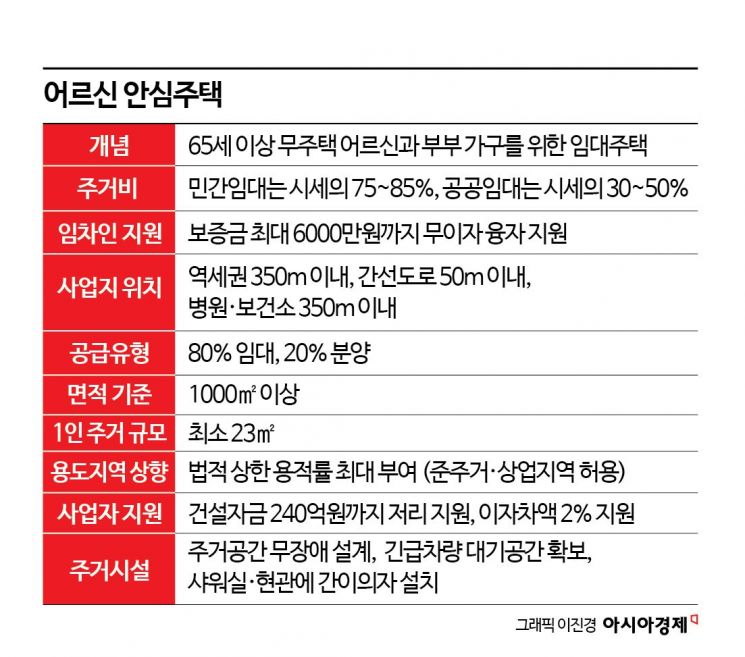
Senior Safe Housing refers to public and private rental housing supplied to households without homes aged 65 and older. Tenants must have seniors aged 65 or older accounting for more than 50% of the residents, and single-person households must make up more than two-thirds of the total households. There are no restrictions on household size or age for sale housing.
In the case of silver towns or elderly welfare facilities, the entire building must be purchased, and partial transactions are not possible. However, since Senior Safe Housing is supplied as rental housing, it is also possible for families supporting their elderly parents to purchase and live in the housing.
Director Han said, "It is designed not only for seniors to live but also to consider owners of sale housing and single-person households," adding, "20% of the total units can be sold, making transactions smoother compared to silver towns."
Among Senior Safe Housing, public rental rents are set at 30-50% of the surrounding market price, and private rental rents are set at 75-85% of the market price. Public rental fees are expected to be a deposit of 30 million KRW with monthly rent of 150,000 to 200,000 KRW, while private rentals will have deposits of 60 to 70 million KRW with monthly rent of 300,000 to 400,000 KRW.
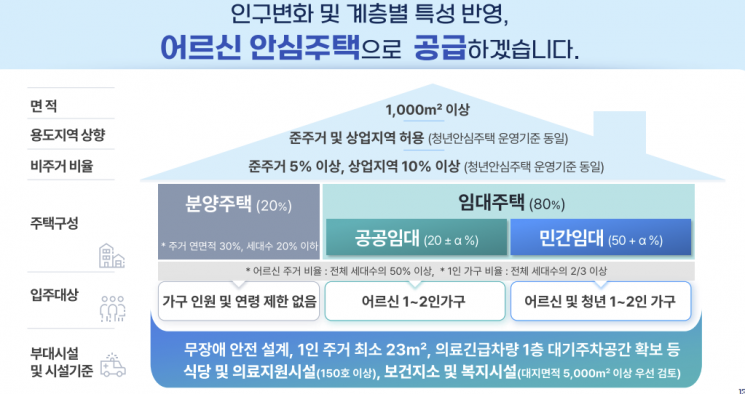
Revenue from paid parking lots and other sources will be reflected in management fees, further reducing the burden on residents. Public rentals will be supplied to elderly one- to two-person households. Private rentals can be occupied by seniors along with one- to two-person youth households.
The advantage of Senior Safe Housing is that it is built near subway stations or adjacent to health institutions and general hospitals. The city has set the project site criteria as within 350 meters of a subway station, public health center, or secondary/tertiary general hospital, and within 50 meters of a main road. Meeting just one of these conditions allows for project site application. Unlike silver towns or nursing facilities located on the outskirts, the intention is to build housing near hospitals with convenient facilities around subway stations to provide medical support and prevent social isolation.
Built Near Hospitals and Subway Stations, 20% for Sale
The city plans to significantly increase the floor area ratio for developers and supply 80% of the units as rental housing and 20% as sale housing. Compared to the 'Youth Safe Housing' supplied to those aged 19 to 39, the project conditions such as floor area ratio relaxation are similar, but allowing 20% sale housing is a major difference.
Additionally, the zoning of the project site will be upgraded to apply the legal maximum floor area ratio. Half of the increased floor area ratio beyond the basic ratio must be supplied as public rental housing. Currently, the floor area ratio for Type 2 General Residential Areas is 200%, but it can be increased up to 500% by upgrading to quasi-residential areas.
A simulation of a project site located in Hoegi-dong, Dongdaemun-gu, adjacent to Kyung Hee Medical Center, showed that a total of 204 households can be built. Applying a floor area ratio of 500% allows construction up to 10 floors. Among the 204 households, 28 are public rentals, 136 are private rentals, and 40 are sale housing units.
Tax benefits such as reductions in acquisition tax, property tax, and comprehensive real estate tax will also be provided. The approval period for permits will be drastically shortened from 12 months to within 6 months, from preliminary consultation to project plan approval. Furthermore, construction loan support of up to 24 billion KRW will be provided at low interest rates, with a 2% subsidy on the interest difference.
The city designed Senior Safe Housing as elderly-customized residential spaces and equipped community facilities. The living spaces will have no thresholds or level differences, and will include handrails on toilets and bathtubs, and simple chairs in showers and entrances. Facilities such as a 'Medical Center' for physical and mental health management, a 'Life Sports Center' for aerobics and Pilates, and a 'Nutrition Center' providing nutritious meals will be introduced. Additionally, a 'Senior Safe Housing Comprehensive Support Center' will operate to assist from move-in to contract and move-out. Physical and rehabilitation therapy rooms linked with medical welfare facilities will be installed, and if the area exceeds 5,000 square meters upon request from autonomous districts, public health clinics and welfare support facilities will also be established.
Director Han said, "We have identified many places intending to promote the Senior Safe Housing project. Some sites that were planning Youth Safe Housing are also considering changing to Senior Safe Housing," adding, "Since there is not much time before entering a super-aged society, we will quickly push forward the project to supply stable housing facilities for seniors."
© The Asia Business Daily(www.asiae.co.kr). All rights reserved.
![Clutching a Stolen Dior Bag, Saying "I Hate Being Poor but Real"... The Grotesque Con of a "Human Knockoff" [Slate]](https://cwcontent.asiae.co.kr/asiaresize/183/2026021902243444107_1771435474.jpg)

















