"Claim of 1 Trillion Won Loss to Company Due to Donation of Treasury Shares to Public Interest Foundation"
Donated Shares Serve as 'Friendly Forces' for Management Succession and Defense
"Activism is a Natural Exercise of Shareholder Rights"
KT&G "No Concealment of Shares or Misappropriation of Treasury Shares Foundation"
"I sincerely hope the company will make a conscientious judgment and take action against the individuals involved. If not, we will have no choice but to proceed with litigation."
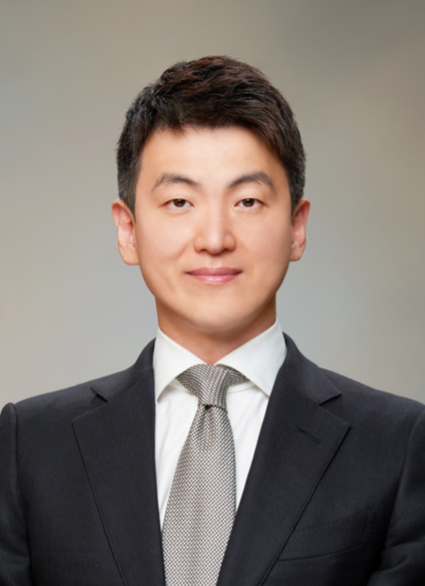
Lee Sang-hyun, CEO of activist fund Flashlight Capital Partners (FCP), expressed his determination on the 30th to proceed with a damages lawsuit against KT&G. Currently staying in Singapore, he said in a written interview with Asia Economy, "After donating treasury shares to a public interest foundation free of charge, they use those shares to create a structure where 'their own people' benefit," and criticized, "KT&G’s infringement on shareholder interests is bold and very creative in its method."
Earlier on the 10th, FCP sent a 'Request for Filing a Lawsuit to Hold Directors Accountable' to KT&G. The claim is that since 2001, board directors have donated 10.85 million treasury shares free of charge to foundations and funds, causing approximately 1 trillion KRW in damages to the company. The targets include 21 current and former inside and outside directors, including current KT&G CEO Baek Bok-in. According to the Commercial Act, if the company does not take any action within 30 days, FCP can file a shareholder derivative lawsuit.
Treasury Share Purchase → Foundation Donation → Friendly Forces
CEO Lee said, "Purchasing treasury shares under the pretext of 'stock price stabilization' and then diverting those shares to foundations for free is not right," adding, "The foundations use their shares to give unconditional support at every shareholders' meeting regardless of management performance." According to FCP, KT&G has contributed to six affiliated foundations and funds over 20 years, holding about 11% of friendly shares. CEO Baek leads the scholarship foundation and three funds, while former CEO Min Young-jin is chairman of the welfare foundation. FCP claims that they actively exercise voting rights in appointing management through a 'prearranged game' among themselves.
Each fund and foundation holds less than 5% of shares, so they are not required to report. Therefore, it is difficult to identify these relationships through audit reports or other disclosures. FCP was able to uncover this by requesting access to the shareholder registry as a shareholder holding about 1% of shares. CEO Lee said, "We uncovered what had been hidden for over a decade," and added, "They have built a 'kingdom of their own' by actively utilizing friendly shares and passing them down among themselves."
Since KT&G’s privatization in 2002, all four CEOs have been internal appointments. CEO Lee said, "Baek was called the 'crown prince' during former CEO Min’s tenure, and there are even rumors that another close aide of Min has already been designated as the next CEO." KT&G is currently in the process of appointing the next CEO."Activism Is Nothing Special... Not Doing It Is Rather Strange"
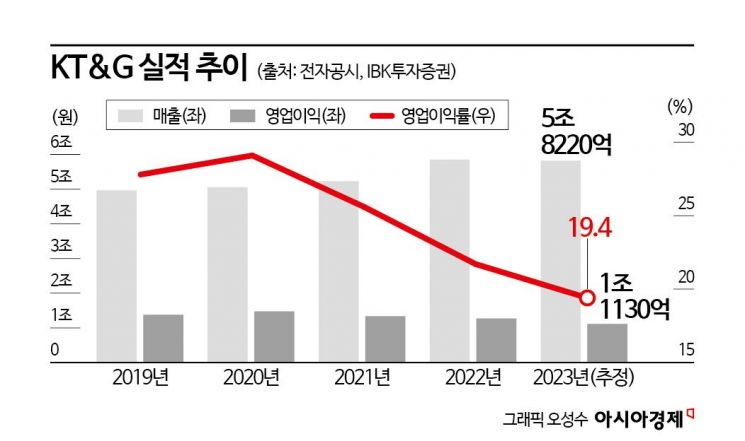
CEO Lee said, "Treating shareholders as owners is the promise of going public," and added, "KT&G is a company that works for management, not shareholders." He pointed out, "During Baek’s tenure (2015?present), the stock price has repeatedly declined contrary to the KOSPI, while the CEO has become the industry's 'highest paid'." He questioned, "Is it in the long-term interest to make the CEO’s salary the highest despite operating profit shrinking?" KT&G posted an operating profit of 1.473 trillion KRW (operating margin 29.1%) in 2020 but has since seen continuous declines in operating profit and margin. The operating margin is expected to be 19.4% (operating profit 1.113 trillion KRW) in 2023, risking falling below the 20% threshold for the first time since privatization.
CEO Lee founded FCP after serving as Korea representatives for Singapore’s Government Investment Corporation (GIC), McKinsey, Affinity Equity Partners, and Carlyle. Regarding his investment in KT&G, he said, "I believed that a 'good company' trading at a 'cheap price' due to 'governance' issues could be improved to 'normalize' the stock price, and KT&G was such a company." He added, "Both the management infringing on shareholder rights and the outside directors willingly participating in this behavior are problematic and must be corrected." Along with governance normalization, various shareholder proposals are being considered. CEO Lee said, "We plan to inform all shareholders as soon as this year’s shareholder proposals are finalized." Last year, FCP achieved the introduction of 'quarterly dividends' through shareholder proposals.
He concluded the interview discussing activist funds: "Is it correct to call shareholders exercising their voting rights 'activism'? If people care about elections, is that 'nationalism'? If students study hard, is that 'studentism'? Exercising voting rights with one’s shares is neither a special ideology nor philosophy. Isn’t it more appropriate to call the opposite 'passivism' or 'laziness'?"
Meanwhile, KT&G stated regarding this matter, "The claims that treasury shares were diverted to foundations for free and that the foundation’s shareholding was concealed are not true."
KT&G said, "The company recognizes the importance of sustainable management and conducts the largest-scale social contribution activities in Korea annually to practice the management philosophy of a 'company together with society.' For long-term and continuous social responsibility activities, we have contributed some treasury shares to nonprofit organizations such as welfare and scholarship foundations. The foundations use dividends from these shares to continue social contribution activities and create social value."
They also explained, "The contribution of treasury shares to nonprofit organizations was carried out through proper procedures, including board approval, in accordance with relevant laws and regulations. The status and ownership of nonprofit organizations are transparently disclosed through the Financial Supervisory Service’s electronic disclosure system under 'Large Business Group Status Disclosure,' and the details of treasury share contributions are also disclosed through the 'Report on Disposal of Treasury Shares' in the electronic disclosure system."
Regarding profitability, they explained, "Profitability was partially affected by global inflation and rising raw material prices." On the criticism of stock price decline compared to the KOSPI, they emphasized, "Due to the defensive and dividend stock characteristics, the stock price may show a different trend from the KOSPI index. For example, while the KOSPI index fell about 9% over the past three years, the company’s stock price rose about 9%."
© The Asia Business Daily(www.asiae.co.kr). All rights reserved.
![Clutching a Stolen Dior Bag, Saying "I Hate Being Poor but Real"... The Grotesque Con of a "Human Knockoff" [Slate]](https://cwcontent.asiae.co.kr/asiaresize/183/2026021902243444107_1771435474.jpg)

















