GI Innovation announced on the 29th that it has signed a business agreement with Progen and SL Vaxigen for the combination therapy of GI-101A and a 'universal cancer vaccine' to explore new scalability possibilities for the immuno-oncology drug 'GI-101A.'
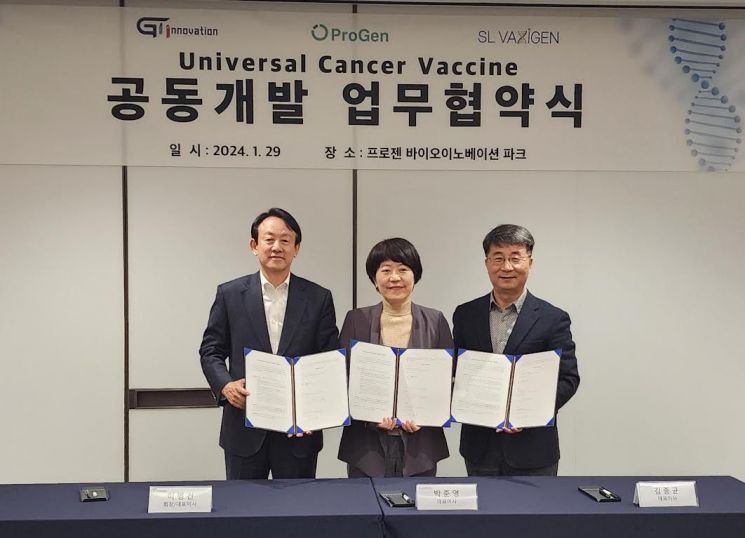 On the 29th, Lee Byung-geon, CEO of GI Innovation, Park Jun-young, CEO of SL Vaxigen, and Kim Jong-gyun, CEO of Progen, are posing for a commemorative photo at the Universal Cancer Vaccine joint development business agreement ceremony held at Progen Bio Innovation Park.
 [Photo by GI Innovation]
Through this agreement, the three companies will initiate a Phase 2 clinical trial of the combination therapy of GI-101A and the DNA vaccine therapeutic 'PG-101' in patients with prostate cancer. The clinical trial will evaluate safety, tolerability, and preliminary efficacy by administering GI-101A and PG-101 in combination to up to 72 patients with metastatic prostate cancer who have failed existing standard treatments. Led by Dr. Jae-ryun Lee at Seoul Asan Medical Center, the first patient dosing took place on the 23rd at Seoul Asan Medical Center.
Recently, the industry has been attempting to enhance cancer treatment efficacy by combining immuno-oncology drugs with cancer vaccines. Moderna's 'mRNA-4157/V940,' the only mRNA cancer vaccine to have reached Phase 3 clinical trials, is also conducting trials in combination with Merck (MSD)'s immuno-oncology drug 'Keytruda' in the United States.
Accordingly, the three companies expect that co-administration of GI-101A, which enhances the proliferation capacity of anti-cancer immune cells, and PG-101, which effectively induces immune responses based on high prostate cancer specificity and immunogenicity, will increase immunotherapy efficacy and reduce side effects, thereby providing a new treatment option for prostate cancer patients.
GI-101A is a dual fusion protein possessing both 'CD80' and 'interleukin (IL)-2 mutant' functions simultaneously. It is expected to exhibit superior anti-cancer activity through higher induction of anti-cancer immune cell proliferation compared to competing drugs, with fewer side effects, making it suitable for combination with various immunotherapies.
PG-101 is a plasmid DNA (pDNA) vaccine applying SL Vaxigen's universal cancer vaccine technology. It induces prostate cancer-specific T cell immune responses. When the DNA vaccine is administered to the human body, it expresses target proteins in muscle cells, and when the immune system detects these target proteins, it activates immune cells that selectively attack cancer cells, leading to their destruction.
Dr. Jae-ryun Lee, Professor of Oncology at Seoul Asan Medical Center and leader of this clinical trial, stated, "In cases where next-generation androgen receptor-targeted therapies have failed, there have been very limited recommended drugs considering treatment efficacy and associated side effects. We expect that the combination of the DNA vaccine targeting prostate cancer-specific antigens and GI-101A, which has demonstrated anti-cancer effects by inducing immune cell proliferation through previous Phase 1 clinical trials, will show safe and excellent anti-tumor effects for patients."
© The Asia Business Daily(www.asiae.co.kr). All rights reserved.

















