Ministry of Employment Business Workforce Survey
Real Wage Growth Slows for Third Consecutive Month
Wages Rise 2.7% While Inflation Jumps 3.14%
Due to high inflation, the growth rate of real wages has slowed for three consecutive months, with real wages in November last year reaching about 3.3 million won, increasing by only 10,000 won compared to a year earlier.
According to the Business Labor Force Survey results announced by the Ministry of Employment and Labor on the 30th, the average monthly total wage per worker at businesses with one or more regular employees as of November last year was 3,714,000 won, up 3.6% from the same month the previous year.
Regular employees received wages of 3.93 million won, up 3.8%, while temporary and daily workers earned 1.86 million won, up 5.4%.
By business size, workers at businesses with fewer than 300 employees received wages of 3,387,000 won, up 2.8%, and workers at businesses with 300 or more employees received wages of 5,319,000 won, up 5.7%.
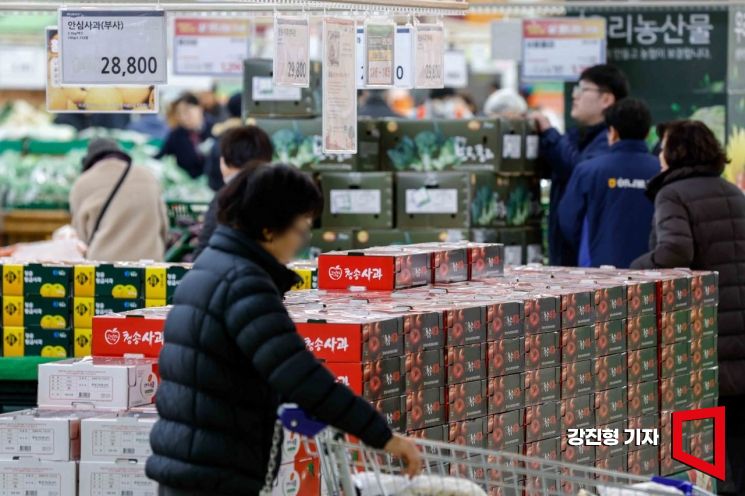 On the 24th, apple boxes were displayed at Hanaro Mart Yangjae branch in Seocho-gu, Seoul. According to a survey conducted by Korea Price Information, a professional price research organization, on the cost of ancestral rites tables at traditional markets and large supermarkets three weeks before Seollal, the cost for a four-person household this year was 281,500 won at traditional markets and 380,580 won at large supermarkets. This is the highest level ever recorded. In particular, prices of fruits and vegetables rose by more than 25%, driving up grocery prices. Photo by Kang Jin-hyung aymsdream@
The lower wage growth rate at businesses with fewer than 300 employees compared to those with 300 or more employees is due to an increase in workers in relatively lower-wage sectors such as health and social welfare, and changes or reductions in the timing of special payments in industries like information and communication and finance and insurance.
Considering inflation during the same period, real wages were 3,297,000 won, increasing by only 0.3% (10,000 won) compared to the same month the previous year.
Real wages, calculated by dividing nominal wages by the consumer price index and converting to a percentage, represent the actual value of wages. The growth rate of real wages, which had rebounded significantly in September last year due to the effect of increased special payments, slowed for three consecutive months at 1.9% in September, 0.6% in October, and 0.3% in November.
On a cumulative basis as of November last year, the average monthly total wage was 3,923,000 won, up 2.8% from the same month the previous year. Working hours were 156.5 hours, down 1.5 hours (0.9%). The total wage increase rate slowed compared to the previous year (5.1%) due to the high wage base from the previous year.
An official from the Ministry of Employment and Labor explained, "Although the number of working days per calendar month increased by one day compared to the same period last year, working hours decreased in sectors such as construction, accommodation and food services, and health and social welfare."
Cumulative real wages decreased by 0.9% to 3,519,000 won compared to the same period last year. This is interpreted as the effect of high inflation, which was 3.6% during this period, lowering the value of wages.
The number of workers employed at domestic businesses has increased year-on-year for 34 consecutive months since March 2021, but the rate of increase is slowing. As of the last business day of last month, the number of workers at domestic businesses with one or more employees was 19,823,000, an increase of 261,000 (1.3%) from 19,562,000 in the same month the previous year.
By industry, the number of workers increased by 99,000 (4.4%) in health and social welfare services and by 41,000 (3.2%) in professional, scientific, and technical services, but decreased by 12,000 (0.8%) in education services and by 1,000 (1.5%) in electricity, gas, steam, and air conditioning supply.
New hires last month, including newly employed workers, increased by 11,000 (1.3%) to 852,000 compared to the same month the previous year, while separations increased by 30,000 (3.1%) to 993,000.
The Business Labor Force Survey conducted monthly by the Ministry of Employment and Labor targets businesses with fixed workplaces, excluding agriculture and similar sectors. Workers in household service industries without fixed workplaces are excluded.
© The Asia Business Daily(www.asiae.co.kr). All rights reserved.

![Clutching a Stolen Dior Bag, Saying "I Hate Being Poor but Real"... The Grotesque Con of a "Human Knockoff" [Slate]](https://cwcontent.asiae.co.kr/asiaresize/183/2026021902243444107_1771435474.jpg)















