A Supreme Court ruling has established that in order to punish hoarding of masks in violation of government policy during the COVID-19 crisis, proof of 'profit-seeking intent' in addition to intent is required.
According to the legal community on the 29th, the Supreme Court's Second Division (Presiding Justice Cheon Dae-yeop) overturned the original ruling that sentenced Kim and others to a fine of 5 million won on charges of violating the Price Stabilization Act and remanded the case to the Busan High Court.
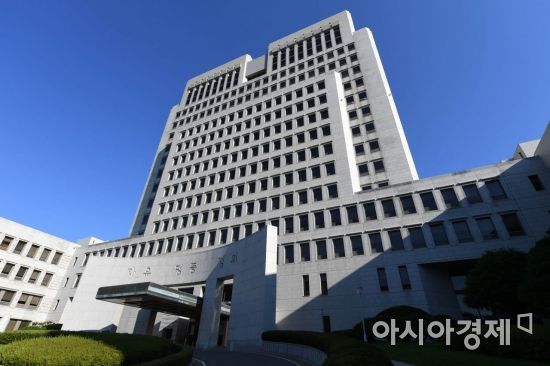
The court stated, "The original court's judgment contained errors that affected the verdict by misinterpreting the legal principles regarding 'profit-seeking intent' under Article 7 of the Price Stabilization Act and the timing of 'business commencement' under Article 5, Paragraph 1 of the relevant notification."
Kim was prosecuted along with his company for violating the government's emergency supply adjustment measures and prohibition of hoarding during the mask shortage caused by COVID-19.
Specifically, Kim was charged with selling approximately 436,000 KF94 health masks from February 12 to May 29, 2020, without approval from or notification to the Minister of Food and Drug Safety, amounting to about 924.3 million won, violating the emergency supply adjustment measures under the Price Stabilization Act.
From February 12 to March 5, 2020, when selling 10,000 health masks to the same buyer on the same day, notification to the Minister of Food and Drug Safety was required. From March 6 of the same year, notification was required when selling 3,000 or more health masks to the same buyer on the same day, and approval was required when selling 10,000 or more.
Kim was also charged with violating the prohibition of hoarding under the Price Stabilization Act by purchasing 32,000 KF94 health masks between April 24 and 27, 2020, and storing 12,000 masks in his office for 77 days until July 14 of the same year without selling them within ten days.
According to the designation by the Minister of Strategy and Finance at the time, businesses newly engaged in mask sales after January 1, 2020, were prohibited from failing to return or sell masks within ten days of purchase.
The first trial court found Kim guilty on both charges and sentenced him and his company to a fine of 8 million won. Kim was also acquitted of charges related to violating the Improper Solicitation and Graft Act while serving as a member of the Gimhae City Council.
The court pointed out, "The government implemented emergency supply adjustment measures and prohibition of hoarding to stabilize mask supply amid the rapid spread of COVID-19, but the defendant sold masks without notification or approval and stored masks without returning or selling them for a long period, failing to cooperate with the effective implementation of government policy."
However, the court also noted, "The act of selling masks itself was not illegal, and there are mitigating circumstances as the defendant mistakenly believed that the buyers were local governments and thus not subject to notification or approval. Also, the prices at which the defendant sold the masks do not appear to exceed general market prices."
The second trial court acquitted Kim of some charges that the first trial court had found guilty and reduced the fines for Kim and his company to 5 million won.
The court found Kim guilty of selling approximately 310,000 health masks for about 767.2 million won without notifying the Minister of Food and Drug Safety, as alleged by the prosecution. The charge of failing to return or sell 12,000 masks for 77 days was also upheld as guilty, consistent with the first trial.
The second trial court also stated, "The defendant did not cooperate with the effective implementation of government policy," but added, "It does not appear that the defendant obtained excessive profits through violations of the Price Stabilization Act."
However, the Supreme Court's judgment differed.
The court first dismissed Kim's appeal regarding the violation of emergency supply adjustment measures under the Price Stabilization Act, stating that it was inappropriate to accept the appeal as it pertained to the selection of evidence and factual findings.
On the other hand, the Supreme Court found two issues with the second trial court's guilty verdict on the prohibition of hoarding violation.
First, at the time of Kim's actions, the relevant notification distinguished between businesses that had been selling masks before January 1, 2019, those newly engaged after January 1, 2019, and those newly engaged after January 1, 2020, setting different standards for judging hoarding. The second trial court judged Kim as a 'new business operator after January 1, 2020,' reasoning that there was no evidence that Kim held mask inventory or generated mask sales before December 31, 2019. However, the Supreme Court found that there was room to consider Kim's claim that he had started mask sales before January 1, 2020.
The court cited that Kim had supplied and sold at least 456,000 masks to public institutions or government offices from January 31, 2010, to May 2020, and that in October 2019, he registered goods to sell masks on the Korea ON-line E-Procurement System (KONEPS) operated by the Public Procurement Service and even signed a multiple supplier contract. However, due to the Public Procurement Service's suspension of procurement sales following the government's emergency supply adjustment measures, the contract was collectively canceled.
Additionally, the court found a problem with the second trial court's easy acceptance of Kim's 'profit-seeking intent' in recognizing guilt for violating the prohibition of hoarding under the Price Stabilization Act.
The court stated, "The crime of violating the prohibition of hoarding under the Price Stabilization Act is an intentional crime requiring the subjective element of 'profit-seeking intent' beyond mere intent, and 'profit-seeking intent' is required separately from intent and must be strictly proven."
It added, "The burden of proof for 'profit-seeking intent' lies with the prosecution, and the mere fact that the actor engaged in hoarding as defined by the notification cannot be presumed to indicate profit-seeking intent."
The court further noted circumstances that made it difficult to view Kim as hoarding or avoiding sales with profit-seeking intent, including: supplying and selling approximately 456,000 masks to public institutions or government offices from January 31, 2010, to May 2020; efforts to lawfully sell and supply masks, such as sending sales advertisement text messages around March 2020 to medical institutions in Gyeongnam stating 'mask supply is possible' after hearing that surgeries were being canceled due to mask shortages; the sales prices offered to medical institutions were not significantly different from market prices at the time; the purchase prices of masks listed in the indictment were 1,940 or 1,960 won, while the sales prices for about 350,000 masks supplied to public institutions or government offices ranged from 1,200 to 2,500 won.
The court concluded, "Given that investigations into mask sales began around March 2020, and that the Public Procurement Service's suspension of procurement sales and collective cancellation of existing multiple supplier contracts occurred, it cannot be ruled out that the defendants were unable to fully sell the masks they secured and purchased, or that this was the main cause of the usual sales delay."
© The Asia Business Daily(www.asiae.co.kr). All rights reserved.

















