Speed of Subsidy Approval Before November Election
Approval Expected in March... Samsung Also a Strong Candidate
U.S. President Joe Biden, who is seeking re-election this November, is reportedly set to approve subsidies worth billions of dollars for semiconductor factory construction within the next few weeks to highlight the achievements of his economic policy, 'Bidenomics.' This move aims to secure votes ahead of the presidential election, and the previously stalled U.S. government semiconductor subsidy efforts are expected to gain momentum.
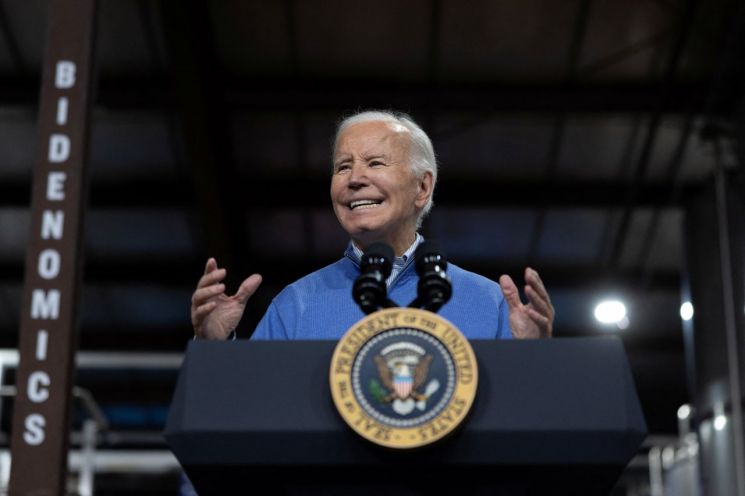
On the 27th (local time), the Wall Street Journal (WSJ), citing industry sources, reported that the Biden administration will approve funding support for major semiconductor companies such as Intel and TSMC to build new factories.
The announcement is likely to come just before President Biden's State of the Union address scheduled for March 7. The subsidies, amounting to billions of dollars, will target advanced semiconductor production related to smartphones, artificial intelligence (AI), and weapons systems.
This is part of the CHIPS and Science Act (CSA) implemented by the Biden administration since August 2022. The U.S. has decided to provide $53 billion (approximately 71 trillion won) in subsidies to companies building semiconductor factories domestically. However, after a year and a half, only two out of about 170 companies that applied for subsidies have received funding. With President Biden ramping up promotion of his economic policies ahead of the election, the pace of semiconductor subsidy payments is expected to accelerate.
Currently, Intel is investing more than $43.5 billion (approximately 58 trillion won) in Arizona, Ohio, New Mexico, and Oregon, while TSMC is investing $40 billion (approximately 54 trillion won) to build a semiconductor factory in Phoenix, Arizona. Samsung Electronics is also investing $17.3 billion (approximately 23 trillion won) to build a factory near Dallas, Texas.
Among these, the states where Intel and TSMC are building factories, such as Arizona and Ohio, are traditional U.S. swing states. For President Biden, whose approval ratings are lower than former President Donald Trump’s, it is urgent to release subsidies to win votes in these battleground states. According to a WSJ poll conducted last month, only 30% of voters viewed Bidenomics positively, while over 50% viewed it negatively.
William Reinhart, Senior Research Fellow for Technology and Innovation at the American Enterprise Institute, a U.S. think tank, analyzed, "There is clear pressure to provide funding to major companies before the situation overheats."
However, there are also forecasts that it will take longer than expected to build semiconductor factories in the U.S. due to a shortage of semiconductor specialists and stringent conditions for receiving U.S. subsidies. Some analyses suggest that by 2030, the shortage of semiconductor specialists will reach 67,000. Additionally, TSMC postponed the start of operations at its second Arizona plant from 2024 to the first half of 2025, citing uncertainty over U.S. government subsidy payments.
John Berway, Security and Technology Advisor at the Pacific Northwest National Laboratory (PNNL), said, "If TSMC builds semiconductor factories in Taiwan or Japan, they can complete the work faster than in the U.S. The lead time (which is relatively long in the U.S.) and the alternatives companies have are the main reasons for delays in semiconductor factory construction."
© The Asia Business Daily(www.asiae.co.kr). All rights reserved.
![Clutching a Stolen Dior Bag, Saying "I Hate Being Poor but Real"... The Grotesque Con of a "Human Knockoff" [Slate]](https://cwcontent.asiae.co.kr/asiaresize/183/2026021902243444107_1771435474.jpg)











