China Surpasses Korea and Japan in NCM Patent Counts
CATL Also Increases High-Nickel Export Share
Oversupply in China Intensifies Competition with Korean Companies
Analysis shows that Chinese battery companies are rapidly catching up with Korean companies not only in lithium iron phosphate (LFP) batteries but also in ternary (NCM, NCA, etc.) batteries, where Korean companies have traditionally held strengths. It is pointed out that Korean battery companies need to secure breakthrough technologies to maintain global competitiveness.
Choi Jae-hee, a senior researcher of the China team at the Korea Institute for International Economic Policy, stated at the "2024 Electric Vehicle Battery Industry Outlook and Next-Generation Battery Development Technology Conference" hosted by the Korea Future Technology Education Institute on the 25th, "China is actively promoting research and development in the ternary battery sector and has overwhelmingly surpassed Korea and Japan in the number of related patent applications."
In fact, as of 2021, China filed 4,178 NCM battery patents, far exceeding Korea's 246, the United States' 273, and Japan's 435. Regarding next-generation battery patent applications by country, the China National Intellectual Property Administration received a staggering 9,625 patent applications in 2021, while the Korean Intellectual Property Office had only 204. The Japan Patent Office had 310, and the United States Patent and Trademark Office had 1,544.
Unlike the United States, where the Inflation Reduction Act (IRA) has raised entry barriers, Chinese companies are expanding their presence in Europe not only in LFP but also in ternary batteries. From January to July 2023, Chinese companies' market share in the European electric vehicle battery market rose significantly to 40.1% from 34% the previous year. Meanwhile, Korea's share declined from 63.5% to 57% during the same period.
In particular, in the high-nickel battery segment within the European market, China's share reached 45%, closely trailing Korea's 55%. CATL's share of high-nickel (NCM811) ternary batteries sold in Europe stands at 57%, surpassing mid-nickel types such as NCM523 (34%) and NCM622 (9%). Researcher Choi analyzed, "Excluding premium products like NCM9, China's technological level has become similar to Korea's."
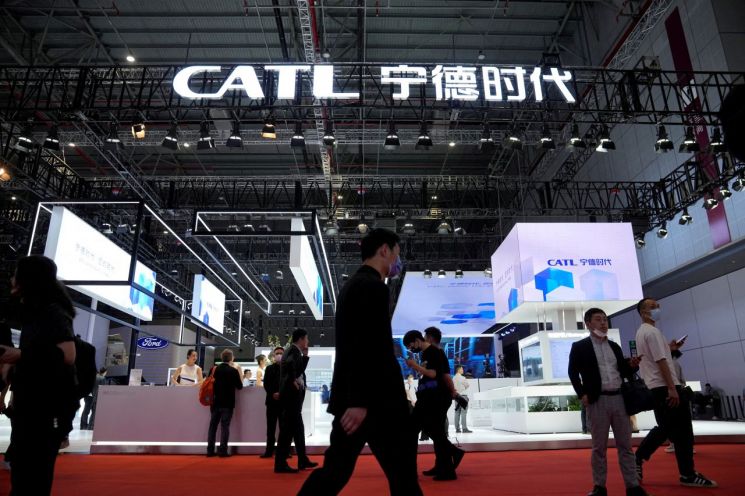 On April 18, 2023, visitors are passing in front of the CATL exhibition hall at the Shanghai Motor Show. Photo by Reuters Yonhap News
Chinese companies' overseas market expansion is rapidly progressing in conjunction with the oversupply situation in their domestic battery market. Researcher Choi said, "Due to oversupply in the Chinese market, Chinese battery companies are accelerating their overseas expansion, intensifying competition with Korean companies in the global market."
Battery supply in China is increasing rapidly compared to demand. As of 2023, the number of battery companies registered in China reached 80,000, with more than half registered after 2023. The ratio of installed capacity to production volume of electric vehicle batteries in China sharply declined from 70% in 2021 to 54% in 2022 and 51% in 2023. In the first quarter of 2023, major material companies' factory operating rates in China remained at 40-60%.
Researcher Choi noted, "As of October 2023, more than half of the 27 battery companies listed on China's A-share market recorded decreased sales or net losses compared to the same period last year," adding, "Many Chinese battery companies are undergoing large-scale restructuring through mass layoffs." CALB, the third-largest battery company in China, recently cut employee salaries and laid off about 5,000 workers due to decreased orders.
China's top company, CATL, is also reportedly struggling with inventory pressure caused by oversupply. CATL's inventory in 2023 increased 12.6 times compared to 2019. Last year, its factory operating rate plunged to 60.5%.
Chinese companies are particularly focusing on the European market. Europe does not apply discriminatory regulations against investments by non-EU companies, including Chinese firms, making it easier for Chinese companies to enter compared to the United States. EU member countries such as Hungary are actively attracting non-EU companies. Chinese companies' plans to build production capacity in Europe are estimated to exceed 300 gigawatt-hours (GWh).
Researcher Choi pointed out, "Chinese companies are rapidly expanding their market share not only in affordable LFP but also in the high-nickel market, so Korean companies cannot be complacent." He advised that Korean companies should ▲secure LFP-related technology and personnel in the short term, and ▲expand investment in upstream sectors (core raw material mining and refining) and stabilize supply chains in the long term to reduce dependence on China.
© The Asia Business Daily(www.asiae.co.kr). All rights reserved.

















