The special law for the Dalbit Railroad connecting Gwangju and Daegu passed the National Assembly plenary session on the 25th. Although the originally specified 'high-speed, double-track' was excluded, the content exempting the preliminary feasibility study (PFS) by the Ministry of Economy and Finance was included.
According to the National Assembly, at the plenary session held that afternoon, the 'Special Act on the Construction of the Dalbit Railroad' was passed with 211 votes in favor, 1 against, and 4 abstentions out of 216 members present. This bill was originally proposed by Yoon Jae-ok, floor leader of the People Power Party, in August.
The Dalbit Railroad is a railway connecting Gwangju Metropolitan City and Daegu Metropolitan City. Its name is derived from the first letters of Daegu's old name 'Dalgu-bul' and Gwangju's pure Korean word 'Bitgoeul.' The Dalbit Railroad special law has faced criticism as a 'populist bill for election purposes' because it includes exemption from the PFS under the pretext of balanced national development and resolving regional conflicts.
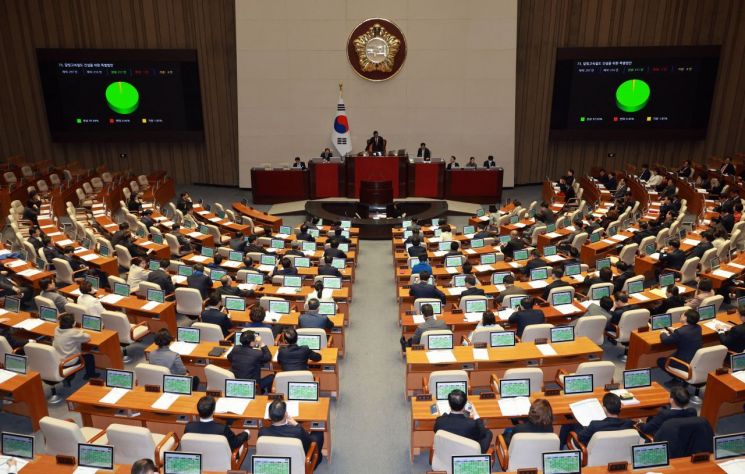
According to the bill, the clause specifying 'high-speed, double-track' railway was revised. The term 'high-speed' was removed from Dalbit High-Speed Railroad, and the name was changed to Dalbit Railroad. The 'double-tracking' was also deleted from the basic direction of the construction project. Additionally, to systematically develop the station area of the Dalbit Railroad, it allows for the designation of station area development zones and the promotion of station area development projects.
The Dalbit Railroad is targeted to be completed by 2030. Once the railway opens, it is expected that travel from Gwangju to Daegu will be possible within about one hour.
© The Asia Business Daily(www.asiae.co.kr). All rights reserved.
![Clutching a Stolen Dior Bag, Saying "I Hate Being Poor but Real"... The Grotesque Con of a "Human Knockoff" [Slate]](https://cwcontent.asiae.co.kr/asiaresize/183/2026021902243444107_1771435474.jpg)
















