Korean Drama Producers Association Holds Drama Industry Meeting
"Lead Actor Fees Have Risen to Unmanageable Levels"
"The lead actor's fee is no longer just a matter of billions won, but now 1 billion won per episode is becoming a reality, and it is time to find some kind of countermeasure."
"Some star actors limit the broadcasting platform at the time of contract signing, frequently change scripts on set, and even replace directors. In such situations, there are times when one feels a sense of self-doubt about what exactly a production company is."
Amid the global K-content boom, there is a growing call to establish a reasonable guideline for appearance fees to curb the skyrocketing drama production costs.
On the 25th, the Korea Drama Production Association announced that it recently held a roundtable meeting at its office in Sangam-dong, Mapo-gu, Seoul, to discuss the crisis in the drama industry and possible solutions. A common point raised by attendees was that the appearance fees of lead actors have risen to an unmanageable level, causing the drama production environment to shrink.
A broadcasting company official, Mr. A, who attended the meeting, mentioned the 1 billion won per episode fee for lead actors, saying, "Among the many issues that arise during various negotiations, actor appearance fees are always a problem." He pointed out, "Production companies are forced to pay hundreds of millions of won per episode to meet the demands of actors, who at least guarantee easier drama scheduling. This, in turn, creates a vicious cycle that further drives up production costs."
Production company representative Mr. B, who criticized the unreasonable demands of star-level celebrities, said, "While preparing a recent project and casting actors, the requested fees were 400 million won, 650 million won, and 700 million won per episode, respectively." He added, "Since payments are now mainly made through global OTT platforms like Netflix, there seem to be difficulties. In reality, the amounts paid are much higher than the figures seen in the media or articles." He continued, "I heard that in China, actor fees cannot exceed 40% of the total production cost, and lead actors' fees cannot exceed 70% of the total actor fees. Our country urgently needs a reasonable and healthy fee guideline for a sustainable ecosystem."
"Producing dramas with remaining budget after casting high-priced actors... leads to lower quality"
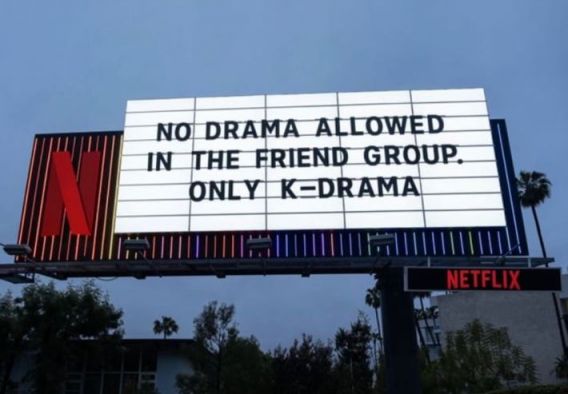 Netflix outdoor advertisement promoting Korean dramas in the United States. The phrase reads, "No dramas among friends. But except for Korean dramas."
 [Photo by Netflix]
Regarding the payment method, proposals were made to pay based on the period regardless of the number of productions, or to pay according to total shooting days or hours instead of per episode fees. Additionally, there was criticism that casting high-priced actors and producing dramas with the remaining budget results in less competitive works.
Production company representative Mr. C said, "The current project was cast with excellent actors found through a two-year audition process, and despite receiving positive reviews after the preview, the purchase price is being unreasonably lowered simply because the lead is not a star actor, which causes marketing difficulties." He pointed out the harsh reality. He emphasized that instead of relying solely on the popularity of star actors who command hundreds of millions of won per episode, more focus should be placed on boldly employing verified actors to enhance the completeness of the content.
The Korea Drama Production Association stated, "Due to the worsening situation of broadcasters, nearly 20 completed works are currently stranded. Approximately 300 billion won is tied up in these projects, which could cause significant damage to the industry." They also stressed, "It is urgent for related government agencies to step in and devise solutions."
© The Asia Business Daily(www.asiae.co.kr). All rights reserved.


















