Chicken Price Index Surpasses 120 in December Last Year
Hard to Find Chicken Under 20,000 Won
Subaba, Dangdang Chicken and Other Alternatives Gain Popularity
#A man in his 30s living in Seoul, a 'Jipgwanjok' (someone who watches games at home) named A, chose frozen chicken instead of delivery chicken on the 25th when the soccer match between Korea and Malaysia took place. Last week, his chicken order was canceled due to a backlog during the Jordan match, and the expensive chicken prices were also a burden. However, after cooking the frozen chicken using an air fryer, he found it convenient, affordable, and was highly satisfied with its crispy texture.
Chicken prices are soaring. A new term, 'Chickenflation' (chicken + inflation), has even emerged. Still, giving up chicken is difficult. Consumers, whose wallets have been tightened by high inflation, are turning to cost-effective frozen chicken or ready-to-eat chicken from large supermarkets as alternatives to delivery chicken.
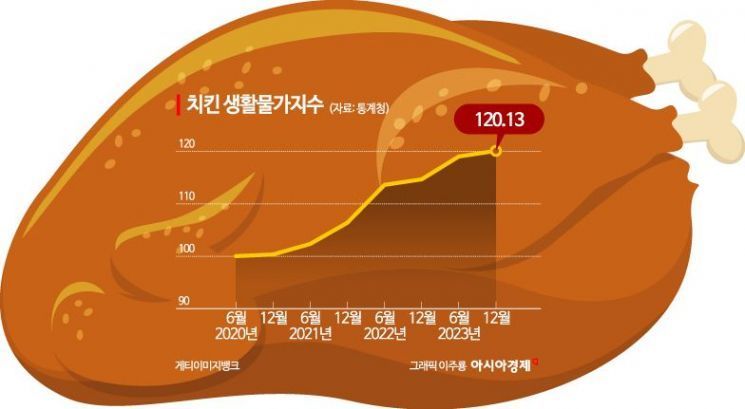
According to the National Statistical Portal of Statistics Korea on the 26th, the living cost index for chicken in December last year recorded 120.13. This means it rose more than 20% compared to the base year 2020. Compared to 114.69 a year ago, it increased by 4.74%.
Due to the actual increase in chicken prices, it is hard to find chicken menu items under 20,000 won at major brands. Kyochon Chicken's signature menu, 'Kyochon Honey Combo,' is 23,000 won, and BBQ's 'Golden Olive Chicken' is 20,000 won. Following Kyochon Chicken and BBQ, bhc's 'Bburinkle,' which raised prices in December last year, is 21,000 won. Chicken franchises each have their reasons for price hikes, citing significant increases in labor costs and raw material prices such as frying oil.
However, as high inflation continues, consumers who want to save even a penny are seeking alternatives to delivery chicken. That is frozen chicken. According to Nielsen Korea, the market size for the fried chicken category from January to September last year grew by 17.7% compared to the previous year.
A representative product that has rapidly emerged in this trend is CJ CheilJedang's 'Gourmet Sobaba Chicken,' launched in April last year. Sobaba Chicken achieved sales of 30 billion won within six months of its launch and reportedly reached 50 billion won last year. Its much lower price than delivery chicken attracted consumers. The price of Sobaba Chicken Soy Honey boneless sold at large supermarkets is 2,128 won per 100g, which is 41.8% cheaper than BBQ Soy Garlic boneless (3,018 won).
The crispy texture, which was hard to experience in existing frozen foods, also spread by word of mouth. CJ CheilJedang double-fries the chicken as if making it in-store and coats the sauce thinly and evenly to enhance the texture.
Homeplus's 'Dangdang Chicken' and ready-to-eat chicken sold independently at large supermarkets such as E-Mart and Lotte Mart are also popular. Last year, large supermarket chicken sales increased by around 20% compared to the previous year. The price of ready-to-eat chicken sold at large supermarkets is also relatively cheaper, ranging from 7,000 to 15,000 won compared to franchises.
An industry insider said, "In the era of high inflation, dining-out prices are so expensive that the demand for frozen chicken products is increasing. The downside of homemade fried chicken is sogginess, but recently, with higher research and development (R&D) levels and the increased penetration of air fryers, the fried chicken market is growing."
© The Asia Business Daily(www.asiae.co.kr). All rights reserved.

















