National Assembly Plenary Session to Open, Over 80 Bills Scheduled for Passage
The "Special Act for the Construction of the Dalbit High-Speed Railway," which was criticized as a 'populist' bill due to doubts about its cost-effectiveness and economic feasibility, has passed the plenary session. However, bills such as the one postponing the application of the Serious Accidents Punishment Act to workplaces with fewer than 50 employees are unlikely to be processed without a miraculous agreement between the ruling and opposition parties.
On the 25th, about 80 bills, including the Dalbit Railway Act connecting Daegu and Gwangju, are scheduled to be processed in the plenary session. This bill set a record for the highest number of co-sponsors in constitutional history, with 261 lawmakers participating in its proposal, but it was also criticized as a bill pushed forward without considering economic feasibility ahead of the general election. Despite the Ministry of Economy and Finance expressing opposition during the legislative review process regarding the exemption from preliminary feasibility studies, the bill passed the Land, Infrastructure and Transport Committee and the Legislation and Judiciary Committee. Once enacted through the plenary session, railway construction connecting Daegu and Gyeongbuk (Goryeong), Gyeongnam (Hapcheon, Geochang, Hamyang), Jeonbuk (Jangsu, Namwon, Sunchang), Jeonnam (Damyang), and Gwangju (Songjeong) with a total length of 198.8 km is expected to commence this year.
The plenary session will also consider the Special Act on Prevention of Insurance Fraud, which prohibits solicitation, inducement, encouragement, and advertising of insurance fraud and imposes penalties for violations.
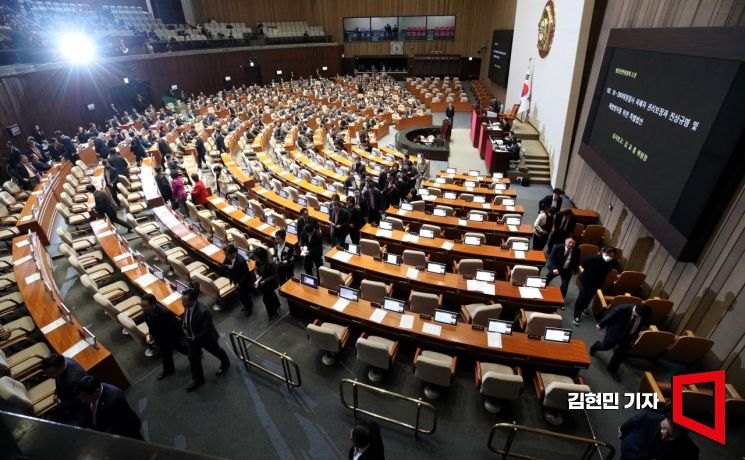 On the 9th, at the plenary session held in the National Assembly, members of the People Power Party are leaving ahead of the vote on the Itaewon Disaster Special Act. Photo by Hyunmin Kim kimhyun81@
Additionally, an amendment to the Framework Act on Small and Medium Enterprises, extending the grace period for SMEs to enter the mid-sized enterprise category from the current 3 years to 5 years, is expected to be processed in the plenary session. The purpose is to prevent the 'Peter Pan syndrome,' where companies remain classified as SMEs to continue receiving benefits such as tax support, participation in public procurement markets, and workforce support, despite being capable of growing into mid-sized enterprises, and to support the stable growth of newly established mid-sized companies.
A bill related to monopoly regulation and fair trade, which raises the sales threshold for exclusion from the presumption of market-dominant business operators from less than 4 billion KRW to less than 8 billion KRW, will also be presented in the plenary session. This adjustment reflects the fact that the presumption criteria for market-dominant business operators have not changed since 2007. To reduce the reporting burden and administrative costs for corporate mergers, the criteria for mergers between affiliated companies will be relaxed. Mergers between parent and subsidiary companies will be excluded from the corporate merger reporting requirements if there are no concerns about restricting competition.
© The Asia Business Daily(www.asiae.co.kr). All rights reserved.

















