86% of Survey Respondents Say They Will Join Collective Action if Medical School Expansion is Enforced
Medical residents are showing signs of collective action if the government forcibly expands the number of medical school admissions, raising concerns about a potential medical service gap. The hospital sector experienced significant difficulties during the residents' strike in 2020, which aimed to block the government's plan to increase medical school quotas.
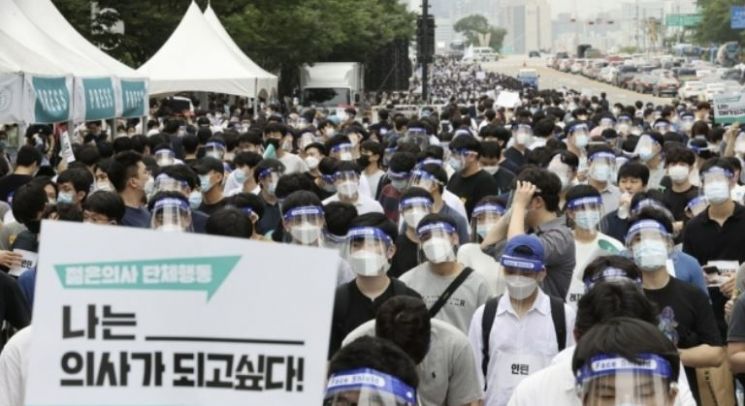 On the afternoon of August 7, 2020, at the entrance of Yeouido Park in Seoul, students affiliated with the Korean Intern Resident Association are taking collective action opposing the government's plan to increase the number of medical residents. [Image source=Yonhap News]
The Korean Intern Resident Association (KIRA) announced on the 21st that in a survey conducted over three weeks starting from the 30th of last month targeting residents, 86% of respondents said they would participate in collective action if the medical school quota expansion is enforced. This survey compiled results from individual surveys conducted at various hospitals. Among approximately 15,000 residents nationwide, about 4,200 residents from 55 training hospitals participated in the survey.
This is the first time that the residents' organization has explicitly mentioned intentions for collective actions such as strikes in response to the government's push to increase medical school admissions. KIRA is also discussing countermeasures with the Korean Medical Student Association (KMSA), a student organization of medical schools and medical graduate schools, and is coordinating schedules to hold an official emergency response meeting.
The Ministry of Health and Welfare immediately expressed regret. The ministry stated the day after KIRA's announcement, "The government plans to strictly enforce all necessary measures according to laws and principles against any illegal acts."
Previously, KIRA also went on strike in 2020 when the government attempted to expand medical school quotas. At that time, the participation rate in the collective suspension of work by the Korean Medical Association (KMA), mainly composed of private practitioners, was in the single digits, but the residents' strike participation rate approached 80%. The government eventually abandoned the expansion plan due to their opposition.
Notably, among the 55 hospitals participating in this survey, 27 have more than 500 beds, including two of the so-called "Seoul Big 5" hospitals. In large hospitals, if residents stop working, professors must take on residents' duties as well, making it difficult to properly conduct outpatient care and surgeries. This is why residents' collective actions have significant influence.
Medical residents refer to doctors who have completed their internship and undergo 3 to 4 years of training to qualify as specialists in various clinical fields. They are commonly called residents. They assist professors in medical treatment and surgeries, monitor the condition of hospitalized patients, and provide care under professors' supervision. According to the "Act on Improvement of Training Environment and Status of Medical Residents," residents can work (train) up to 80 hours per week. Even calculated over seven days, this means working about 11 to 12 hours per day. For educational purposes, an extension of up to 8 hours is allowed. Work exceeding 36 hours is prohibited, but in emergencies, continuous work of up to 40 hours is legally permitted.
In response, the hospital sector expressed concerns that medical service gaps caused by residents' collective actions would ultimately harm patients. A representative from a top-tier general hospital in Seoul said, "During the 2020 strike, elderly professors had to see patients at dawn, causing disruptions in patient care. If another large-scale collective action occurs, the damage will ultimately fall on the patients."
The Korea Hospital Association stated that residents' strikes are inevitably burdensome for hospitals and that they will monitor the situation. A representative said, "Since the government has taken a firm stance, we will first observe the situation. The most important thing is patient safety. We will assess the actual conditions of individual hospitals and consider countermeasures." They added, "If the collective action is short-term, it might be manageable, but if it prolongs, issues such as fatigue accumulation among replacement personnel could become serious."
Meanwhile, the Ministry of Health and Welfare plans to announce the scale of the increase in medical school admission quotas to be applied from the 2025 academic year around the Lunar New Year holiday.
© The Asia Business Daily(www.asiae.co.kr). All rights reserved.
![Clutching a Stolen Dior Bag, Saying "I Hate Being Poor but Real"... The Grotesque Con of a "Human Knockoff" [Slate]](https://cwcontent.asiae.co.kr/asiaresize/183/2026021902243444107_1771435474.jpg)
















