92.1% of Accidents Occur During Skiing Falls
Basic Training and Equipment Safety Inspections Needed
The Korea Consumer Agency recently issued a safety advisory, stating that cases of safety accidents while enjoying skiing and snowboarding are increasing.
According to the Consumer Agency on the 24th, a total of 1,234 skiing and snowboarding safety accidents were reported to the Consumer Injury Surveillance System (CISS) from 2019 to 2023. Since 2021, when the impact of COVID-19 subsided (111 cases), the number has increased every year, with 443 cases reported last year, an 86.9% increase compared to the previous year.
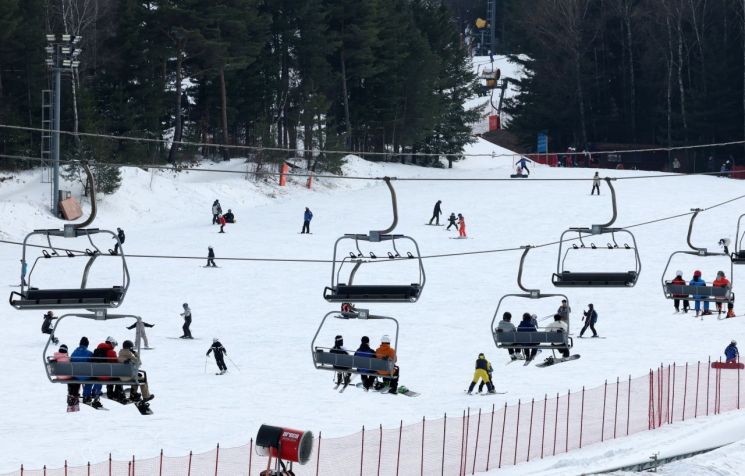 The Yongpyong Resort ski area in Pyeongchang-gun, Gangwon Province, is bustling with skiers and snowboarders. [Image source=Yonhap News]
Looking into the detailed causes of the reported cases, slipping or falling accidents accounted for 1,137 cases, making up 92.1% of the total. This was followed by collisions with 56 cases (4.5%), and sharpness or poor finishing with 13 cases (1.1%).
Analyzing safety accidents by age group for each item, both skiing and snowboarding occurred most frequently in people in their 20s. Specifically, by age group, skiing accidents were 257 cases (37.4%) in their 20s, 157 cases (22.9%) in their teens, 88 cases (12.8%) in their 30s, and 82 cases (11.9%) in their 40s. For snowboarding, 256 cases (48.7%) occurred in their 20s, 124 cases (23.6%) in their 30s, and 99 cases (18.8%) in their teens, with nine out of ten accidents occurring in the 10-30 age range.
Skiing and snowboarding showed differences in major injury areas when accidents occurred. In skiing accidents, injuries to the buttocks, legs, or feet were the most common at 32.8% (224 cases), followed by arm and hand injuries at 21.4% (146 cases), and head and face injuries at 20.1% (137 cases). Cases such as shinbone fractures caused by leg twisting during downhill skiing or wrist fractures from falling and bracing on the ground were also confirmed.
On the other hand, snowboarding injuries were most common in the arms or hands at 40.5% (213 cases), followed by head or face injuries at 25.5% (134 cases), and neck or shoulder injuries at 17.3% (91 cases). Cases such as forearm fractures from falling forward while descending the slope or concussions from falling backward were also reported.
The Consumer Agency advised that since most skiing and snowboarding accidents are caused by slipping or falling, using slopes appropriate to one’s skill level and learning how to fall safely can help prevent injuries. They also emphasized the need for maintenance and inspection of essential equipment such as ski boots and bindings, given the characteristics of skiing and snowboarding.
A Consumer Agency official urged, "To prevent safety accidents, basic training on direction changes, speed control, and falling techniques should be received before skiing or snowboarding, and when trading secondhand equipment, avoid transactions involving aged equipment that has deteriorated."
© The Asia Business Daily(www.asiae.co.kr). All rights reserved.

















