The interest rates on demand deposit accounts (commonly known as parking accounts), which gained popularity amid expectations of the end of monetary tightening, are on the decline. This is a result of market interest rates falling rapidly due to expectations of a base rate cut.
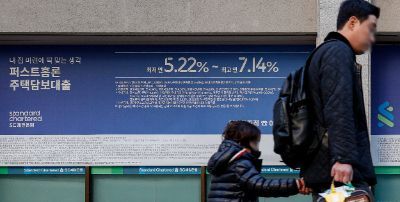 On the 21st, a notice about mortgage loan interest rates was posted at a commercial bank in Seoul. Photo by Jinhyung Kang aymsdream@
According to the financial sector on the 24th, SC First Bank will lower the base interest rate of its representative parking account product, 'First EZ Account,' by 0.5 percentage points from 2.6% per annum to 2.1% per annum starting next month on the 1st. Accordingly, the maximum interest rate for this product will also be adjusted from 3.6% per annum to 3.1% per annum from next month.
The First EZ Account offers new SC First Bank customers a preferential interest rate of 1 percentage point for six months up to a limit of 3 million KRW, providing the highest interest rate level among parking accounts at commercial banks, which made it popular. The reason SC First Bank decided to cut the interest rate on this product lies in the rapidly declining market interest rates.
The one-year bank bond rate, considered the benchmark rate for one-year fixed deposits, was as high as 4.146% on November 1 last year but dropped significantly after the U.S. Federal Reserve (Fed) hinted at ending monetary tightening. As of the 22nd, it fell to 3.579%. This situation raises concerns about negative interest margins. An SC First Bank official explained, "Market interest rates have fallen faster than expected, and this is a response to that."
This is not limited to parking accounts alone. As of the previous day, the one-year fixed deposit (simple interest) rates at the five major commercial banks (KB Kookmin, Shinhan, Hana, Woori, NH Nonghyup) were surveyed to be at a maximum of 3.50% to 3.60% per annum. With the removal of bank bond issuance limits and the decline in market interest rates, banks have less incentive to attract deposits with high interest rates.
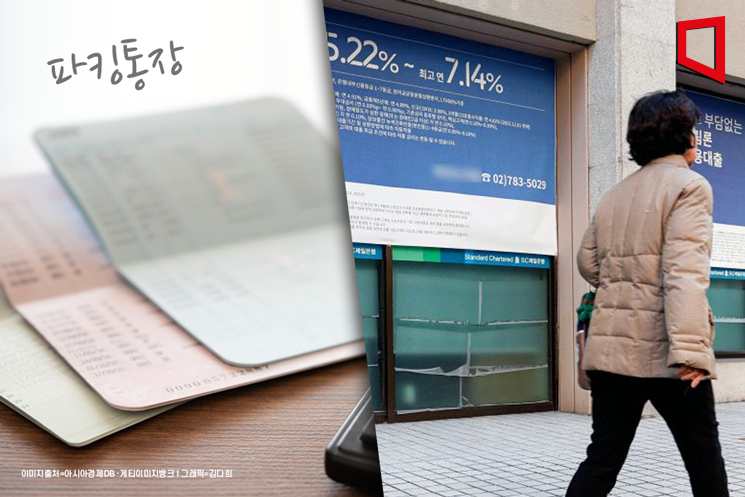
A similar phenomenon is occurring in the savings bank sector, which had enjoyed considerable benefits from parking account products. SBI Savings Bank, a leader in the industry, recently lowered the interest rate on its demand deposit accounts by 0.2 percentage points from 3.5% per annum to 3.3% per annum, and OK Savings Bank reduced the interest rate on its OK Eutbaekman Account from a maximum of 4.0% per annum at the end of last year to 3.5% (for 1 million to 5 million KRW), a 0.5 percentage point cut. Generally, savings banks attracted consumers with a gap of around 1 percentage point compared to commercial bank deposit products, but their fixed deposit products are currently hovering at an average of 3.84% per annum.
Since savings banks cannot practically raise funds through bonds, they would normally have to actively attract deposits. However, issues with asset quality accumulated during the COVID-19 pandemic and the real estate boom are holding them back.
As of the end of the third quarter last year, the delinquency rate in the savings bank sector was 6.15%, significantly higher than the banking sector's 0.39%. For savings banks, rather than aggressively expanding loans by attracting deposits at high interest rates, they are compelled to actively pursue the sale of delinquent loans.
A financial sector official said, "Even if the current base rate level is maintained for the time being, the possibility of rapid fluctuations in deposit interest rates in the financial sector is low," adding, "To prepare for the interest rate decline, it is advisable to keep an eye on remaining high-interest products or hold short-term deposits and watch the market conditions of other investment options such as securities."
© The Asia Business Daily(www.asiae.co.kr). All rights reserved.
![Clutching a Stolen Dior Bag, Saying "I Hate Being Poor but Real"... The Grotesque Con of a "Human Knockoff" [Slate]](https://cwcontent.asiae.co.kr/asiaresize/183/2026021902243444107_1771435474.jpg)












