Welcome from the perspective of securing management autonomy
However, "No immediate plans to increase"
Focus on non-face-to-face transition due to cost aspects
Savings banks can now open branches and sub-branches with only notification, without approval from financial authorities. The industry has welcomed this move as it secures management autonomy, but there are no immediate plans to increase the number of branches. Since expanding branches increases fixed costs, it is expected that these expenses will rather be invested in enhancing non-face-to-face services.
Since the 19th, savings banks have been able to establish branches with prior notification without approval from authorities. For sub-branches that do not directly handle deposit and loan operations, reporting to financial authorities after establishment is sufficient. Previously, savings banks needed approval from the Financial Services Commission to open branches and sub-branches. This was intended to prevent insolvency caused by excessive external expansion and to curb excessive competition among savings banks. This regulation applied only to savings banks.

The savings bank industry welcomes this as it secures management autonomy. One official stated, “If new branches are needed in the future due to mergers and acquisitions (M&A), failing to increase them in time could result in operational losses,” adding, “It is positive that the regulation has been lifted in advance to prepare for this.”
However, savings banks currently have no plans to increase the number of branches. In fact, there is a sense of reduction. SBI Savings Bank, the industry leader, will consolidate its Gangnam branch and Jeonju branch with nearby branches by the end of this month. OK Savings Bank also reduced its branches from 22 in September 2022 to 21 last September. The same trend is seen across the 79 nationwide savings banks. Since the current system of 79 savings banks was reorganized in June 2015, the number of branches and sub-branches combined has decreased from 249 to 197 as of last September, with a total of 52 branches disappearing.
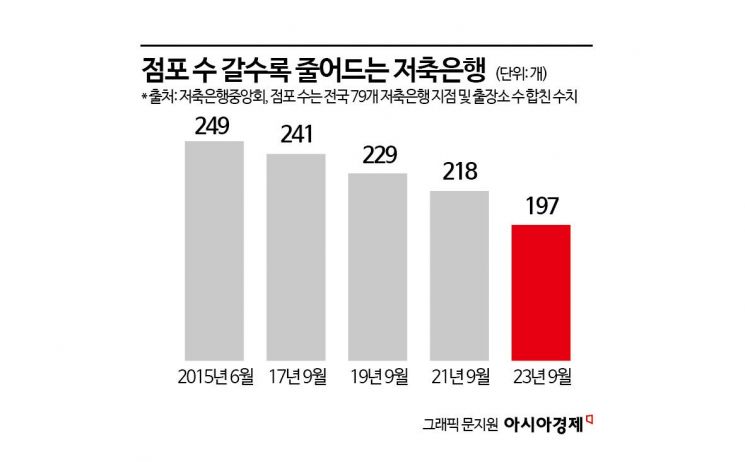
The reason savings banks are cautious despite deregulation is that they find it difficult to bear the increasing fixed costs. The more branches they open, the higher the fixed costs such as labor costs for additional staff and expenses required to operate branches. They are reluctant to increase the number of branches because there are many “places where money goes out.” For example, additional loan loss provisions for real estate project financing (PF) defaults by savings banks and other secondary financial institutions are a concern. Loan loss provisions refer to the process of recognizing some or all of the uncollectible non-performing loans as losses or expenses in advance.
The industry plans to focus on transitioning to online non-face-to-face services, which incur lower costs, rather than increasing offline branches for the time being. An industry official said, “Even the elderly now often use mobile banking, and to attract the demand of younger generations familiar with online services, we will advance non-face-to-face services.” According to a recent report published by Hana Financial Management Research Institute, the mobile banking usage rate of the Baby Boomer generation (born 1946?1965) increased by 6.9 percentage points from 73.8% in 2022 to 80.7% last year. Meanwhile, bank branch usage declined by 7.9 percentage points from 50.3% to 42.4% during the same period.
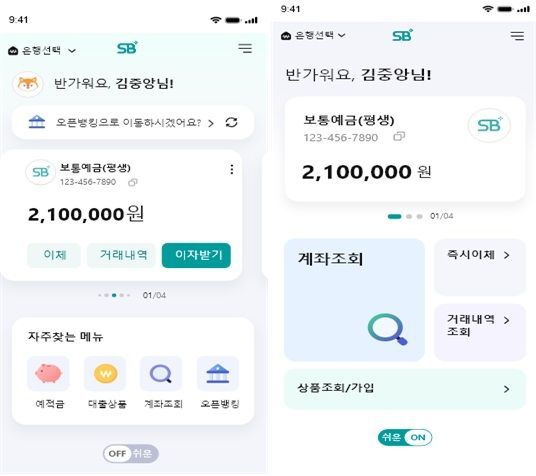 The exclusive application (app) 'SB Toktok Plus' of the Korea Federation of Savings Banks in general mode (left photo) and easy mode (right photo). [Photo provided by Korea Federation of Savings Banks]
The Korea Federation of Savings Banks, which gathers savings banks nationwide, has also launched a mobile web banking service and is enhancing its dedicated application (app) ‘SB TokTok Plus.’ Since the 15th, the service can be used without installing the app. Additionally, by introducing an ‘easy mode,’ the app not only increases font size but also improves visual accessibility for the elderly to check information more easily. The number of app subscribers surpassed 2 million, rising from 1,682,906 in January last year to 2,040,123 as of the 23rd.
© The Asia Business Daily(www.asiae.co.kr). All rights reserved.
![Clutching a Stolen Dior Bag, Saying "I Hate Being Poor but Real"... The Grotesque Con of a "Human Knockoff" [Slate]](https://cwcontent.asiae.co.kr/asiaresize/183/2026021902243444107_1771435474.jpg)


















