CSI300 Index Plunges to Lowest Level in 5 Years
Premier Li Chang Orders Effective Measures but
Skeptical Due to Lack of Substantial Stimulus Plan
Chinese Premier Li Chang emphasized stabilizing the local stock market and ordered the preparation of countermeasures. This comes as the CSI300, a benchmark index of large-cap stocks in China, has fallen to its lowest point in five years, with the stock market showing weakness day after day. However, some argue that the cause of the decline in Chinese stock prices is due to delayed economic recovery, and express skepticism that it will be difficult to raise stock prices without substantial stimulus measures.
According to China Central Television (CCTV) on the 22nd, Premier Li presided over a State Council executive meeting and ordered authorities to take stronger and more effective measures to stabilize the depressed stock market and investor confidence. At the meeting, Li stated, "We must further improve the basic system of the capital market, pay more attention to the balance between investment and financing, actively enhance the quality and investment value of listed companies, and increase the entry of medium-sized enterprises," adding, "We need to inject long-term funds into the market to strengthen fundamental stability, and strengthen capital market supervision to create a standardized and transparent market environment."
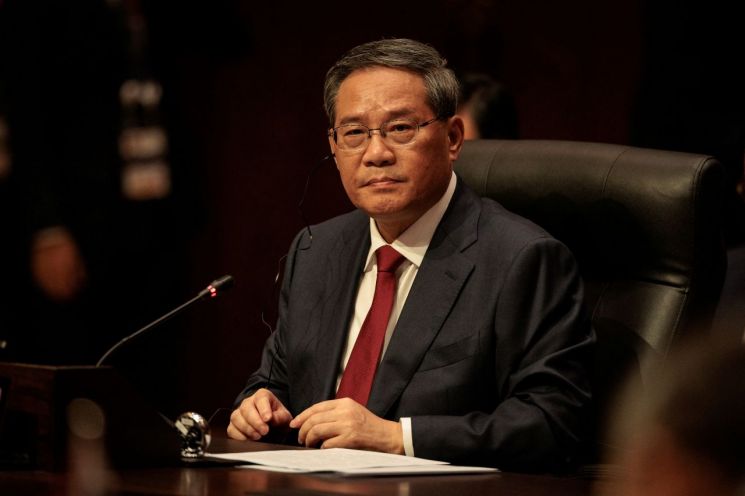
This is the second time since July last year that Premier Li has mentioned capital market measures at a State Council executive meeting. At that time, he also emphasized the need to revitalize the capital market and boost investor confidence.
Earlier, the CSI300 index, composed of large-cap stocks from the Shanghai and Shenzhen stock exchanges, closed at 3,218.90, down 1.56% from the previous trading day. This is the lowest point in five years since January 31, 2019 (3,201.63), before the outbreak of COVID-19. China’s Pengpai News quoted Chen Guo, Chief Strategy Officer at CITIC Securities, saying, "(Premier Li’s) remarks will help increase investors' investment preferences," calling it a "clear policy signal."
However, outside observers largely attribute the weakness and sell-off in the Chinese stock market to various factors such as delayed economic recovery, persistent deflationary pressures, and the real estate crisis. This is why skepticism arises that without decisive stimulus measures, it will be difficult to alleviate investors' concerns.
Gabriel Wildau, Managing Director of New York-based consulting firm Neteo Holdings, told Bloomberg News, "There was no indication of any special measures that could fundamentally change market expectations," adding, "It has become clear that Chinese President Xi Jinping does not view major stock indices as key indicators to gauge the success or failure of economic strategy." David Koo, an analyst at Bloomberg Intelligence, diagnosed, "Slow recovery is the fundamental cause of the stock price decline," and emphasized, "It is important for the government to introduce strong measures to quickly reverse the sentiment."
Although demands for strong economic stimulus are being raised both domestically and internationally, China still appears to be holding back its policy cards. On the same day, the People's Bank of China, the country's central bank, announced it would keep the Loan Prime Rate (LPR), which effectively serves as the benchmark interest rate, unchanged. The 1-year LPR linked to general loans remains at 3.45% per annum, and the 5-year LPR linked to mortgage loans remains at 4.20% per annum. Since announcing on August 21 last year a 0.1 percentage point cut to the 1-year LPR after two months and keeping the 5-year LPR unchanged, the LPR has not been adjusted for five consecutive months since September. Won Bin, Chief Economist at China Minsheng Bank, evaluated, "In the short term, there was no urgent situation to lower interest rates, and currently there is still a need to maintain exchange rate stability."
© The Asia Business Daily(www.asiae.co.kr). All rights reserved.
![Clutching a Stolen Dior Bag, Saying "I Hate Being Poor but Real"... The Grotesque Con of a "Human Knockoff" [Slate]](https://cwcontent.asiae.co.kr/asiaresize/183/2026021902243444107_1771435474.jpg)
















