Mainichi Survey... 293,700 Double Care Population
90% Are in Their 30s and 40s... Career Breaks and Economic Burdens Also
In Japan, the so-called 'double care,' where individuals simultaneously support both children and elderly parents, is being identified as a new factor contributing to the low birthrate. As women in their 30s and 40s facing double care situations increasingly give up on having children, the Japanese government is also struggling to devise countermeasures.
On the 22nd, Mainichi Shimbun reported that, based on an independent analysis commissioned from the Tokyo Statistical Center, the population engaged in 'double care'?simultaneously raising children and providing elder care?was estimated at 293,700 nationwide as of 2017. This means that one out of every 38 people raising children is also responsible for caring for elderly parents or older generations.
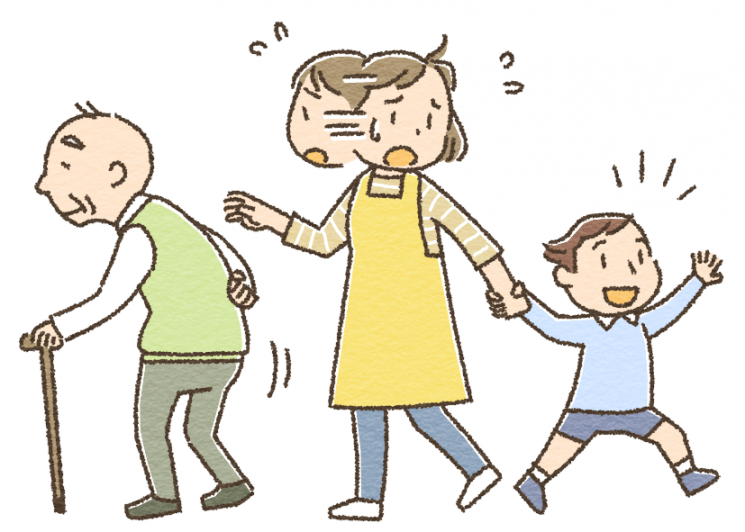
The double care population in Japan has steadily increased over the past five years. According to the Cabinet Office's 2016 report based on the 2012 population census, the double care population was 253,000, indicating an increase of about 40,000 over five years. However, Mainichi pointed out that "the survey limits childcare to preschool-aged children, so the actual double care population is likely to be even higher."
Double care is also a cause of career discontinuation. Among those in double care situations, 203,700 have experienced job changes in the past, and 35% of them cited childcare and caregiving as the reasons.
The economic burden is also increasing for women who have quit their jobs entirely and become full-time homemakers. Among the 293,700 double care population, 29% were unemployed without a job. However, 70% of the unemployed expressed a desire to work. Half of those wishing to work said it was "because they need to earn income." Even among those who reported having a job, 33% were in non-regular employment such as part-time or temporary work. When limited to women bearing the brunt of double care responsibilities, the rate of non-regular employment rises to 54%.
Mainichi introduced the case of Kayo Otani, who simultaneously cares for her two elementary school children, her bedridden mother, and her father with progressing dementia. Born as an only daughter, Otani married at 35 and was raising two children when her mother became bedridden due to an incurable disease and unable to walk, confronting her with double care. With no siblings to share the responsibility, she single-handedly manages the nursing care for both parents.
Otani sees her husband off at 5 a.m., finishes household chores such as laundry, sends her children to school, then goes to her parents' home to assist her mother with bathroom needs and all nursing care. In the afternoon, she works a part-time job at a convenience store for a short time. After returning home, she prepares dinner, helps her children with homework, and brings the prepared dinner to her parents' home, ending her day. She said, "I often cry wondering why only I have to be in this situation."
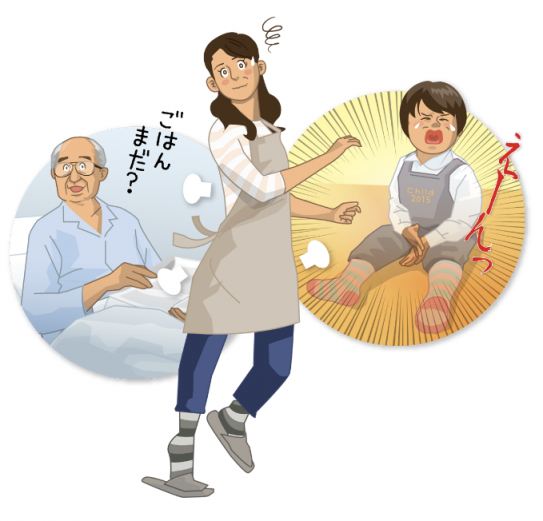
Mainichi pointed out that "double care ultimately reflects changes in Japan's social structure and is a microcosm of modern Japanese society." Due to aging, the number of elderly people requiring nursing care in Japan is steadily increasing. The population recognized by the government rose from 2.56 million in 2000 to 6.9 million in 2021, tripling over 20 years. Additionally, as the age of first marriage and first childbirth rises, the period of parental caregiving overlaps with childcare.
Ultimately, Mainichi analyzed that double care is a phenomenon arising from the overlapping trends of long-standing low birthrate, aging population, and late marriage. Especially, while childcare allows time for family planning and preparation, caregiving occurs suddenly as a family member's health rapidly deteriorates, meaning double care situations arise without warning or preparation.
Japanese media have pointed out that low birthrate and aging should not be considered separately but require integrated countermeasures. Mainichi stated, "Double care is a downside of the vertical administrative system that separately supports welfare services for childcare and caregiving. Because the time to address both issues comprehensively has passed, necessary support is not reaching those in need. People struggling with double care often get pushed aside when seeking counseling, which ultimately deepens their sense of isolation."
Professor Hirofumi Watanabe of the Department of Social Welfare at Musashino University also emphasized, "Double care encompasses various challenges in modern Japanese society, including poverty, isolation, caregiving-related job resignation, and gender disparities. It is necessary to establish a cross-sectional system to provide meticulous support."
© The Asia Business Daily(www.asiae.co.kr). All rights reserved.


















