250,000 People Take to the Streets Across Germany to Protest
Chancellor Also Expresses Support, Calling It a "Noble and Rightful Act"
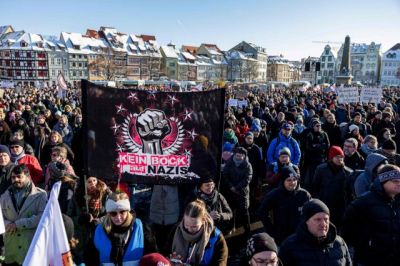
Opposition protests against far-right forces are gradually spreading in Germany. On the 20th, as many as 250,000 people poured into the streets to demonstrate.
Foreign media including AFP reported on the 20th (local time) that about 250,000 people across Germany, including Frankfurt, Hanover, and Dortmund, participated in protests against the far-right party Alternative for Germany (AfD). Another protest is scheduled in the capital Berlin on the 21st.
On the 10th, investigative media Correctiv reported that AfD members discussed plans to deport millions of immigrants from Germany together with extremists.
They held a meeting last November at a hotel in Potsdam to discuss immigrant deportation. Four AfD politicians attended the meeting, including Roland Hartwig, an advisor to AfD co-leader Alice Weidel and former member of the federal parliament, and current parliamentarian Gerrit Huy. Several neo-Nazis and activists from the far-right group Identitarian Movement (IB) were also present.
At the meeting, it was reported that if AfD came to power, plans to deport up to 2 million immigrants to North Africa were discussed.
As controversy erupted, AfD denied that the deportation plan was party policy. The AfD leadership drew a line by stating, "The meeting that day was not a party event but an informal gathering," but the situation escalated rapidly.
Protests demanding the dissolution of AfD continued daily, and a petition calling for the political expulsion of Bj?rn H?cke, AfD leader in Thuringia, gathered about one million signatures. The American CNN reported, "Germany's far-right AfD is facing growing protests related to the immigrant deportation plan."
Major politicians, including the Chancellor, joined the criticism, saying, "The immigrant deportation plan is an attack on German democracy." German Chancellor Olaf Scholz expressed support for the weekend protests in a video message on the night of the 19th, calling them "a wonderful and righteous act."
Recently, voices expressing concern over the rise of far-right forces have been growing in Europe. This is due to the unusual rise of far-right parties in key EU countries such as Germany and France. If the influence of the far-right grows in the European Parliament, significant changes are expected in EU policies on immigration and other areas.
AfD, which was founded in 2013 on an anti-EU platform, has recently seen a rapid rise in support riding on anti-immigrant sentiment in Germany. In the upcoming state elections in three former East German states scheduled for September, there is even speculation that AfD could produce a state premier for the first time.
© The Asia Business Daily(www.asiae.co.kr). All rights reserved.

















