Emergency Medical Reform Forum on the 19th at Hanbando Seonjinhwa Foundation, Jung-gu, Seoul
The medical community has raised its voice, stating that health insurance and medical reform must precede the expansion of medical school quotas to prevent the collapse of essential medical services.
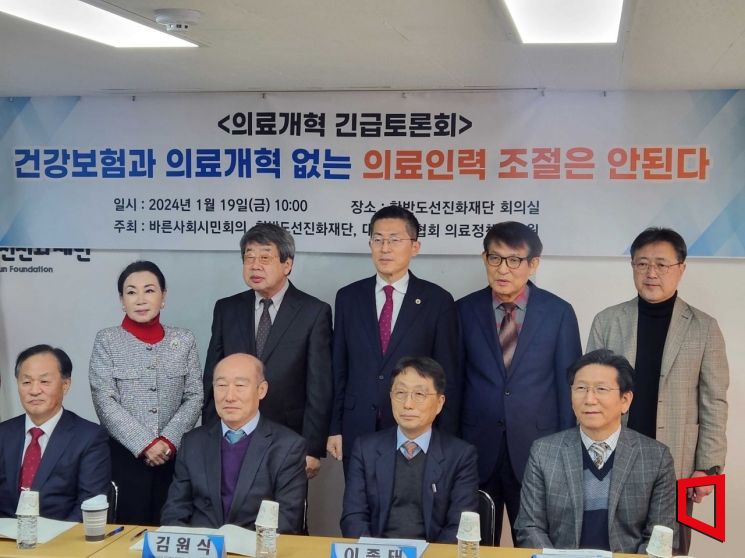 The Korea Medical Association Medical Policy Research Institute, the Barun Society Citizens' Coalition, and the Korean Peninsula Advancement Foundation held an urgent medical reform forum on the 19th at the Korean Peninsula Advancement Foundation in Jung-gu, Seoul, under the theme "Adjusting Medical Personnel Without Health Insurance and Medical Reform Is Not Acceptable."
 Photo by Choi Taewon peaceful1@
On the 19th, the Korea Medical Association Medical Policy Research Institute, the Barun Society Citizens' Coalition, and the Korean Peninsula Advancement Foundation held an urgent medical reform forum titled "Adjusting Medical Personnel Without Health Insurance and Medical Reform Is Not Possible" at the Korean Peninsula Advancement Foundation in Jung-gu, Seoul. Participants from the medical community criticized the government policy for being fixated on expanding medical school quotas and argued that regional and essential medical issues should be resolved through comprehensive system improvements ranging from medical education to health insurance.
Professor Park Jong-hoon of Korea University Anam Hospital stated, "I would support increasing medical school quotas if it improved the avoidance of essential medical fields and the collapse of regional healthcare, but there is no possibility of that happening," and pointed out, "The claim that the cause of regional and essential medical problems is a shortage of doctors is a misdiagnosis." He continued, "The number of residency positions and applicants each year is almost a one-to-one ratio. However, popular specialties attract many applicants, while essential medical fields are avoided. This means the cause is not a shortage of doctors."
Professor Park explained, "The reason doctors do not go to areas outside the metropolitan region is also because patients are reluctant to use regional medical services," adding, "Since the integration of health insurance in 2000, the regional medical delivery system has collapsed, establishing a trend of avoiding regional healthcare. This is a problem caused by policy failure." He also emphasized that governance must be established before adjusting medical personnel. He said, "We have educated science and technology talents, but the top several thousand students end up going to medical schools. Even if they do, medical science does not advance. The reality is that the top 1st to 10th medical students all choose dermatology," and added, "If we increase medical school quotas by 1,000 now, top-tier university science and engineering students will all flock to medical schools. This means giving up future scientific talents."
Woo Bong-sik, director of the Korea Medical Association Medical Policy Research Institute, predicted side effects of expanding medical school quotas from the perspective of health insurance finances. Director Woo said, "With rapid aging, medical expenses are also soaring," and added, "Since the so-called 'Moon Jae-in Care' in 2017, the increase has accelerated." He further explained, "According to the National Assembly Budget Office, the health insurance financial balance will turn to a deficit in 2024, the accumulated reserves will be completely depleted by 2028, and the cumulative deficit will reach 61.6 trillion won by 2032."
He analyzed that an increase in the number of doctors would negatively impact health insurance finances. Director Woo said, "One of the biggest factors affecting medical expenses (health insurance finances) is the number of doctors. An increase of one doctor per 1,000 people is estimated to increase total medical expenditure by about 22%." He added, "If we try to increase doctors indefinitely, health insurance finances will collapse much earlier than the national pension, ultimately resulting in a health insurance premium bomb."
Lee Jong-tae, director of the Policy Research Institute at the Korean Association of Medical Colleges and Medical Schools, pointed out, "Even if medical students are increased, the conditions for education are insufficient." He said, "There is an absolute shortage of basic medical science professors. The number of professors in seven basic medical science subjects across medical schools nationwide decreased by about 80 from 2018 to 2022," and added, "The government's idea that education will be possible just by increasing the number of students is impossible."
Professor Lee also stated, "The evaluation criteria for tertiary general hospitals and the designation criteria for research-oriented hospitals are too focused on hospitals. Evaluation criteria should reflect investment in basic medical science and clinical practice education in medical schools," and argued, "Before asking why doctors needed by society are lacking, I want to question how much investment has been made in training such doctors. You reap what you sow."
He also emphasized the need for an independent permanent advisory body to establish a plan for medical personnel supply and demand. Professor Lee said, "It is necessary to establish an independent permanent advisory body with a majority of representatives from the medical community," and added, "A database related to the supply and distribution of doctors should be built to develop a medical personnel supply and demand prediction model, predict current and future shortages and surpluses of doctors, specialists, and sub-specialists, and establish governance for medical personnel planning."
© The Asia Business Daily(www.asiae.co.kr). All rights reserved.
![Clutching a Stolen Dior Bag, Saying "I Hate Being Poor but Real"... The Grotesque Con of a "Human Knockoff" [Slate]](https://cwcontent.asiae.co.kr/asiaresize/183/2026021902243444107_1771435474.jpg)











