First Debate... YouTube's 'Political Polarization' Issue
"Overwhelming Negative Comments... Many Hate Expressions"
Channels with High Subscribers and Views... Pro-Yoon or Pro-Myeong
The Future Great Union, which is promoting the establishment of a new party in the third zone, held a discussion on the issue of 'political polarization' occurring on YouTube. Suggestions were made that measures such as 'strengthening responsibility and ethics' are necessary to prevent the rampant hate speech that fosters division and the production of various conspiracy theories.
On the afternoon of the 18th, the Future Great Union held a political reform forum at the National Assembly Members' Office Building under the theme "YouTube and Party Politics, Regression to Hatred and Division." This was the first forum since the formation of the Future Great Union, with all co-chairpersons of the joint founding committee?Kim Jong-min, Park Won-seok, Lee Won-wook, Jung Tae-geun, and Jo Eung-cheon?attending. Committee Chairman Kim Jong-min introduced the event, saying, "This is a presentation of the results of months-long research with various experts on the impact of the online environment on politics," and added, "We organized this forum to explore solutions to various problems, including the recent intensification of political polarization on YouTube."
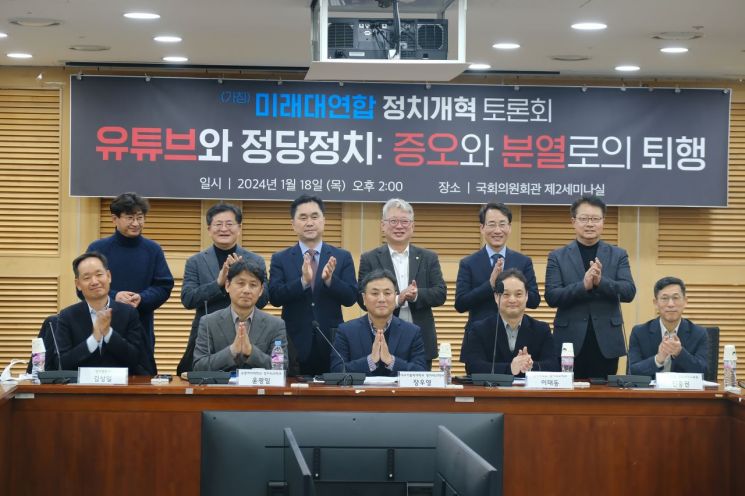 On the afternoon of the 18th, the Future Grand Alliance held a political reform forum at the National Assembly Members' Office Building on the theme of "YouTube and Party Politics, Regression to Hatred and Division."
 [Photo by Future Grand Alliance]
The forum was chaired by Professor Yoon Kwang-il of the Department of Political Science and Diplomacy at Sookmyung Women's University, and the presentation was delivered by Professor Jang Woo-young of the Department of Political Science and Diplomacy at Daegu Catholic University. Panelists included Professor Lee Tae-dong of Yonsei University's Department of Political Science and Diplomacy, Professor Jin Joong-kwon of Kwangwoon University's School of Information Science Education, and political commentator Kim Sang-il.
Professor Jang Woo-young presented the results of his research on political and current affairs YouTube channels from June 2021 to March of last year. He classified approximately 7 million comments on 270 videos from the top 110 political and current affairs YouTube channels by subscriber count into 20 clusters, finding that only four clusters were positive. Negative comments overwhelmingly dominated, and many posts included hate speech. In particular, the proportion of election fraud conspiracies and hate speech was very high, and a trend of increasing potential for the spread of false and manipulated information was confirmed.
Professor Jang also introduced findings from an analysis of channels with high subscriber counts and views on YouTube, revealing tendencies described as 'pro-Yoon' or 'pro-Myeong.' Additionally, an analysis of BigKinds media reports from January 2000 to March of last year detected growing conflicts not only between out-groups based on political camps but also within in-groups. It was pointed out that conflicts between different factions within the same party's support base are intensifying.
As alternatives to resolve this political polarization phenomenon, suggestions included ▲strengthening political responsibility and ethics ▲restoring political rationality ▲controlling political sign-based partisanship ▲enhancing political legitimacy against false and manipulated information, emphasizing the need for self-purification efforts within the political sphere. Furthermore, Professor Jang stressed, "Online platform operators should be incorporated into regulatory systems to enable the removal of malicious information."
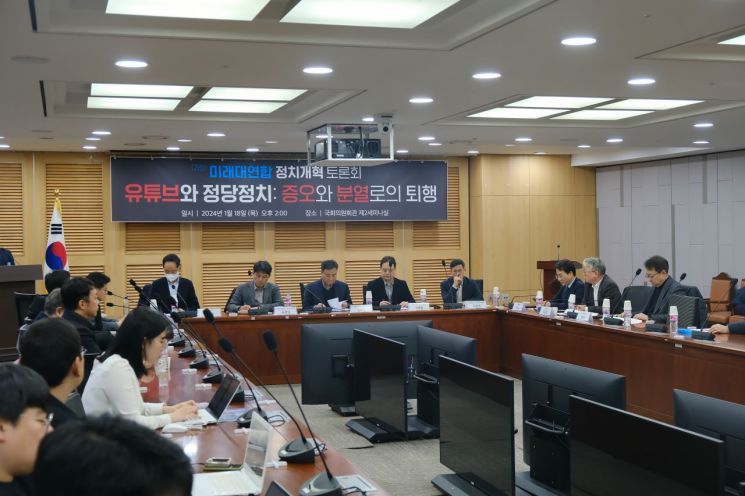 On the afternoon of the 18th, the Future Grand Alliance held a political reform forum at the National Assembly Members' Office Building on the theme of "YouTube and Party Politics, Regression to Hatred and Division."
 [Photo by Future Grand Alliance]
In the discussion, Professor Lee Tae-dong emphasized the urgency of research on 'how YouTube channels affect political polarization.' He stated, "It is important to study how much YouTube channels influence public perception and, based on that, establish various institutional measures."
Professor Jin Joong-kwon defined YouTube channels as part of the 'entertainment industry,' diagnosing that "YouTubers gain not only political influence but also economic benefits." He added, "To replace these YouTubers, it is necessary to actively create alternative media that satisfy entertainment desires and serve citizens tired of the extremes."
Political commentator Kim Sang-il pointed out, "Every profession has ethics, and there are institutions such as private associations that handle ethics," but "YouTubers have no (ethical standards or procedures)." He added, "It is necessary to create institutions that can handle YouTube ethics by linking them with existing social sectors."
© The Asia Business Daily(www.asiae.co.kr). All rights reserved.


















