KOSPI, Worst Performer Among Major Global Stock Markets Since Early Year
Declining Rate Cut Expectations, Poor Earnings, Weak Chinese Economy, and Geopolitical Risks Combine
Support at 2400 Level Possible but Adjustment May Prolong
At the end of last year, the KOSPI, which recorded the highest rate of increase among major countries' stock indices, fell to 30th place this year, plunging to the bottom ranks. This was because overlapping negative factors were excessively reflected, dragging down the stock prices.
According to the Korea Exchange on the 19th, the KOSPI's fluctuation rate ranked 30th out of 31 stock indices from 27 countries (the major 20 countries (G20) + Asia) as of the 16th of this year. During this period, the KOSPI fell by 5.94%, marking the second largest drop after the Hong Kong Hang Seng Index, which fell by 6.93%. The KOSDAQ fell by 1.35%, ranking 18th. The average fluctuation rate of the 31 indices was -0.09%, with both the KOSPI and KOSDAQ recording rates below the average.
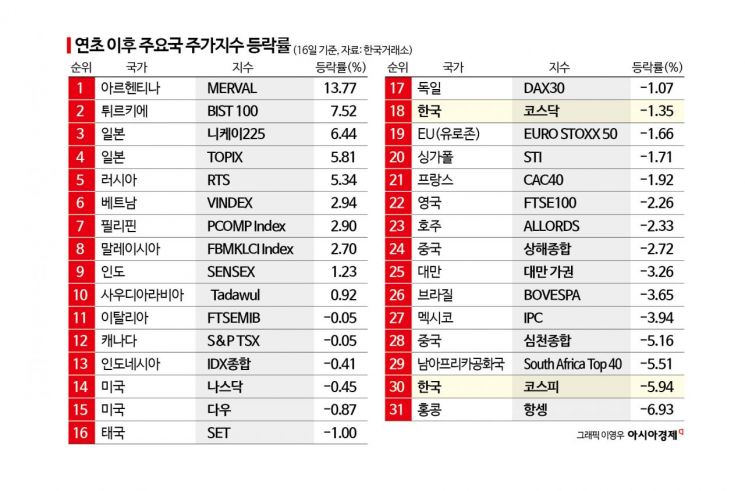
Argentina and T?rkiye (Turkey) stock markets, as well as Japan's Nikkei 225 and TOPIX, and the Russian stock market recorded increases of over 5%, ranking high in terms of growth rates. Meanwhile, the Hong Kong Hang Seng Index, KOSPI, South African stock market, China’s Shenzhen Composite Index, and the Mexican stock market remained in the lower ranks.
The atmosphere around the KOSPI is completely different from the end of last year. From November last year until the end of the year, the KOSPI's rate of increase ranked first among the major 7 countries (G7) and Asian countries. However, since the beginning of the new year, it has continued to decline, falling to the bottom ranks. Dropping below the 2450 level, the KOSPI has given back all the gains made in the previous two months.
Labor Gil, a researcher at Shinhan Investment Corp., said, "The domestic stock market has borne an unwelcome burden by recording the lowest returns among major countries' stock markets since the beginning of the year," adding, "The global stock market's decline since the start of the year is relatively shallow at 1.1%, so domestic stock market investors feel a relatively strong sense of deprivation."
The reason the KOSPI has performed worse than other major stock markets is that overlapping negative factors have prompted foreign investors to withdraw. Foreign investors have sold more than 6 trillion won in the futures market since the beginning of this year. The reduction in expectations for interest rate cuts, disappointing earnings from major companies, sluggish Chinese economy, and geopolitical risks have combined to act as negative factors for the stock market. Researcher Noh said, "Expectations for interest rate cuts diminished after the release of the U.S. Federal Open Market Committee (FOMC) minutes in December last year, and representative stocks such as Samsung Electronics, LG Energy Solution, and LG Electronics announced earnings below expectations for the fourth quarter of last year," adding, "The sluggish Chinese economy and the rise of geopolitical risks on the Korean Peninsula also affected foreign investor sentiment." He further explained, "The outflow of foreign capital has increased exchange rate volatility, and the heightened exchange rate volatility has accelerated foreign capital outflows, creating a temporary vicious cycle."
There is an analysis that vulnerability to external variables is becoming more pronounced. Kim Jung-yoon, a researcher at Daishin Securities, said, "In January, seasonal supply and demand influences have been maximized more than before, and after the preliminary earnings announcements of Samsung Electronics and LG Energy Solution, concerns about this year's earnings consensus (average securities firm forecasts) and increased volatility in the foreign exchange market have expanded, increasing the KOSPI's decline," adding, "In particular, in the foreign exchange market, complex factors such as heightened geopolitical risks in the Middle East, the retreat of early interest rate cut expectations by the U.S. Federal Reserve (Fed), and worsening Chinese economic instability are intertwined, revealing the vulnerability of the won-dollar exchange rate to external variables."
The KOSPI is expected to secure support around the 2400 level, but it is anticipated that it will take time to resolve the variables currently affecting the stock market, leading to a prolonged period of adjustment. Researcher Kim said, "The 12-month forward price-to-earnings ratio (PER) of 9.55 times (the low point at the end of October) is at the 2360 level, so the KOSPI is likely to secure support around the 2400 level," but added, "However, there are still many issues to be resolved, and the adjustment period is likely to be prolonged during the process of resolving them."
A conservative response is expected to be necessary for the time being. Na Jung-hwan, a researcher at NH Investment & Securities, said, "Excessive expectations for interest rate cuts and earnings uncertainties, which act as downward factors for stock prices, have not yet been completely resolved, so adjustments and sector-specific market trends will continue in January," adding, "The process of normalizing excessive expectations for interest rate cuts is likely to continue until early February, and adjustments to earnings expectations for this year’s companies are also necessary. After the full announcement of last year's fourth-quarter earnings and sufficient adjustments to earnings forecasts, a trend rise in stock prices is expected, so it is necessary to maintain a conservative view for the time being."
© The Asia Business Daily(www.asiae.co.kr). All rights reserved.


















