4603 Tons Collected and Processed by the 17th
"Declaration of Special Disaster Area Needed"
Hwaseong City in Gyeonggi Province announced on the 18th that as of 5 p.m. on the 17th, it had collected and treated 4,603 tons of contaminated water following a water pollution accident caused by a fire at a hazardous materials factory in Yanggam-myeon, Hwaseong.
The city also added that it separated 22,944 tons of river water flowing downstream to prevent it from mixing with the contaminated water.
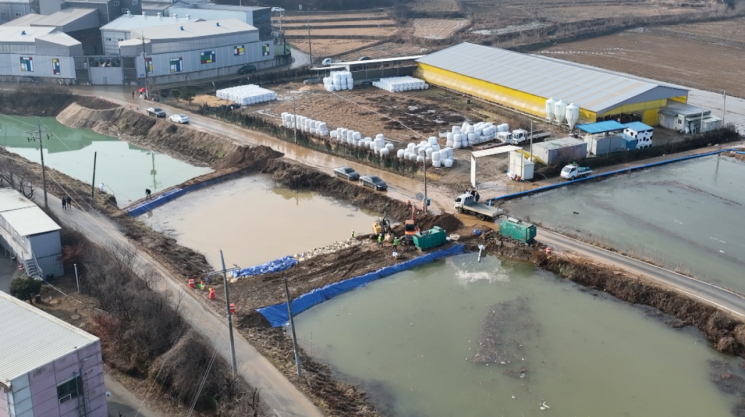 Authorities are conducting containment work on contaminated water that leaked into the management stream during the fire at the hazardous materials storage warehouse in Yanggam-myeon, Hwaseong.
 [Photo by Hwaseong City]
In this regard, Mayor Jeong Myeong-geun of Hwaseong conducted an emergency on-site inspection on the evening of the 17th after receiving a report that the containment dike installed upstream was at risk of overflowing due to heavy rain. On the morning of the 18th, he presided over a countermeasure meeting at the local Disaster and Safety Countermeasures Headquarters set up at the site to discuss response measures.
Mayor Jeong said, "Since the treatment of contaminated water is urgent, we will mobilize all available resources to take every possible measure to prevent the spread of water pollution," adding, "As this is a disaster situation, I hope the affected area will be promptly declared a special disaster zone."
Meanwhile, the city explained that there are no water intake or purification plants for local residents' drinking water supply downstream of Jinwi Stream, where it joins the management stream, and so far, there is no demand for agricultural water from the management stream. The city plans to strengthen water quality monitoring of the management stream by expanding measurement points in cooperation with the Ministry of Environment and other related agencies, and will continue soil and groundwater inspections.
Earlier, from the day after the fire on the 10th until now, the city installed 11 containment dikes at upstream and downstream points of the management stream to block contaminated water from joining Jinwi Stream. Additionally, to control the water level of the upstream river in the management stream, water spray trucks have been deployed to transfer water to Baran Stream, and the flow is being dispersed using nearby irrigation channels. However, the city stated that if these containment efforts are prolonged, additional measures will be necessary.
Meanwhile, the contaminated water leaked from the fire is being treated by various methods depending on the degree of contamination. Contaminated water exceeding water quality standards at the inflow of the management stream is being treated by a specialized company using wastewater tankers. Contaminated water downstream of the management stream, which shows discoloration but meets water quality standards, is being treated in small amounts at nearby public sewage treatment plants after safety tests, with plans to increase treatment volume and the number of treatment facilities.
Meanwhile, the Ministry of Environment reported that water quality measurements at the point where contaminated water entered the management stream showed that on the first day, the 10th, five types of specific water quality hazardous substances exceeded water quality standards, but subsequently decreased to within standards or were 'not detected,' and ecological toxicity decreased from more than 16 times the standard to about 2.4 times.
© The Asia Business Daily(www.asiae.co.kr). All rights reserved.

















