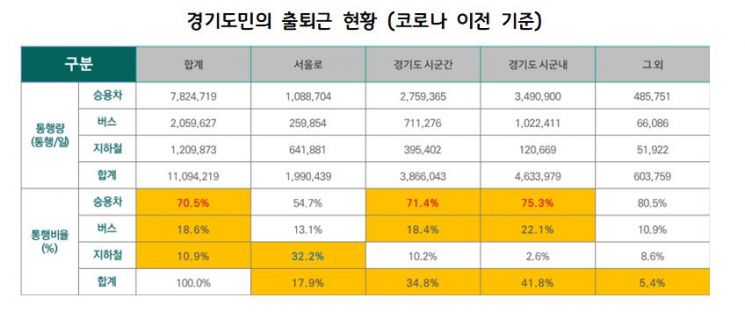
It was found that when residents of Gyeonggi Province commute to Seoul, 55% use private cars rather than public transportation such as buses. Additionally, commuting time was found to be faster by private car compared to public transportation.
On the 18th, the Gyeonggi Research Institute published a report titled "Changes in Commuting Patterns in the Post-COVID Era," analyzing commuting characteristics in Gyeonggi Province by region and mode of transportation using metropolitan area traffic volume and network data from 2019 to 2022.
According to the report, commuting trips between Gyeonggi and Seoul (based on one trip per commuter per day) accounted for 18% (2 million trips) of the total daily commuting trips in Gyeonggi Province (11.09 million trips). By mode of transportation, private cars accounted for 55%, and public transportation accounted for 45%.
The volume of commuting trips to Seoul by city and county was highest in Seongnam, Goyang, Bucheon, Namyangju, and Yongin. Among these, the private car usage rate was highest in Pocheon, Yeoncheon, and Gapyeong, while the public transportation usage rate was highest in Suwon, Gwangmyeong, and Bucheon.
Within the province, dependence on private cars for commuting also accounted for more than 70% (71.4% between cities/counties and 75.3% within cities/counties).
The Gyeonggi Research Institute also revealed results analyzing changes in transportation mode performance before and after COVID-19 based on transportation card big data from 2019 to 2022.
Metropolitan buses and urban railroads, which mainly handle commuting between Gyeonggi and Seoul, saw a sharp decline in passenger volume during the COVID period but mostly recovered afterward. However, city buses and village buses, which mainly serve commuting within the province, remained at about 75% of pre-COVID levels.
In particular, for one-way commuting trips between Gyeonggi and Seoul, it took 58.1 minutes by private car and 78.3 minutes by public transportation, meaning public transportation took 1.4 times (35%) longer than private cars.
On the other hand, for commuting between cities and counties within the province, private cars took 34 minutes, while public transportation took 71 minutes, showing a 2.1 times (108%) difference compared to private cars. This was analyzed to be due to a significant reduction in the frequency of city and village bus operations during the COVID period.
Furthermore, a survey conducted last September targeting 2,300 office workers aged 25 to 59 residing in Gyeonggi Province on changes in work patterns and commuting transportation behavior during the COVID period found that flexible working hours (including staggered work hours and autonomous commuting) reduced commuting time by 8 minutes (towards Seoul) to 12 minutes (within the province) compared to those who did not use flexible working hours.
In response, the institute proposed policy alternatives to achieve commuting within one hour for Gyeonggi residents, including ▲expansion of subway and metropolitan bus facilities and services ▲expansion of bus routes and infrastructure between cities and counties within the province ▲alleviation of commuting congestion through the expansion of flexible working hours.
Researcher Gu Dong-gyun of the Gyeonggi Research Institute explained, "Public transportation in Gyeonggi Province has become more difficult after COVID," adding, "To achieve the goal of commuting within one hour for residents who face daily commuting battles, supply policies such as expanding city buses and bus-only lanes, along with demand management policies like flexible working hours, must be implemented together."
© The Asia Business Daily(www.asiae.co.kr). All rights reserved.

















