Half of Adults Evaluate "Student Character as Negative"
'Character and Volunteer Activities' Rise to First Place in 9 Years
It was found that adults in our country consider character to be more important than academic performance such as the CSAT and school grades in college admissions. Additionally, there was a prevailing perception that educational activities at schools are seriously infringed upon. Many attributed the cause of such infringements on educational activities to the excessive emphasis on student rights.
On the 17th, the Korea Educational Development Institute (KEDI) released the 'Education Opinion Survey (KEDI POLL 2023)' containing these findings. This survey has been conducted annually by KEDI since 1999 to understand the public's perception of education and education policies in Korea. Last year's survey included 4,000 adults nationwide aged between 19 and under 75, conducted from July 31 to August 17.
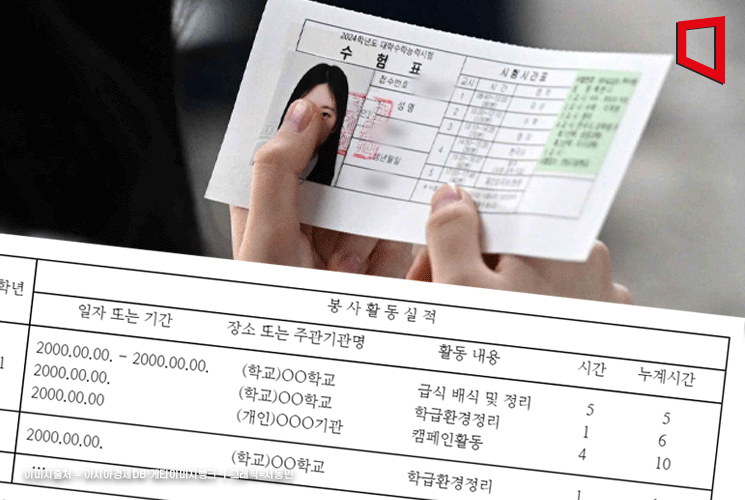
In the results of this education opinion survey, 27.8% of respondents answered that 'character and volunteer activities' should be most reflected in college admissions. This is an increase of 7.7 percentage points compared to the previous year. Next were 'special talents and aptitudes (26.0%)' and 'CSAT (25.4%)' in order. The CSAT had ranked first for five consecutive years from 2018 to 2022 but dropped to third place this time. The percentage of respondents who believed the CSAT should be heavily reflected decreased by 5.4 percentage points from 30.8% the previous year.
The selection of 'character and volunteer activities' as first place is the first time in nine years since 2014. This is analyzed to have been influenced by the case where the son of lawyer Jeong Soon-shin, who was appointed but then dismissed as head of the National Investigation Headquarters last year, committed school violence during high school but entered Seoul National University through regular admissions that fully reflected CSAT scores.
Furthermore, regarding the overall character level of students in elementary, middle, and high schools in Korea, 45.9% responded negatively. In particular, 54.3% evaluated middle school students' character negatively, and 52.5% did so for high school students, with more than half of respondents giving a negative assessment. Regarding elementary school students' character, 42.8% answered negatively. Regarding the severity of school violence in elementary, middle, and high schools, 59.9% of respondents perceived it as 'serious.'
In middle schools, this rate soared to 65.5%. It was 64.2% for high schools and 45.9% for elementary schools. The main cause of school violence was most frequently pointed out as 'lack of family education (37.4%)'. Next was 'lack of student guidance by schools (24.0%)'. Regarding the opinion that 'punishment measures for students who commit school violence should be stricter,' 60.6% agreed. The opinion that 'reconciliation and guidance should be emphasized' remained at 19.5%.
Severity of Educational Activity Infringement '3.78 out of 5'
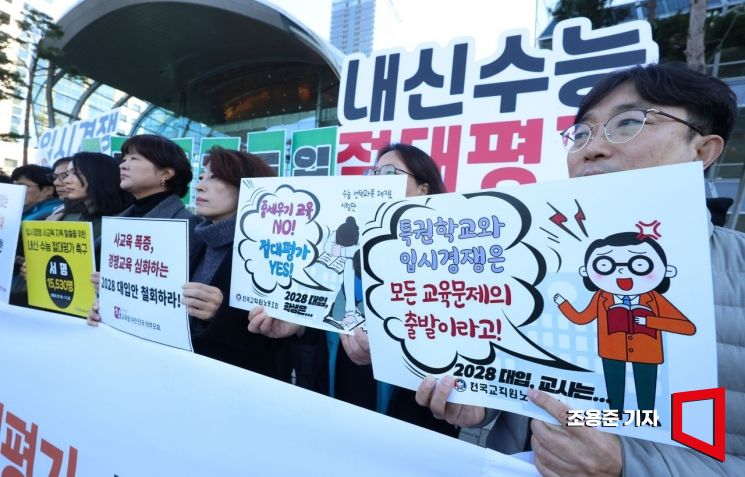 Educational civic groups for the 2028 college entrance system reform held a press conference on the 20th in front of the Federation of Korean Industries building in Yeongdeungpo, Seoul, shouting slogans for the full implementation of absolute evaluation in the CSAT and school grades.
 [Photo by Jo Yongjun jun21@]
When asked to grade the current elementary, middle, and high schools in Korea in this survey, the largest portion of respondents, 46.0%, answered 'average.' However, negative responses also reached 41.8%, and only 12.2% evaluated them positively. Regarding trust in the ability and qualifications of elementary, middle, and high school teachers, 48.3% answered 'average,' which was the highest. 'Positive' was 32.7%, and 'negative' was 19.1%.
Regarding the degree of infringement on educational activities by students or their guardians, 62.5% viewed it as 'serious.' Only 10.1% answered 'not serious.' This appears to reflect the nationwide interest in the controversy over infringement of teachers' authority triggered by the death of an elementary school teacher in Seocho-gu, Seoul, last year. When converted to a 5-point scale, the severity of educational activity infringement was measured at 3.78 points. This is the highest level in the past three years, including 2021 (3.39 points) and 2022 (3.61 points).
As for the reason why educational activity infringement is serious, the largest portion of respondents, 39.6%, cited 'excessive emphasis on student rights' as the primary cause. The second was 'lack of awareness among students and guardians about protecting educational activities (22.7%)', and the third was 'distrust of school education or teachers by students and guardians (17.2%).'
© The Asia Business Daily(www.asiae.co.kr). All rights reserved.

![Clutching a Stolen Dior Bag, Saying "I Hate Being Poor but Real"... The Grotesque Con of a "Human Knockoff" [Slate]](https://cwcontent.asiae.co.kr/asiaresize/183/2026021902243444107_1771435474.jpg)
















