Isu Construction Faces 24 Billion Won Bond Maturity
Privately Placed Bonds Issued Only 4 Billion Won
CAMCO and KODIT Support Far from Sufficient
Since Taeyoung Construction filed for workout (corporate financial restructuring), construction companies have been struggling to cope with maturing borrowings. The real estate market downturn has already made financing difficult, and the Taeyoung Construction incident has further worsened market conditions. Construction companies that had been holding on with secured bonds, bonds with options, and commercial papers (CP) last year are facing difficulties refinancing maturing borrowings this year.
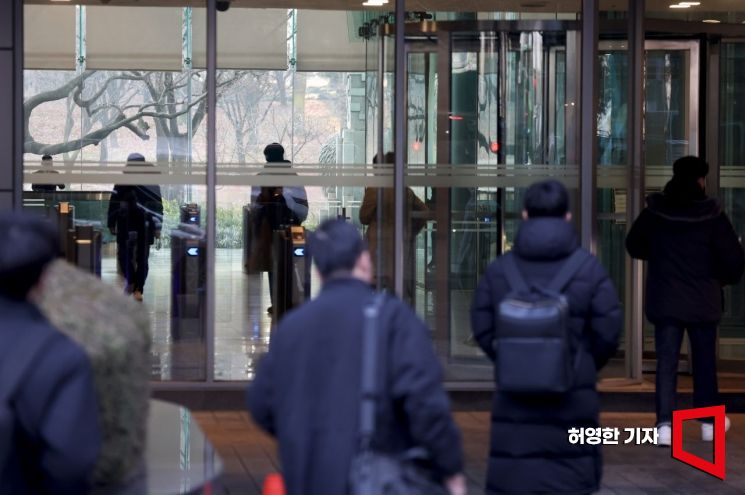 The day after Taeyoung Construction's workout was decided, on the 12th, people were entering and exiting the Taeyoung Construction headquarters building. Photo by Heo Younghan younghan@
Credit Crunch Deepens for Construction Companies... Difficulties in Refinancing Maturing Bonds

According to the investment banking (IB) industry on the 18th, Isu Construction issued 4 billion KRW worth of private bonds the day before. Bonds worth 14 billion KRW and 10 billion KRW will mature sequentially on the 22nd and 26th, which is far from enough to repay. They are in a situation where they must find other financing methods or repay with available cash. Bonds worth 13 billion KRW and 10 billion KRW will also mature in March and April, requiring preparation for repayment or refinancing.
The private bonds issued by Isu Construction have shorter maturities and higher interest rates compared to the past. Isu Construction issued private bonds of 2 billion KRW each with maturities of 6 months and 1 year. Previously, they had issued leftover bonds with maturities of 1 year and 1.5 years consecutively, but this time they could not exceed 1 year maturity. The interest rate is in the high 7% to 8% range, which is quite high for short-term bonds under 1 year.
For small and medium-sized construction companies with low credit ratings, this is considered a relatively favorable situation. In the case of Isu Construction, although its own credit rating is low, its parent company, Isu Chemical, provides joint guarantees for most of the bonds. Although Isu Chemical's credit rating is not high, it is evaluated that there is willingness and capacity for group-level support, which allowed even a small amount of bond issuance.
Other construction companies facing bond maturities are also worried. Bonds of large construction companies such as Daewoo Construction, SK Ecoplant, and DL Construction are also maturing within the year. Daewoo Construction will face the maturity of 50 billion KRW worth of private bonds on the 29th. As a top-tier construction company in terms of construction capability, it is expected that refinancing and repayment of borrowings around 50 billion KRW will not be a big problem. However, concerns have been raised that the market atmosphere is so deteriorated that optimism is difficult.
A bond issuance officer at a major securities firm said, "In the case of Daewoo Construction, if they accept high interest rates, there will be no major difficulty in refinancing maturing bonds," but added, "Except for top-tier contractors like Samsung C&T or Hyundai Construction, it is hard to say that there is sufficient demand for bond investment, so it cannot be taken for granted."
Small and medium-sized construction companies with many local construction sites are in a more vulnerable position for financing. IS Dongseo, which has many construction sites in regions such as Busan, Daegu, and Ulsan, has a bond maturity of 70 billion KRW waiting in early March. This bond was issued last year with a high interest rate in the 9% range for a 1-year maturity. They also need to respond to maturities of general corporate bonds and secured bonds afterward.
A bond market official said, "Except for top-tier contractors like Samsung C&T, Hyundai Construction, Daewoo Construction, Hyundai Engineering, SK Ecoplant, or construction companies affiliated with large conglomerates, bonds are not well absorbed in the market," and predicted, "Construction companies with credit ratings below A will face considerable difficulties in refinancing maturing bonds."
"Short-term Borrowing Also Difficult" CP Balances Reduced
Raising short-term borrowings such as commercial papers (CP, including short-term bonds) is also not easy. For this reason, since last year, construction companies have reluctantly repaid maturing CPs, reducing CP balances.
A construction company affiliated with the Halla Group, HLD&I Halla, increased its CP balance to 110 billion KRW last year but reduced it to 11 billion KRW by the end of last year. Due to growing concerns about project financing (PF) site defaults, refinancing of maturing CPs was not properly done, and they have been sequentially repaying maturing CPs since October last year.
Hanshin Engineering, whose CP credit rating fell to A3- at the end of last year, had a CP balance of 50 billion KRW at the beginning of last year, which became zero in October last year. After the Legoland incident, CP issuance became difficult, and they could not refinance maturing CPs, resulting in sequential repayments.
A bond market official said, "Since the Legoland incident at the end of 2022, as financing for construction companies became difficult, mid-sized construction companies have been raising funds through short-term CPs, bonds with options allowing investors to request early repayment, and secured bonds backed by high-quality assets," adding, "This year, it is also difficult to utilize these alternative financing methods."
Only Reliance is on KAMCO and KODIT Support... "Support Amount Insufficient Due to Concerns Over Defaults"
The only reliable support for construction companies is government assistance. KCC Construction recently secured liquidity of 62.5 billion KRW by providing its office building in Jamwon-dong, Seocho-gu, Seoul as collateral and obtaining a guarantee from the Korea Asset Management Corporation (KAMCO). In a situation where it is difficult to raise funds independently, they were able to raise funds at relatively low interest rates compared to their credit rating by providing prime assets as collateral.
BBB-rated construction companies such as Hanyang, Hanshin Engineering, and Gyeryong Construction are responding to maturing borrowings by issuing private bonds guaranteed by the Korea Credit Guarantee Fund (KODIT). These companies have a series of maturing private bonds issued with KODIT support.
However, government support from KAMCO or KODIT is far from sufficient compared to the financial difficulties of construction companies. A financial company official said, "Since KODIT and KAMCO must bear responsibility for increasing default rates, it will be difficult to provide unlimited funding support just because construction companies are struggling," and added, "Construction companies need to create and implement financial improvement plans such as support from parent companies or selling business sites themselves."
A construction company official said, "Although the government has announced various support measures to resolve construction companies' financial difficulties, it is hard to feel any warmth on the ground," and pointed out, "Just as financial institutions responsible for Taeyoung Construction bonds were granted indemnity benefits for defaults, revolutionary measures such as allowing some indemnity for KAMCO or KODIT's financial support to construction companies are needed."
© The Asia Business Daily(www.asiae.co.kr). All rights reserved.


















