CES2024 Review
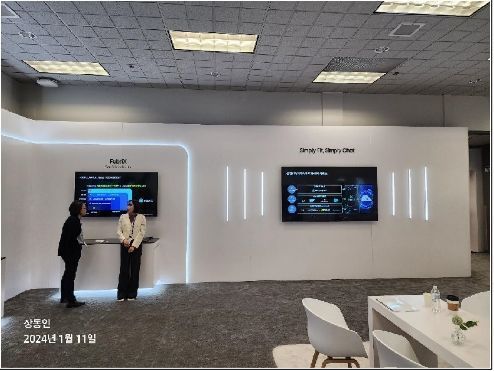 Samsung SDS's enterprise LLM solutions, FabriX and Brity Copilot. Photo by Dongin Jang, Professor at KAIST AI Graduate School
Massive conferences like CES 2024 are best appreciated with prior knowledge. Since many domestic and international media outlets and YouTubers have already covered the event, the focus was more on savoring the direction and pace of technological advancements rather than just the exhibited content. CES was summarized through scenes that capture the atmosphere along with key keywords.
AI Infused in Every Product
The core keyword of this event was ‘On-Device AI.’ Last year, with the widespread use of LLMs (Large Language Models) like the conversational AI service ChatGPT, the threshold for AI usage was lowered to the level of general users. The fact that AI was applied to all products and services means companies are confident in its effectiveness.
Previously, the focus was on Digital Transformation (DX), which pursued corporate change through digital technologies, but now AI Transformation (AX) has become the trend. Google launched generative AI-based Workspace solutions focusing on existing email, photo and video editing, and corporate collaboration. These are competitors to Microsoft’s Copilot, which did not appear at this CES.
Particularly eye-catching was Samsung SDS, which is preparing products utilizing generative AI called FabriX and Brity Copilot. FabriX is a solution that connects internal corporate systems with chatbots, while Brity Copilot is an LLM solution that drafts and summarizes meeting minutes and sends them via corporate email or automatically generates reports. It will be introduced in Korea this April.
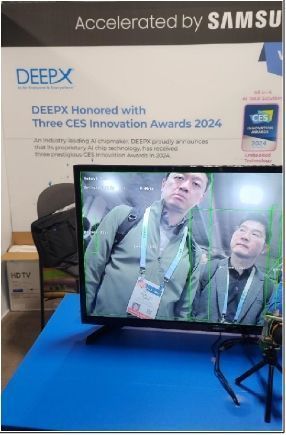 DeepX's AI chip. Photo by Dongin Jang, Professor in charge at KAIST AI Graduate School
On-Device AI is a new concept in terms of pioneering a new market. Until now, AI models were created on PCs or laptops, and large amounts of data were trained using large-scale GPUs on servers or in the cloud. The trained results were then uploaded to the cloud for service. In this environment, service providers like Amazon Web Services (AWS), Microsoft (MS), and Google benefited, and these companies purchased massive GPGPUs from Nvidia.
However, On-Device AI differs in that the trained models are deployed directly on devices for service. It must be implemented in the form of a System On Chip (SoC) that includes sensors, communication modules, and dedicated AI chips with embedded NPUs and memory. Ultimately, since On-Device AI is a newly emerging market, the companies leading it are very important.
If asked which company best implemented On-Device AI at this CES, I would recommend ‘DeepX.’ This company is one of the C-Lab startups incubated by Samsung. It is a fabless company designing NPU semiconductors that perform inference by embedding AI models in various devices. Their chips consume one-tenth the power of existing GPUs and are priced at one-tenth as well.
What particularly caught attention was that attaching a DeepX chip to a camera module enables immediate AI-based image recognition. Until now, cameras and PC-level computers were required, but now it can be directly mounted on the camera without a PC. Once mass-produced, prices could drop to the tens of thousands of Korean won range. This company seems poised for rapid growth as it aligns with the current trends.
On-Device AI also applies to vehicles. Qualcomm exhibited the Snapdragon Digital Chassis, an On-Device AI chip for vehicles. This SoC includes not only AI but also functions supporting the vehicle cockpit and wireless external connectivity. In automobiles, it is designed to support not only AI functions but also SDV (Software-Defined Vehicle) operations.
On-Device LLMs
The most notable aspect in the On-Device AI field is installing and operating LLMs directly on devices. One of the most popular items at the event was the R1 mobile phone by Rabbit. Priced at $199, it is completely different from conventional smartphones. Traditional smartphones require installing mobile applications (apps), and people typically use over 100 apps. In contrast, the R1 requires no app installation; users simply give voice commands. Whether booking travel, listening to music, or calling an Uber, all commands are voice-based. It is similar to Apple’s Siri or Google Assistant but distinctly different because no app installation is needed.
However, apps that do not respond to voice commands must be accessed through the ‘Rabbit Hole Web Portal’ and operated in a predetermined manner. While very innovative, the process of entering the portal and training it may be cumbersome. Success remains to be seen.
Robots Are Just Beginning
One of the highlights was HL Mando’s autonomous parking robot ‘Paki.’ The robot enters under the car and lifts it to park in tight spaces. ‘Paki’ recognizes surrounding obstacles, driving paths, tires, license plates, and also independently judges the distance between wheels and the vehicle’s center of gravity. It can transport all types of vehicles, from low-profile sports cars to heavy SUVs. It seems very useful in parking lots with extremely limited space, like those in Korea.
Also attracting attention was the ExoSuit robot. It is a wearable robot. The ‘H-Flex’ released by Professor Lee Ki-wook’s Hurotics at Chung-Ang University won a CES Innovation Award this year. Wearing this suit reportedly enables elderly people to go hiking.
Hyundai-Kia’s New Challenge
Hyundai Motor Company presented two major themes: hydrogen and SDV. The exhibition showcased hydrogen vehicles and a hydrogen ecosystem. However, there was some skepticism about whether Hyundai would truly push forward with this.
Rather than the hydrogen ecosystem, SDV attracted more attention. The SDV ecosystem proposed includes an integrated ECU (Electronic Control Unit), Connected Car OS, autonomous driving software, as well as a broad ecosystem covering vehicle charging and car payments. If realized and standardized, cars could be assembled with parts as freely as computers. Hyundai acquired ‘42dot’ for 420 billion KRW to lead its SDV strategy.
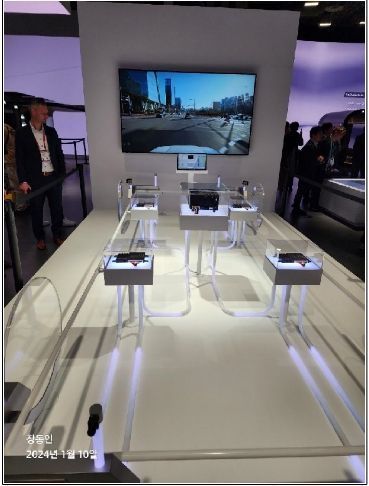 Hyundai Motor Company's SDV (Software Defined Vehicle) mockup. Photo by Dongin Jang, Professor at KAIST AI Graduate School
Kia’s PBV (Purpose Built Vehicle) represents a new type of vehicle platform beyond traditional cars. For example, it can serve as transportation as well as office space, commercial space, or leisure activity space. At CES, a scene was shown where a passenger module was converted into a truck module for cargo. This vehicle is scheduled for mass production in 2025.
Hyundai Mobis demonstrated an actual functioning sideways-moving car equipped with its self-developed Uni-Wheel technology. Because it can move sideways, parallel parking becomes easier, and it can rotate 360 degrees on the spot, allowing easy operation even in tight spaces.
Traditional Companies’ AI Transformation
Another feature of this event was traditional companies transforming by integrating AI and IT. Representatives include Hyundai HD, Walmart, L’Or?al, Nikon, and Mando. Walmart CEO Doug McMillon introduced cases combining generative AI with Walmart’s vast data through collaboration with Microsoft during his keynote speech. A representative example is the ‘In Home’ service, which helps customers shop and automatically delivers preferred products considering consumer purchasing characteristics. Additionally, generative AI is used to assist employees with document creation and summarization, and interpretation services will be provided in stores by country.
Notably, when CEO McMillon spoke, Microsoft CEO Satya Nadella appeared, surprising the audience and receiving much applause.
Camera manufacturer Nikon, facing a sharp decline in sales due to smartphone cameras, is transforming into a company producing high-end telephoto lenses that smartphones cannot match, highly precise semiconductor process camera equipment, and optical microscopes used in medical fields.
HD Hyundai Chairman Chung Ki-sun announced a new vision called ‘Site Transformation’ in his keynote. This refers to innovatively changing infrastructure construction methods, focusing on remote control, autonomous driving, and unmanned operation of construction heavy equipment through AI. Hyundai aims for fully autonomous construction sites by 2030 and intends to change the future of the construction industry.
HD Hyundai’s unmanned heavy equipment demonstrated how construction sites should be defined in the future, as dangerous or extreme environment work requires no human presence. Operators can control heavy equipment remotely or entrust it to autonomous driving from a distance. This moment highlights the promising future of HD Hyundai.
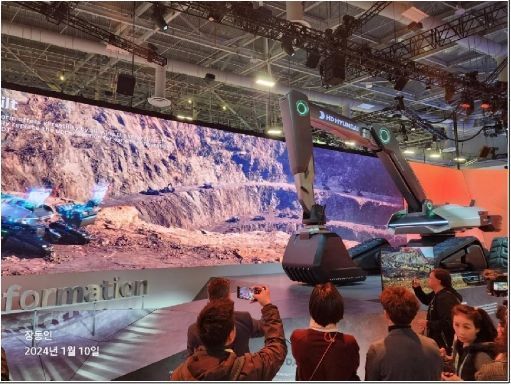 HD Hyundai's autonomous unmanned heavy equipment. Photo by Jang Dong-in, KAIST AI Graduate School Associate Professor
CES Led by Korean Companies
CES 2024 was the largest event since COVID-19, with 4,124 companies participating. Korean companies participated in record numbers, with 772 companies, accounting for 18.7% of the total. There were so many Korean attendees that it was said to be like ‘moving COEX here.’ As the saying goes, quantity determines quality, and the exhibition level of Korean pavilions was the highest. They showcased the present and future better than other countries’ pavilions.
On the other hand, global big tech companies were somewhat disappointing. Apple is famously absent from CES, so excluding them, Microsoft, Nvidia, Salesforce.com, IBM either did not participate or were only visible to invitees. Exhibitors like HP, AWS, and Google also showed reduced presence. AMD and Qualcomm concluded with keynote speeches. American companies tend to participate decisively when they lead the event, but otherwise, they do not attend at all. Therefore, it was somewhat disappointing to get a comprehensive view of their future technologies.
Some say Korea has transformed from a fast follower to a technology leader. However, we should not think we lead the world when global big tech companies are absent. At one time, Japanese electronics companies were so prosperous that it was said selling just Tokyo Bay could buy all of the United States. But after the 1985 Plaza Accord, the Japanese economy gradually declined. Excessive nationalism can lead to corresponding consequences.
© The Asia Business Daily(www.asiae.co.kr). All rights reserved.
![Clutching a Stolen Dior Bag, Saying "I Hate Being Poor but Real"... The Grotesque Con of a "Human Knockoff" [Slate]](https://cwcontent.asiae.co.kr/asiaresize/183/2026021902243444107_1771435474.jpg)


















