Decisive Contribution to Resolving Workforce Shortage in Industry
Emphasis on the Need for Customized Government Policies
If 5% of the idle workforce, including non-working youth, elderly retirees, and women with career interruptions, engage in economic activities, it could alleviate the labor shortage in our industrial sites and the shock caused by the decline in the working population. Therefore, there is a claim that tailored policies to promote their economic activities are necessary.
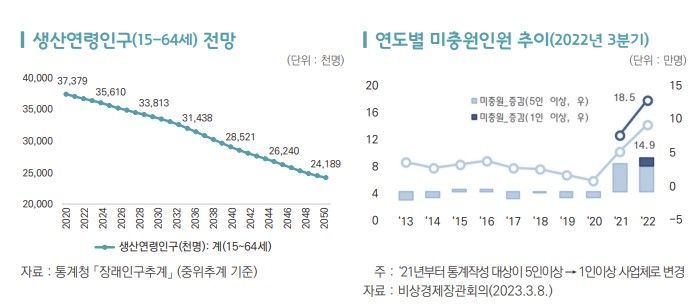 The Korea International Trade Association's Institute for International Trade and Commerce report includes a graph related to the status of the working-age population. Photo by Report Capture
The Korea International Trade Association's International Trade and Commerce Research Institute stated this in a report titled "Measures to Promote Economic Activities of Idle Workforce to Expand the Working Population" on the 17th.
The report suggested that the estimated 3.28 million idle workforce within the economy as of last year should be utilized as an active labor force. Specifically, it pointed out that 620,000 non-working youth, 1.26 million elderly retirees, and 1.4 million women with career interruptions should be engaged in economic activities.
According to the report, the number of "unfilled positions," referring to those who could not be hired despite active recruitment efforts by businesses as of 2022, was counted at 185,000.
Based on this, the report projected that if 5% of the 3.28 million idle workforce, equivalent to 164,000 people, were converted into the economically active population and filled positions in sectors facing labor shortages, it would make a decisive contribution to resolving the labor shortage in the industrial sector.
Furthermore, to promote the economic activities of the idle workforce, the report emphasized the need for government-level attention to non-working youth, coexistence with middle-aged and elderly retirees, and tailored policies for women with career interruptions. It called for social interest in youth who are resting without particular reasons or are isolated and withdrawn, supporting their successful social reintegration, and activating personalized social readjustment plans suited to individual tendencies to help these youths overcome lethargy.
It also proposed benchmarking Japan's policies to promote elderly employment by encouraging employment retention of potential retirees through extending retirement age and reemployment as contract workers. Additionally, it argued that tailored policies should be designed for women with career interruptions to resolve difficulties in balancing work and family due to childbirth and childcare. Measures such as creating family-friendly jobs like telecommuting and part-time work should be considered to support potential economically active women who wish to continue their careers.
Kim Min-woo, senior researcher at the Korea International Trade Association, said, "If various idle workforce groups in society remain in a non-working state for a long time, it could lead not only to direct human capital loss but also to a significant increase in various social costs in the future. To avoid missing the golden time to bring the idle workforce back into economic activities, now is the time for the government and society to take action."
© The Asia Business Daily(www.asiae.co.kr). All rights reserved.

















