Slight Decrease in Last Year's Crackdown Cases but 23% Increase in Weight
Customs Service Reports International Mail as the Most Common Smuggling Route
Last year, the scale of drug smuggling detected by our authorities amounted to 704 cases, with a total weight of 769 kg. It was the first time that the weight per case exceeded 1 kg.
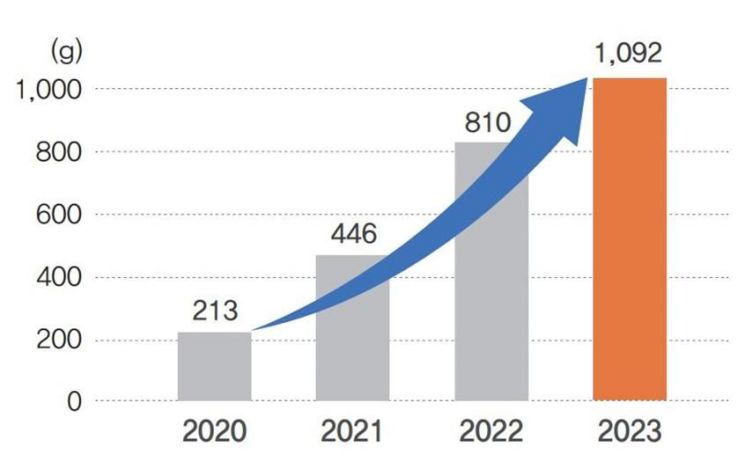
According to the drug smuggling crackdown status released by the Korea Customs Service on the 17th, the number of cases slightly decreased compared to the previous year, 2022, but the total weight increased by 23%. The weight per detected smuggling case has steadily increased from 213g in 2020 to 446g in 2021, 810g in 2022, and 1092g last year.
In detail, small-quantity drug smuggling of 10g or less has conversely decreased. Small-quantity smuggling is commonly presumed to be for personal consumption. This suggests an increase in smuggling intended for illegal distribution within the country.
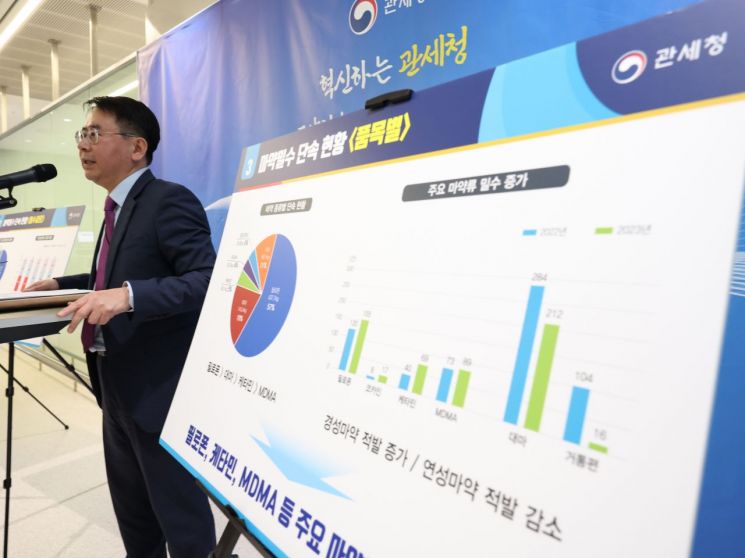 Kim Hyun-seok, Director of the International Investigation Division at the Korea Customs Service, is briefing on the 2023 drug smuggling crackdown performance and trends at the Arrival Hall of Terminal 1, Incheon Airport, on the morning of the 17th.
 [Photo by Yonhap News]
A traveler arriving from Thailand was caught at Incheon Airport hiding ketamine, a new type of drug, wrapped in plastic and then packaged in a condom, concealed in a secret part of the body. There were also cases where methamphetamine was hidden in a plastic bag at the bottom of a suitcase, or hashish oil vacuum-packed inside the inner wall of a used pressure cooker and brought in via express delivery.
The main smuggling routes were international mail with 328 cases and 327 kg, followed by express cargo (194 cases, 274 kg), and travelers (177 cases, 148 kg). In particular, with the COVID-19 endemic leading to an increase in travelers, smuggling through this route surged. The Korea Customs Service explained, "There are also cases of international drug crime organizations recruiting couriers for smuggling attempts," and "the weight per smuggling case by travelers has also significantly increased."
Thailand and the United States accounted for more than 40% of the total smuggling origins detected. These countries have long been known as major drug smuggling sources. Recently, Germany and Malaysia have seen a significant increase in the number of detected cases. The government plans to strengthen inter-country cooperation activities, reporting that joint crackdowns with major drug-producing countries have reduced the amount of drugs detected.
On the same day, Kwanghyo Ko, Commissioner of the Korea Customs Service, held the first special task force meeting for drug smuggling countermeasures of the year at Incheon Airport Terminal 1 to review the crackdown achievements so far. While encouraging customs officers on site at the airport, he also observed demonstrations of millimeter-wave body scanners and thermal cameras. The millimeter-wave scanner is equipment that effectively detects drugs hidden on the body, and three units were introduced at Incheon Airport last year. This year, 13 units will be expanded to major airports and ports nationwide. The thermal camera is newly introduced equipment.
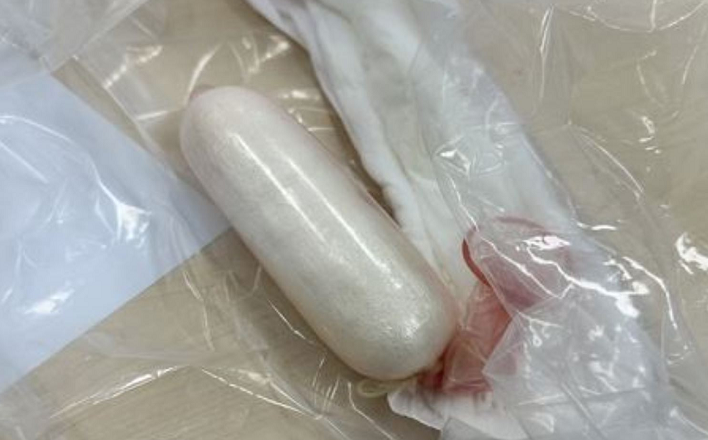 A traveler entering from Thailand was caught at Incheon Airport hiding ketamine inside their body. They wrapped 94g of ketamine in plastic and then packaged it with a condom, concealing it in a private area.
 [Photo by Korea Customs Service]
The Korea Customs Service and Incheon Airport recently designated fixed boarding bridges for customs inspections at three locations: the east and west sides of Terminal 1 and one at the boarding area. Equipment will be installed here to establish a customs inspection system before immigration screening. Commissioner Kwanghyo Ko stated, "We have focused customs administration capabilities on drug detection at the border stage to prevent the spread of drugs into our society," adding, "Since drug smuggling methods continuously change to evade detection, a single countermeasure cannot fulfill its role. We must constantly devise new response measures to adapt to the changing environment and methods."
© The Asia Business Daily(www.asiae.co.kr). All rights reserved.



















