Ministry of Agriculture, Food and Rural Affairs Implements Strengthened 'Rice Grading Standards'
The government is strengthening the limit on the admixture of broken rice grains in the 'ordinary' grade to improve the quality of Korean rice. When the content of broken rice grains is high, water absorption during cooking occurs more quickly, resulting in porridge-like rice and relatively poorer taste.
The Ministry of Agriculture, Food and Rural Affairs announced on the 17th that the revised rice grading standards, which reduce the limit of broken rice admixture in the ordinary grade from 20% to 12%, will be fully implemented this month after a six-month grace period.
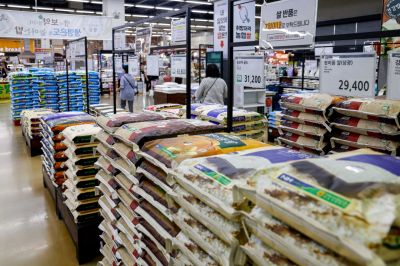 On the 5th, rice is being sold at Hanaro Mart Yangjae Branch in Seocho-gu, Seoul, where the consumer price index for August rose to the 3% range, marking the largest increase in four months due to the effects of heatwaves and heavy rain. Photo by Kang Jin-hyung aymsdream@
Rice grades distributed in the market are classified as 'Special - Superior - Ordinary,' with grading criteria set based on the degree of admixture of broken rice grains and discolored grains (where more than half of the grain is discolored).
Before the revision, the limit for broken rice admixture in the ordinary grade was set relatively higher compared to other grades (Special 3.0%, Superior 7.0%, Ordinary 20%), so the related standards were strengthened last year to improve rice quality.
Jeon Han-young, Director of Food Policy at the Ministry of Agriculture, Food and Rural Affairs, said, "With the full implementation of the strengthened rice grading standards for broken rice content, it will be an opportunity to improve rice quality, and it is expected to help stabilize rice prices by limiting the circulation of low-quality rice." He added, "When purchasing rice, please carefully check the labeling information such as variety, grade, origin, and milling date."
© The Asia Business Daily(www.asiae.co.kr). All rights reserved.
![Clutching a Stolen Dior Bag, Saying "I Hate Being Poor but Real"... The Grotesque Con of a "Human Knockoff" [Slate]](https://cwcontent.asiae.co.kr/asiaresize/183/2026021902243444107_1771435474.jpg)
















