Last Year, 1.47 Million Hybrid Cars Registered... 360,000 Increase in One Year
Gasoline Vehicles Increased by 240,000 in One Year, First Overtake
"Electrification is a Practical Alternative," Industry Sees Active New Car Launches
Last year, the growth rate of hybrid vehicles in South Korea surpassed that of gasoline cars for the first time. This is interpreted as a rise of hybrids as a practical eco-friendly vehicle amid a slowdown in electric vehicle growth.
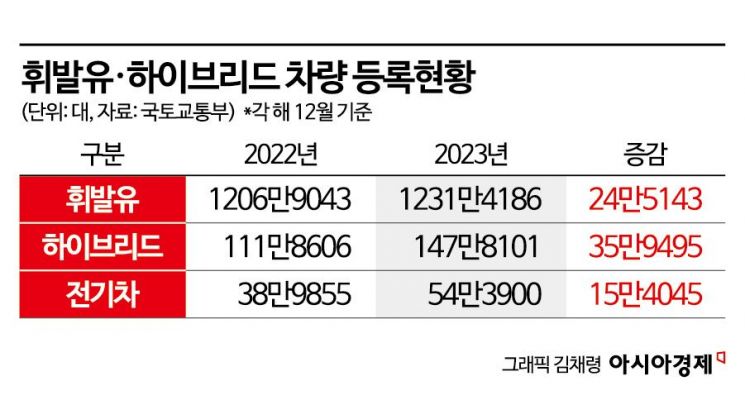
According to the Ministry of Land, Infrastructure and Transport's fuel-based vehicle registration status as of December last year, the number of hybrid vehicles reached 1,478,101, an increase of 359,495 compared to the previous year. During the same period, gasoline vehicles increased by 245,143, from 12,069,043 to 12,314,186. In 2022, gasoline and hybrid vehicles increased by 309,476 and 247,900 respectively, but the situation reversed within a year. The share of hybrids among all registered vehicles in the country also rose by 1.3 percentage points to 5.7% over the year.
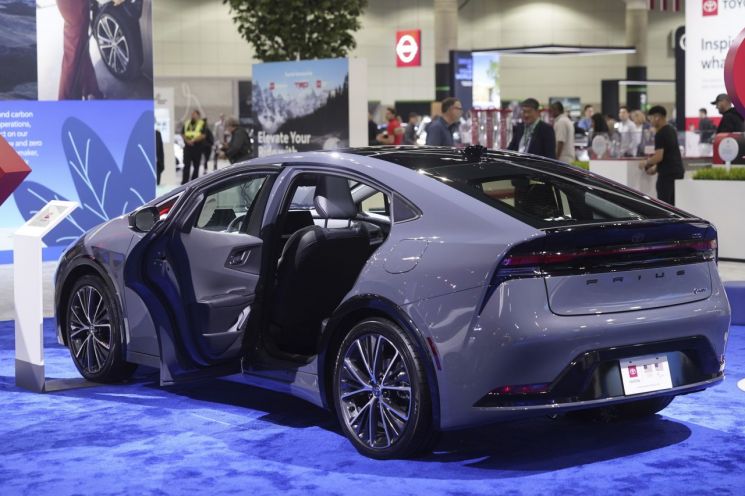 The Toyota hybrid car Prius was exhibited at the LA Auto Show held last November.
 [Photo by Yonhap News]
Looking at new car sales alone, gasoline cars still outnumber hybrids. However, many older or accident-deregistered vehicles offset this, resulting in a smaller net increase compared to hybrids. This count excludes diesel, liquefied petroleum gas (LPG), and compressed natural gas (CNG) hybrid vehicles due to their relatively low numbers.
The increase in hybrid vehicles aligns with the current slowdown in electric vehicle growth. Electric vehicles remain expensive, and subsidies have been reduced, leading to a slower growth rate than in the past. Although charging infrastructure has improved compared to before, it is still insufficient compared to internal combustion engine vehicles. Electric vehicles increased by 158,412 units in 2022, but last year the increase was only 154,045 units. After rapid growth every year, the market has slowed since the second half of last year.
The industry expects steady demand for hybrids this year as well. Last year, Hyundai's Grandeur, the best-selling model domestically, sold more than 10,000 more hybrid units than the regular gasoline model. Among SUVs, the best-selling Kia Sorento sold about 57,000 hybrids, nearly double the gasoline sales of 28,702 units. Hyundai Santa Fe, Kia Niro, and K8 also have higher sales in their hybrid versions. Kia and labor unions agreed last year to bring hybrid engines from their underutilized Chinese factory to assemble complete vehicles domestically.
Luxury brand Genesis is also reportedly developing a separate hybrid engine. Renault Korea Motors plans to launch a mid-size SUV hybrid model in the second half of this year. KG Mobility jointly developed a hybrid system with Chinese eco-friendly car company BYD last year, and the industry expects a new model to be released as early as the year after next.
Imported cars have actively introduced hybrid models for several years. By brand, Japanese companies like Toyota and Honda sell full hybrids, while European brands such as BMW, Mercedes-Benz, and Volvo offer so-called mild hybrid models, where the motor plays a relatively smaller role.
Professor Lee Hogun of Daeduk University's Department of Future Automotive Studies said, "With stricter emission regulations and some delays in the ban on internal combustion engine sales, hybrid models are gaining attention as a practical alternative in various policy aspects. The increase in sales has led to mass production systems that have lowered prices, and the lack of suitable electric vehicle models in mid-size and larger SUVs are factors expected to sustain steady demand for the foreseeable future."
© The Asia Business Daily(www.asiae.co.kr). All rights reserved.



















