Kim Kyun-ho, a member of the Gwangju Metropolitan City Seo-gu Council, announced on the 16th that on the 15th, he held a “Meeting to Support Lifelong Education for People Growing as Themselves” at the council with related experts, parents, officials from relevant departments (such as the Education Library Division), and Gwangju Metropolitan City council members.
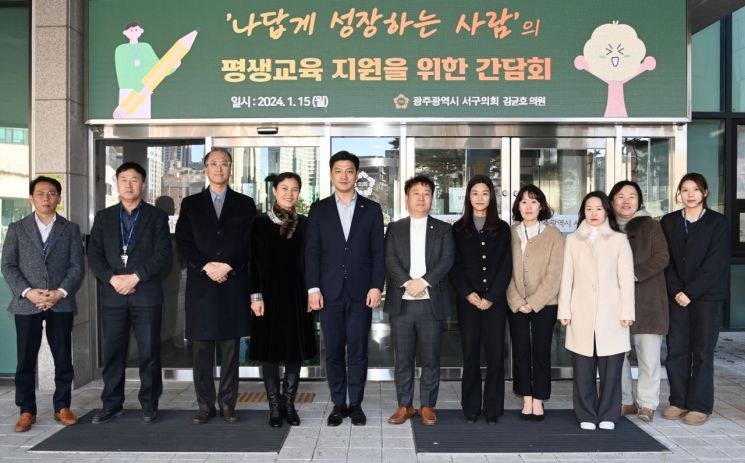
“People growing as themselves” refers to individuals commonly called “borderline intellectual functioning” or “slow learners.” These individuals do not have intellectual disabilities (IQ 70 or below) but have an intelligence quotient lower than average (IQ 71?84), causing difficulties in learning and interpersonal relationships.
They neither fall under the category of intellectual disability (IQ 70 or below) nor belong to the “non-disabled” group with average intelligence of IQ 85 or above, placing them in a blind spot of our society, sometimes described as “existing on a remote island.”
Council member Kim, who hosted the meeting, began his interest in “borderline intellectual functioning (slow learners)” from personal experience. In September last year, he held a meeting with the Gwangju Metropolitan City Superintendent of Education to discuss the current status and necessity of policies for these individuals.
Additionally, during the 314th extraordinary session (’23.09.19), he emphasized the need for ordinance enactment and policy establishment through a “5-minute speech.”
Kim stated, “The term ‘borderline intellectual functioning (or slow learners)’ carries somewhat negative stigmatizing effects from the terminology itself. Estimated to be about 14% of the population, these individuals can live without major issues as members of society if they receive early intervention through professional diagnosis and lifelong education tailored to their life cycle. Nevertheless, they are not receiving adequate protection and support in social and economic blind spots. It is necessary for public institutions and local communities to cooperate actively to prepare and expand policies.” He explained the purpose of holding the meeting.
The discussion began with Gwangju Metropolitan City Council member Lee Myung-no explaining the representative proposal, the “Gwangju Metropolitan City Office of Education Ordinance on Support for Students with Borderline Intellectual Functioning,” stating, “We will strive to secure budgets to expand support projects in the future. Also, I believe more discussion and consideration are needed regarding the terminology such as ‘people growing as themselves,’ ‘borderline intellectual functioning,’ and ‘slow learners.’”
A parent attending the meeting said, “My child recently underwent a ‘borderline intellectual functioning’ test, but the long time required for the test, the counseling and education needed for the child, the lack of information, and low social awareness cause a lot of difficulties and burdens as a parent.”
Following this, Lee In-sook, director of Vision School Regional Child Center, added, “Open support is needed for all children regardless of conditions. Only then can early detection and continuous education be possible. We are also experiencing children growing through intervention and education.”
Lee Kyung-ho, director of Gwangju National University of Education Integrated Education Support Center, pointed out, “In related projects such as basic learning difficulties, the target and support systems often overlap. There is a need to distinguish these and unify the responsible departments and divisions as a priority.”
Choi Kang-nim, head of the Regional Child Center Gwangju Support Group, explained the progress of the “Children Growing as Themselves” project, saying, “There were some initial difficulties, but the Regional Child Center was able to start because a stable trust relationship with parents was formed. If budget preparation and job stability for dispatched teachers are secured in the future, we will actively cooperate to ensure many children can receive continuous education. I hope Seo-gu becomes a leading local government in this regard.”
Officials from the Education Library Division, Child and Youth Division, and Disability Hope Welfare Division, who attended as responsible and related departments, said, “Through this meeting, we have gained a better understanding of the current status. We will try to concretize policy projects such as budget establishment and beneficiary selection.”
Concluding the discussion, Council member Kim said, “Visiting the four Regional Child Centers in Seo-gu that are implementing the ‘Children Growing as Themselves (slow learners)’ project and listening to their stories changed many of my previous thoughts. I ask for continued help with field stories and expert opinions. We will carefully consider the valuable opinions shared today to enact effective ordinances and establish policies.”
Shin Dong-ho, Honam Reporting Headquarters, Asia Economy bless4ya@asiae.co.kr
© The Asia Business Daily(www.asiae.co.kr). All rights reserved.
![Clutching a Stolen Dior Bag, Saying "I Hate Being Poor but Real"... The Grotesque Con of a "Human Knockoff" [Slate]](https://cwcontent.asiae.co.kr/asiaresize/183/2026021902243444107_1771435474.jpg)
















