Jisu Slightly Rebounded but Plummeted Again After One Day
Due to Rising Geopolitical Risks and Foreign Exchange Market Volatility
Deterioration in Foreign Investor Demand
The KOSPI index fell below the 2,500 mark for the first time this year amid a joint selling spree by foreigners and institutions.
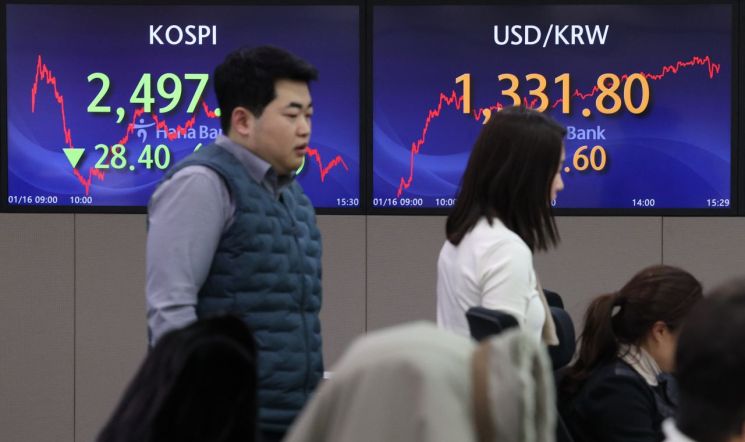
On the 16th, the KOSPI index closed at 2,497.59, down 28.40 points (1.12%) from the previous trading day. The 2,500 level was breached for the first time in over a month since the 7th of last month. Notably, the KOSPI fell more than 1% that day, dropping below the 120-day moving average (2,515.65), which is considered a key economic indicator.
The previous day, the KOSPI index closed at 2,525.99, up 0.04% from the previous trading day. After nine consecutive trading days of decline, it had a slight rebound but plunged again the very next day.
Foreigners and institutions pulled the index down. On that day, foreigners and institutions sold 183.6 billion KRW and 407.5 billion KRW, respectively. Individual investors were the only buyers, purchasing 585.5 billion KRW.
Geopolitical risks such as tensions involving Iran and North Korea, as well as increased volatility in the foreign exchange market, were cited as factors worsening foreign demand. The US dollar index surged from 102.32 points to 102.63 points, and the KRW-USD exchange rate surpassed 1,330 won.
Ji-won Kim, a researcher at KB Securities, said, "North Korea designated South Korea as its primary adversary, triggering geopolitical risks on the Korean Peninsula, which led to foreign demand withdrawal and institutions switching to net selling in just one day. The geopolitical risk spotlight and the rise in the dollar index caused the KRW-USD exchange rate to jump by 11 won, and Asian stock markets also showed overall weakness."
Jun-gi Cho, a researcher at SK Securities, analyzed, "The rekindling of geopolitical risks in multiple areas is believed to be fueling risk-averse sentiment. The news coming from the Middle East is clearly far from positively influencing risk asset preference sentiment."
By sector, food and beverages plunged 4.32%, while machinery (-2.19%), textiles and apparel (-1.89%), insurance (-1.83%), medical precision (-1.72%), transportation equipment (-1.49%), services (-1.47%), electrical and electronics (-1.26%), manufacturing (-1.21%), and transportation and warehousing (-1.18%) also declined. In contrast, electric and gas utilities rose 2.02%.
Most of the top market capitalization stocks closed weaker. Kakao (-2.45%), Samsung Electronics (-1.76%), and SK Hynix (-1.49%) fell by 1-2%, while LG Energy Solution (0.25%), Samsung Biologics (0.26%), and NAVER (0.22%) closed slightly higher.
The KOSDAQ index closed at 854.83, down 4.88 points (0.57%).
Among the top market cap stocks on KOSDAQ, JYP ENT. fell nearly 8%, and Pearl Abyss closed down about 4%. EcoPro, HLB, Celltrion Pharm, and Lino Industrial each dropped more than 1%, while L&F rose more than 8%. EcoPro BM, Alteogen, and HPSP also rose more than 1%.
© The Asia Business Daily(www.asiae.co.kr). All rights reserved.
![Clutching a Stolen Dior Bag, Saying "I Hate Being Poor but Real"... The Grotesque Con of a "Human Knockoff" [Slate]](https://cwcontent.asiae.co.kr/asiaresize/183/2026021902243444107_1771435474.jpg)
















