Impact of Stable International Oil Prices and Exchange Rates
Import Price Index Fell 1.7% in December Last Year
Export Price Index Also Dropped 0.9%
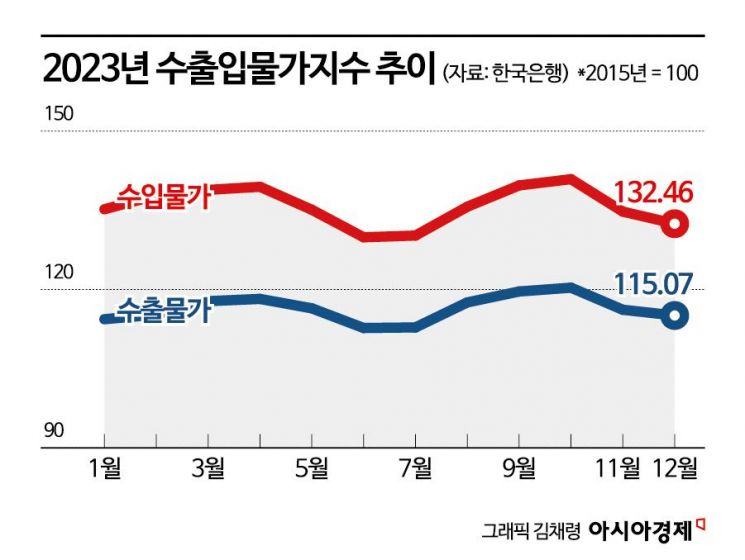
With the decline in international oil prices and the won-dollar exchange rate, export and import prices have fallen for two consecutive months. This is seen as a sign that prices, which had risen sharply for a while, are stabilizing.
According to the export and import price index statistics released by the Bank of Korea on the 16th, the import price index in December last year fell 1.7% compared to the previous month. It also dropped 4.1% compared to the previous year.
The import price index rose for four consecutive months from July to October last year, but has been declining for two consecutive months since November (-4.4%). The import price index directly affects South Korea's producer price index.
The decline in import prices was largely influenced by international oil prices. The average price of Dubai crude oil in December last year was $77.33, down 7.4% from $83.55 in the previous month. International oil prices are falling due to concerns about economic slowdown and increased supply.
In December last year, mineral products fell 5.2% compared to the previous month, and the manufactured goods index also dropped 0.2%. Among detailed items, jet fuel (-12.1%), crude oil (-7.9%), and butadiene (-6.7%) saw significant declines.
Even on a contract currency basis excluding the exchange rate effect, import prices in December last year fell 1.5% compared to the previous month.
The recent military tensions surrounding the Red Sea were analyzed to have a minimal impact. Yuseong Wook, head of the price statistics team at the Bank of Korea, said in a briefing, "We need to monitor the trend," but added, "The Red Sea issue does not significantly affect exports and imports."
The export price index in December last year also fell 0.9% compared to the previous month and dropped 2.3% compared to the same period last year.
Like import prices, export prices rose for four consecutive months from July to October last year, then showed a declining trend from November (-3.5%).
The decline in export prices was largely influenced by the fall in the won-dollar exchange rate. The average won-dollar exchange rate in December last year was 1,303.98 won, down 0.5% from 1,310.39 won in the previous month.
By item, coal and petroleum products (-6.0%), non-metallic mineral products (-3.5%), and chemical products (-1.5%) pulled the index down.
Among detailed items, flash memory rose 11.8%, while jet fuel fell 10.0%, and the chemical xylene dropped 8.4%.
On a contract currency basis excluding the exchange rate effect, export prices fell 0.7% compared to the previous month.
On an annual basis last year, the import price index fell 8.2% and the export price index dropped 7.9% compared to the previous year. The decline rate of the export price index was the largest since 2006 (-8.2%).
The price stabilization trend is expected to continue for the time being. Team leader Yoo said, "Following December last year, international oil prices have shown stability in January this year," adding, "There is unlikely to be significant fluctuation in the index trend for the time being."
© The Asia Business Daily(www.asiae.co.kr). All rights reserved.
![Clutching a Stolen Dior Bag, Saying "I Hate Being Poor but Real"... The Grotesque Con of a "Human Knockoff" [Slate]](https://cwcontent.asiae.co.kr/asiaresize/183/2026021902243444107_1771435474.jpg)

















