Ahead of the Lunar New Year, the government is pouring a total of 84 billion won in discount subsidies to reduce the prices of Lunar New Year seasonal products such as apples, beef, chicken, and eggs by up to 60%. Electricity bill discounts of up to 6,604 won per household per month for vulnerable groups will continue this year as well. More than 700,000 people will be hired early for senior jobs and other positions around the Lunar New Year holiday, while fiscal and social overhead capital (SOC) projects will be expedited to boost the construction industry.
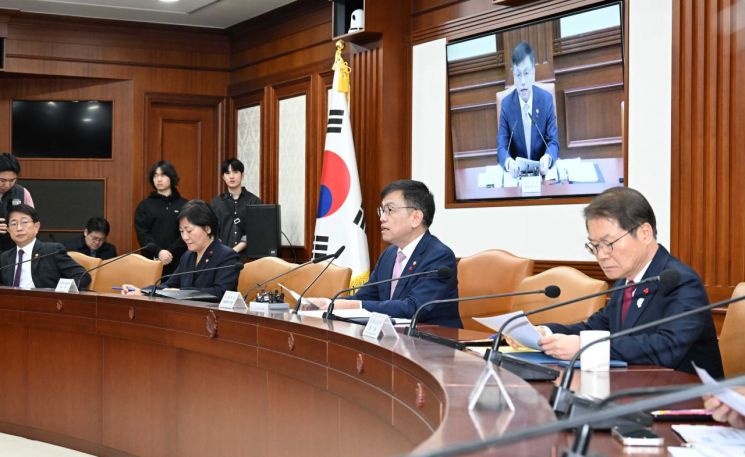
On the 16th, Choi Sang-mok, Deputy Prime Minister and Minister of Economy and Finance, announced the Lunar New Year livelihood stabilization measures jointly with government ministries. Deputy Prime Minister Choi said, "The government has prepared the Lunar New Year livelihood stabilization measures focusing on price stabilization and livelihood support so that all citizens can have a warm Lunar New Year holiday," adding, "The government will implement follow-up measures on economic policy directions and the New Year’s work report with the policy will of ‘we will do anything for livelihood recovery.’"
In this livelihood stabilization plan, the government will raise the government discount support rate for agricultural, livestock, and fishery products from the annual 20% level to 30%. The government discount support system for agricultural, livestock, and fishery products is a system where the government supports discounts based on the industry's own discounts, and combined with the industry's own discounts, it can provide a maximum discount effect of 60%. Discounted items include major seasonal products such as napa cabbage, radish, apples, pears, beef, pork, chicken, and eggs. In particular, if limits are applied weekly by purchase location and discount event, benefits can be repeatedly received. For example, receiving a 20,000 won discount at Lotte Mart in the second week of January and then another 20,000 won discount at a different mart.
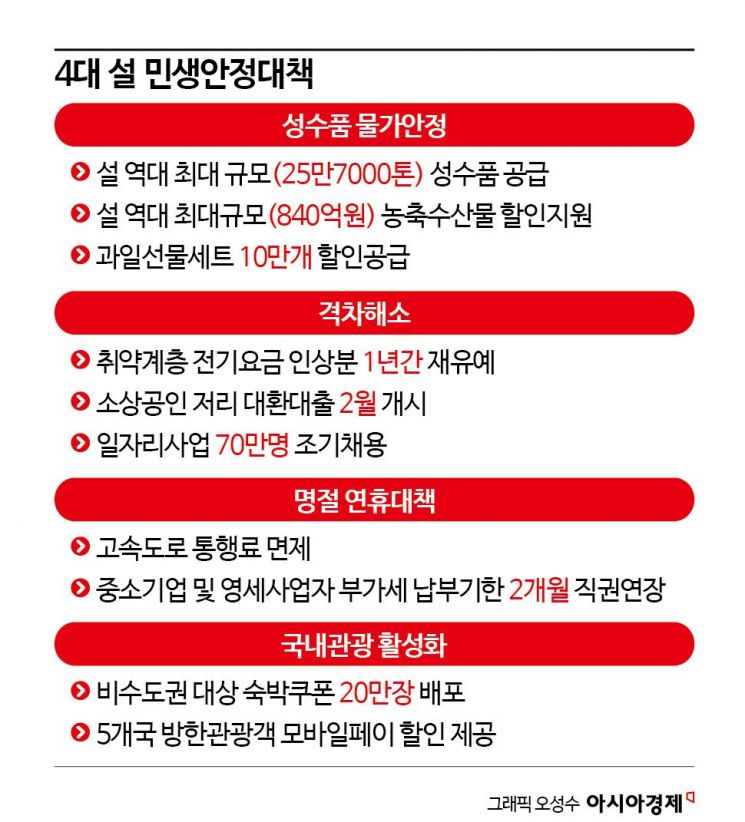
In addition, the supply of fruits during the Lunar New Year period will be increased to more than 120,000 tons through contract cultivation volumes of apples and pears and shipments from the Nonghyup, and 100,000 Nonghyup fruit gift sets will be sold at up to 20% discount. Chicken 30,000 tons, processed egg products 5,000 tons will be introduced as much as possible before the Lunar New Year, and 1.12 million imported fresh eggs will be supplied to stabilize egg prices. Deputy Prime Minister Choi explained, "We will supply a record-high 260,000 tons of seasonal products and invest 84 billion won, more than double last year, in discount support to manage prices lower than last year," adding, "In particular, we plan to expand the supply of apples and pears significantly to normal levels and manage the price increase rate, which was in the 20% range, to single digits."
The number of traditional markets participating in the Onnuri gift certificate refund event, which returns 30% of the purchase amount, will be expanded from the existing 104 to 189, and the monthly individual purchase limit for Onnuri gift certificates will be increased by 500,000 won. The monthly cash exchange limit for Onnuri gift certificate merchants will be expanded, and an automatic discount system for agricultural and livestock products credit cards (NH Card) will be introduced for the first time. Mobile gift certificates for the elderly will also be sold separately.
Support will also be provided for small business owners and vulnerable groups. Deputy Prime Minister Choi said, "We will establish a low-interest refinancing loan for small business owners starting from February, extend the VAT and corporate tax payment deadlines for 1.28 million small and micro businesses, and provide early VAT refunds," adding, "For 3.65 million vulnerable households, the electricity bill increase that was deferred in January and May last year will be deferred again for one year, reducing the burden by about 290 billion won." Accordingly, about 3.65 million vulnerable households, including people with disabilities, war veterans, basic livelihood security recipients, and households with three or more children, will be able to receive electricity bill discounts of up to 6,604 won per household per month this year as well. More than 700,000 people will be hired early through job projects before and after the Lunar New Year, including 630,000 senior jobs next month.
The government will also assist citizens' holiday convenience. Highway tolls will be waived during the Lunar New Year holiday period (February 9-12), including substitute holidays, and 405.2 billion won in veterans' benefits will be paid early to a total of 420,000 veterans' families. Information on medical institutions and pharmacies open during the Lunar New Year holiday will be provided, and non-face-to-face medical treatment will be allowed for all citizens even if they have no prior face-to-face medical experience. Starting next month, 200,000 accommodation coupons for non-metropolitan areas will be distributed sequentially, and a 20% discount will be offered when tourists from five countries including China use mobile payments, promoting domestic tourism.
Deputy Prime Minister Choi also requested the cooperation of the National Assembly regarding these livelihood measures. Since temporary increases in income deduction rates for traditional markets from 40% to 80% and temporary reductions in individual consumption tax on old cars are legislative matters, he urged, "For rapid livelihood recovery, it is urgent for the National Assembly to legislate policies that citizens are eagerly waiting for, such as temporarily raising the income deduction rate for traditional markets and temporarily reducing individual consumption tax when replacing old cars."
Along with the livelihood stabilization measures, the government also announced an early execution plan to revitalize the construction industry. Deputy Prime Minister Choi emphasized, "Fiscal spending will focus on welfare for the vulnerable, jobs, and SOC projects, with a record-high execution rate of over 65% in the first half of the year," adding, "To revitalize the construction industry, which has recently shown a slowdown, about 15.7 trillion won (65%) will be intensively invested in SOC projects in the first half."
He continued, "To ensure rapid execution to the final demanders, 75% of the total budget will be allocated quickly in the first half, and execution conditions will be improved by expanding advance payment limits," adding, "Public institution investments and private investment projects will also be executed at record-high levels of 34.9 trillion won and 2.7 trillion won respectively in the first half to support domestic demand and construction investment recovery."
© The Asia Business Daily(www.asiae.co.kr). All rights reserved.


















