The Democratic Party of Korea’s Gwangju Metropolitan City Party and Daegu Metropolitan City Party have joined hands to promote harmony, unity, and the eradication of regionalism.
On the morning of the 15th, the two city parties held the ‘22nd General Election Gwangju-Daegu Joint Pledge Agreement Ceremony’ at the Kim Dae-jung Hall of the Daegu City Party.
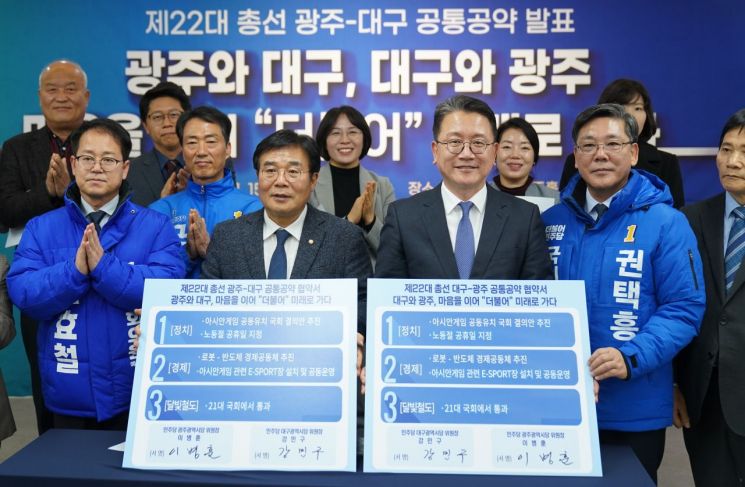
This joint pledge agreement ceremony is regarded as significant because it is the first time that Yeongnam and Honam regions have come together to hold a joint pledge agreement ceremony, sharing the consensus that harmony between Yeongnam and Honam and balanced regional development are a historic mission for the development of the Republic of Korea.
The ceremony was attended by Lee Byung-hoon, chairman of the Gwangju Metropolitan City Party, Kang Min-gu, chairman of the Daegu Metropolitan City Party, as well as Gwangju City Party members Lee Gwi-soon, Lim Mi-ran, Chae Eun-ji, and Lim Seong-hwa, university student committee chairman Na Seon-gil, prospective candidates for the general election from the Daegu City Party, and about 100 key party members.
At the joint pledge agreement ceremony, attendees cited examples such as the Gwangju May 18 Democratic Uprising, the Gwangju Student Movement, the Daegu February 28 Student Movement, and the National Debt Repayment Movement, pledging to inherit the spirit of the citizens of Gwangju and Daegu who led the development of democracy and the nation, and to commit to harmony, unity, and the eradication of regionalism.
The main contents of the joint pledge agreement include ▲ pushing for the passage of a special law for the construction of the Dalbit Railroad before the general election ▲ promoting a National Assembly resolution for the joint hosting of the Asian Games ▲ designating Labor Day as a public holiday ▲ promoting a robot-semiconductor economic community ▲ installing and jointly operating an Asian Games E-sports WAR GAME venue ▲ expanding exchanges between the two major events of Gwangju May 18 and Daegu February 28.
In particular, the Basic Act on the Construction of the Dalbit Railroad, which was jointly proposed by a record 261 lawmakers from both ruling and opposition parties in the history of the constitution, is expected to contribute to harmony and mutual development between Yeongnam and Honam and balanced national land development; however, it is currently stalled due to the ruling party’s government’s feasibility study issues.
Regarding the economic pledge to promote the Gwangju-Daegu economic community, it embodies the will to create and expand an organic economic ecosystem between Gwangju and Daegu by combining Gwangju’s AI semiconductor specialized complex and Daegu’s National Robot Test Field, aiming to prevent local extinction.
Lee Byung-hoon, chairman of the Gwangju City Party, said, “What the political sphere must do ahead of the 22nd general election is not to pursue political interests but to engage in harmony and integration to improve the lives of the people,” adding, “The Democratic Party’s Gwangju and Daegu city parties have reached the point of announcing joint pledges as a result of sharing the belief that East-West harmony must be achieved for the development of the Republic of Korea.”
He continued, “The Democratic Party of Korea is the party striving to eradicate regionalism,” emphasizing, “The People Power Party should not ignore the public’s grievances about their difficult lives and only watch the presidential office’s reactions, but should join the policy arena for the people beyond political interests.”
Kang Min-gu, chairman of the Daegu City Party, said, “Today’s event is the fruit of the efforts made so far for harmony between Gwangju and Daegu,” and expressed hope that “the efforts made by Gwangju and Daegu for the goal of East-West harmony will continue.”
© The Asia Business Daily(www.asiae.co.kr). All rights reserved.

















