Tax Burden Rate Should Increase from 22% to 25%
Inheritance and Gift Tax Exempted for Average Seoul Apartment Price
Income Tax Deductions Removed, Gradual Increase in Consumption Tax Planned

Saeroun Seontaek proposed a ‘tax reform’ plan that includes a 50 trillion won scale tax increase package, featuring a reduction in income tax deductions and a gradual increase in consumption tax starting on the 15th. The plan also includes measures to exempt inheritance and gift taxes on the average price of apartments in Seoul while expanding the Earned Income Tax Credit (EITC) and other benefits.
On the same day, Saeroun Seontaek introduced a tax reform plan centered on class-compromised tax increases, eliminating punitive taxes. The overall direction is a tax increase plan to secure welfare finances in an aging society, but it is notable that the plan contains compromise elements tailored to different social classes.
Saeroun Seontaek proposed raising South Korea’s tax burden rate (22%), which currently falls short of the OECD average (25%), to the OECD level, responding through public social welfare expenditures. The proposed tax increase amounts to 50 trillion won, with the distinctive feature that it is not a tax increase targeting the wealthy.
In this regard, Saeroun Seontaek unveiled an ‘advanced country-style tax increase based on inter-class compromise’ plan. First, it includes a measure to make inheritance and gift taxes more realistic. Currently, the average price of apartments in Seoul is around 1.3 billion won, and the plan proposes exempting inheritance and gift taxes at this level. The idea is that ‘passing down one house’ is a reasonable wish for the middle class.
The top tax rate on corporate share inheritance and gifts will also be lowered from 50% to 25%. Additionally, it stated, "Based on reforms that expand the rights of small shareholders and make corporate governance more transparent, we will gradually abolish inheritance and gift taxes on corporate shares."
Regarding income tax, which has a low effective tax rate due to various deductions, the plan states, "We will drastically reorganize and reduce various deduction systems," and "We will narrow the gap between nominal and effective tax rates to raise the income tax share of GDP to the OECD average of 8% (currently 6%)." Saeroun Seontaek explained that this would secure an additional 40 trillion won in income tax revenue. With this reform, some existing income tax-exempt taxpayers will have to pay taxes, and the tax burden on the middle and upper classes will increase.
A negative income tax support plan for taxpayers below the standard income level will also be introduced. The core of this is to expand the target of the Earned Income Tax Credit (EITC), which provides earned income credits as tax refunds based on household income levels, and to increase the tax rate and ceiling. According to Saeroun Seontaek’s plan, "All households earning 30 million won or less, the average income of a single-person household, will be eligible, and the ceiling will be raised from the current 3 million won to 50% of the average income of a single-person household."
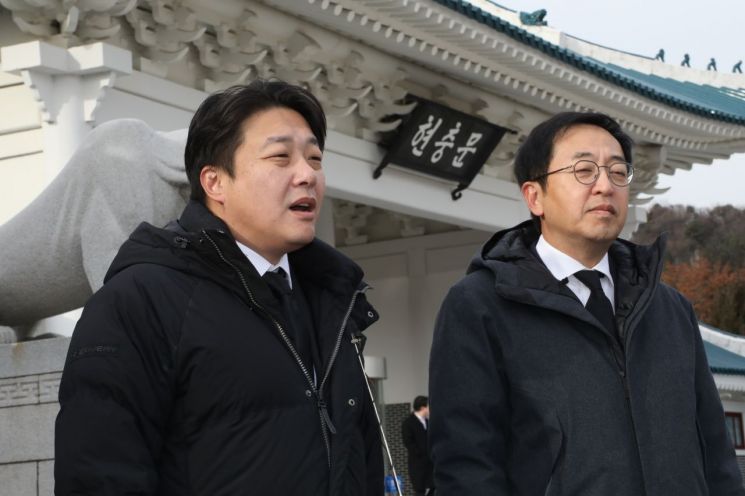 New Choice representatives Geum Tae-seop and Jo Seong-ju are paying their respects at the National Cemetery in Dongjak-gu, Seoul, on the morning of the 18th of last month. [Image source=Yonhap News]
A gradual consumption tax increase plan was also proposed. Saeroun Seontaek stated, "To secure welfare funds in an aging society, consumption tax must also be increased beyond the current level," and suggested, "Considering the regressive nature of consumption tax, it should be changed from the current single rate to multiple rates." The increase will be gradual, with "a bipartisan decision, and a special law for consumption tax advancement should be enacted so that regardless of which party is in power, the tax rate automatically increases by 1 percentage point every five years during the president’s term." They added, "We will propose the Consumption Tax Advancement Act in the 22nd National Assembly."
Cho Seong-ju, co-representative of Saeroun Seontaek, criticized, "Despite the exponential increase in welfare finances due to aging, the two major parties keep talking about ineffective tax increases on the wealthy or tax cuts for the wealthy," emphasizing, "We must immediately undertake a major tax reform to secure welfare finances." In particular, Cho criticized the progressive camp’s wealthy tax frame, pointing out, "In a progressive tax system, to make the wealthy pay more taxes, a decision is needed for the upper-middle class, notably members of the Korean Confederation of Trade Unions, to pay more taxes, but the progressive camp remains silent on this."
Han Ji-won, chairperson of the Policy Committee, explained, "Like advanced countries that have succeeded in securing welfare finances, a tax increase involving all citizens and a tax increase that allows compromise between the upper and lower classes are necessary."
© The Asia Business Daily(www.asiae.co.kr). All rights reserved.


















