Active Trading on Used Goods Apps for 1996 Calendars
Nostalgia for the 1990s Rises with Drama 'Beonhwa' Popularity
It has been revealed that Chinese people are buying 1996 calendars to celebrate the New Year. This appears to reflect the nostalgia of Chinese people longing for the 1990s.
On the 15th, Hong Kong's South China Morning Post (SCMP) reported, citing Chinese state media, that Chinese people are seeking 1996 calendars as they reminisce about the 1990s. It is said that they are acquiring these calendars because 1996, like this year, was a leap year starting on Monday. This is why they are looking for the corresponding calendar.
Transactions on second-hand trading apps are also becoming active. On the Chinese second-hand trading app Xianyu, vintage 1996 calendars are being traded from 5 yuan (about 917 won) to over 1000 yuan (about 180,000 won). A single tear-off page from a daily calendar is sometimes sold for 60 yuan (about 11,000 won). Over the past week, searches for the 1996 calendar on Xianyu increased by 600%, and transactions reached an all-time high. A Xianyu employee said, "The daily transaction volume and inventory of the 1996 vintage calendar are on the rise," adding, "On the 9th, about 400 people simultaneously searched for '1996 calendar.'"
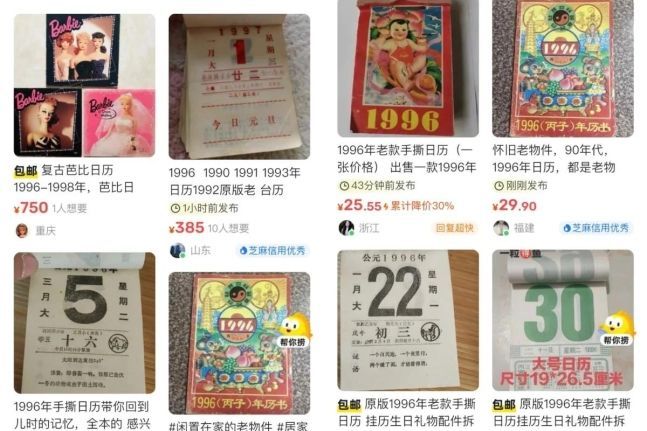 Photo of a 1996 calendar for sale posted on a Chinese secondhand trading app. [Image source=South China Morning Post]
The calendar is also popular overseas, selling for $200 (about 260,000 won) on the global commerce platform eBay. The designs of the calendars vary widely. Some calendars are decorated with traditional Chinese patterns, while others feature American and Japanese cartoon characters such as Mickey Mouse, Ultraman, and Cardcaptor Sakura. SCMP explained that this is because China in the 1990s embraced influences from abroad in economics, culture, and fashion. There are also calendars reflecting modern Chinese elements, such as photos of Mao Zedong, pages from state media, and images of the Beijing Guoan football club.
The reason Chinese people are nostalgic for the 1990s is related to the recently popular TV drama series "Fan Hua" (繁花). Directed by Hong Kong’s Wong Kar-wai, the drama depicts the prosperous Shanghai of the 1990s, a time when the city was opening up to foreign countries and beginning rapid growth. As the drama gained popularity, a retro craze began, and netizens have been posting photos of Shanghai, Shenzhen, and Beijing from the 1990s on social networking services (SNS), expressing their longing for that era, SCMP reported.
© The Asia Business Daily(www.asiae.co.kr). All rights reserved.

















